
Global financial markets experienced volatility Friday morning as escalating Middle East tensions cast doubt on the stability of this week’s ceasefire between the United States and Iran.
Asian trading sessions opened with modest gains, but investor confidence wavered amid concerns about Israel’s continued military operations in Lebanon, which Iran has identified as a major obstacle to maintaining the recently brokered peace agreement.
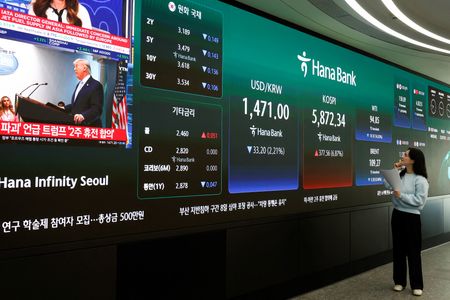
Market performance across the Asia-Pacific region showed mixed signals, with the MSCI index of regional shares excluding Japan climbing 0.5%. South Korea’s Kospi index led the way with a 1.9% increase, while Japan’s Nikkei 225 added 1.5%. U.S. futures markets for the S&P 500 managed to recover from earlier declines to finish unchanged.
“The U.S.-Iran ceasefire led to a sharp recovery in Asian markets but the risk-on sentiment got tested yesterday,” explained Rupal Agarwal, who serves as Asia quant strategist at Bernstein in Singapore.
“We believe this could be the beginning of the end and is presenting an opportunity for investors to focus on pre-war trends and fundamentals,” Agarwal continued. “We recommend adding back some beaten-down names.”
Thursday’s trading in the United States saw the S&P 500 advance 0.6%, with international equity benchmarks posting small gains following Israeli Prime Minister Benjamin Netanyahu’s announcement that he would pursue direct negotiations with Beirut. This diplomatic overture came just one day after the conflict’s deadliest bombardment claimed over 300 lives in Lebanon, putting the U.S.-Iran ceasefire at risk.
Energy markets responded sharply to renewed hostilities, with Brent crude oil climbing 1% to reach $96.83 per barrel during Asian trading hours. The price increase followed Hezbollah’s missile launch toward Israel, which activated emergency sirens across multiple areas, including Tel Aviv.
Maritime traffic through the crucial Strait of Hormuz remained severely restricted, with shipping volumes running at less than 10% of typical levels Thursday. Iran continues to maintain control over this vital passage, which normally handles approximately one-fifth of worldwide oil and gas transportation.
The six-week conflict with Iran and the resulting strait closure have created significant disruptions across global markets, driving up energy costs and creating supply shortages worldwide.
President Donald Trump issued a stern statement regarding Iran’s handling of the shipping lane. Writing on Truth Social, he criticized Iran for doing a “very poor job” of permitting oil transit through the strait. “That is not the agreement we have!” Trump posted, highlighting Washington’s growing impatience as market disruptions continue to worsen.
Currency markets saw the U.S. dollar index gain 0.1% to reach 98.92, supported by Thursday’s employment data showing weekly unemployment claims rose by 16,000 to 219,000. Continuing jobless claims decreased by 38,000 to 1.794 million, marking the lowest figure since May 2024.
Inflation data revealed the Core PCE price index increased 0.4% for the second consecutive month, representing a 3.0% annual growth rate.
Bond markets pushed the yield on 10-year U.S. Treasury notes up by 0.6 basis points to 4.285%.
Federal Reserve interest rate expectations shifted based on recent economic indicators, with futures markets now pricing in the next 25-basis-point rate reduction for April 2027. The probability that the central bank will maintain current rates at that meeting has dropped to 49.6% from Thursday’s 64%, according to CME Group’s FedWatch tracking tool.
In corporate news, Carlyle Group reported that investors have requested withdrawals exceeding 15% of assets from its primary private credit interval fund, as disclosed in a Thursday shareholder communication.
Cryptocurrency markets declined, with Bitcoin falling 0.7% to $71,903.27 and Ethereum dropping 1.0% to $2,191.81.