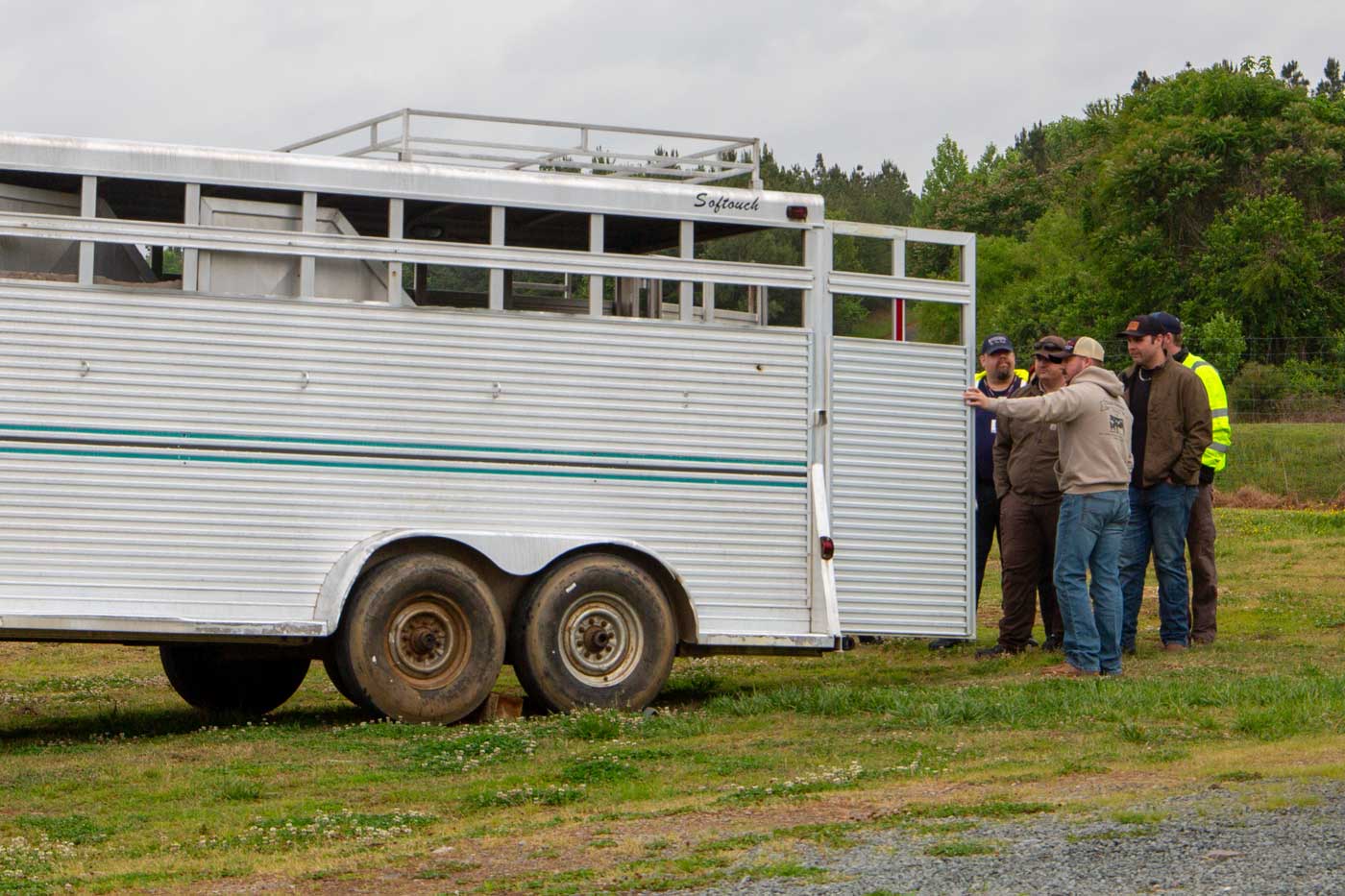

You’ve probably seen them on the road — large trailers hauling cattle or other farm animals. But how you drive around them could make a big difference in preventing a serious accident.
Farmers move live animals on public roads all the time, whether heading to pasture, market, or a county fair. But hauling livestock is far more complicated than moving ordinary cargo, according to Mark Campbell, a Nelson County farmer and Virginia Farm Bureau district field services director.
“Unlike boxes in a trailer that don’t move, livestock do move and care must be taken to give them a smooth, uneventful ride,” Campbell said.
Beef cattle typically weigh between 1,200 and 1,400 pounds each. When you factor in the trailer and the truck, the total weight can climb into the tens of thousands of pounds. When animals shift their weight inside the trailer, it changes how the load is distributed — raising the risk of a rollover and making the vehicle harder to control.
“Drivers hauling livestock must start and stop gradually so as to not cause the livestock to fall or loose footing,” Campbell explained. “And they must maintain extra distance between the vehicle in front of them to allow for a gradual stop. The weight of the load requires extra stopping distance.”
Because of this, farmers transporting animals tend to drive at slower speeds, take turns more carefully, and leave a large gap between themselves and the vehicle ahead. Like other large trucks and buses, livestock trailers simply cannot react as quickly as a regular passenger car — sudden stops, sharp turns, or erratic lane changes can injure the animals or cause the driver to lose control.
That extra space in front of a livestock trailer is often misread by other drivers as an open invitation to merge in front of the truck. Campbell says that’s a mistake with serious consequences.
“When a car slides into that spot, the stopping distance (for the livestock trailer) is drastically reduced,” he said. “These moves by cars are especially dangerous on roads with lots of stoplights.”
Campbell knows this danger firsthand. “A car passed me and then came into my lane before suddenly stopping,” he said. “I drive slower, but I still had to brake hard, which caused my trailer’s tires to skid and jostle the cattle.”
Crashes involving livestock trailers also create complicated situations for first responders. Beyond helping injured motorists, emergency crews may need to shut down roads, call for backup, and set up containment zones if animals escape. In March, Route 37 in Frederick County was closed for six to seven hours while crews worked to recover a livestock hauler that overturned while carrying 110 calves.
Campbell’s advice to drivers is straightforward: be patient and “give them plenty of space, especially in front of the truck.” Avoid cutting in front of livestock trailers, don’t linger in blind spots, and always merge with plenty of room to spare.