
DETROIT — Michigan’s Republican Party is experiencing growing pessimism about the 2026 midterm elections, abandoning earlier confidence that they could reclaim control in a state where Democrats currently dominate all major offices.
Economic pressures including skyrocketing fuel costs, an unpopular conflict in Iran, and trade policies damaging the automotive sector have created challenging conditions for GOP candidates across the state.
A significant alarm bell sounded this week when a Democratic candidate secured victory in a state Senate special election with a nearly 20-point margin in a district that Vice President Kamala Harris barely captured by less than one percentage point in 2024. The previous Democratic incumbent had won the same seat by just 6 points two years earlier.
“To get to this margin in that kind of a district means that Democrats and independent voters are working in tandem to send a message to the Trump administration,” explained Michigan polling expert Richard Czuba regarding the recent electoral outcome.
This political climate presents obstacles for Michigan’s GOP as they approach critical midterm contests that will determine the governor’s mansion, legislative control, and a high-profile U.S. Senate race. The state’s voter sentiment also carries national implications for Republicans, who view Michigan as essential to their coalition after Donald Trump’s 2024 victory there.
Across the country, Trump’s economic approval ratings have declined between March and April as the Iranian conflict drove up consumer costs, according to AP-NORC polling data. The April survey revealed weakening support even among Republican voters, with positive economic views dropping from 74% to 62% during that period.
Independent voters, who play a decisive role in battleground states like Michigan, remain largely unimpressed with Trump’s economic performance. Approximately 20% of independents endorsed his economic handling in April, down from roughly 30% the previous month. Just one-quarter of American adults expressed approval for his approach to cost-of-living issues.
Michigan residents may be experiencing these economic impacts more severely than citizens in other regions. The state’s gasoline prices currently average approximately $4.80 per gallon, ranking tenth nationally according to AAA data, following an 80-cent weekly spike.
Local voter Jared Kaufman, 26, expressed frustration with escalating expenses and the Iranian military involvement. He supported Democrat Chedrick Green in the recent election, explaining that as an educator with limited income, the sacrifices required “for something that is nowhere near us” seem unjustified.
Trade policies have generated additional concerns in a state heavily dependent on automobile manufacturing and Canadian commerce. While Trump contends these measures will bolster domestic production, Michigan suppliers and smaller manufacturers report that uncertainty has complicated investment and growth planning.
“The more stability there is in the environment, the easier it is for me to make decisions to grow and expand,” stated John Lytle, president of Promess Inc., a Detroit-area manufacturing company. “That’s probably been the biggest impact it’s had on us.”
Jason Roe, a political consultant and former Michigan GOP executive director, acknowledged current environmental challenges while arguing that Democrats face their own difficulties and Trump retains time to reduce costs.
“But if they don’t get Iran figured out pretty quick, we’re screwed,” he added.
These political headwinds coincide with internal Republican divisions among leading candidates.
The gubernatorial contest was previously considered the GOP’s strongest pickup opportunity, given Democratic Governor Gretchen Whitmer’s term limits forcing her departure. Michigan historically tends to elect governors from the opposing party when incumbents step down.
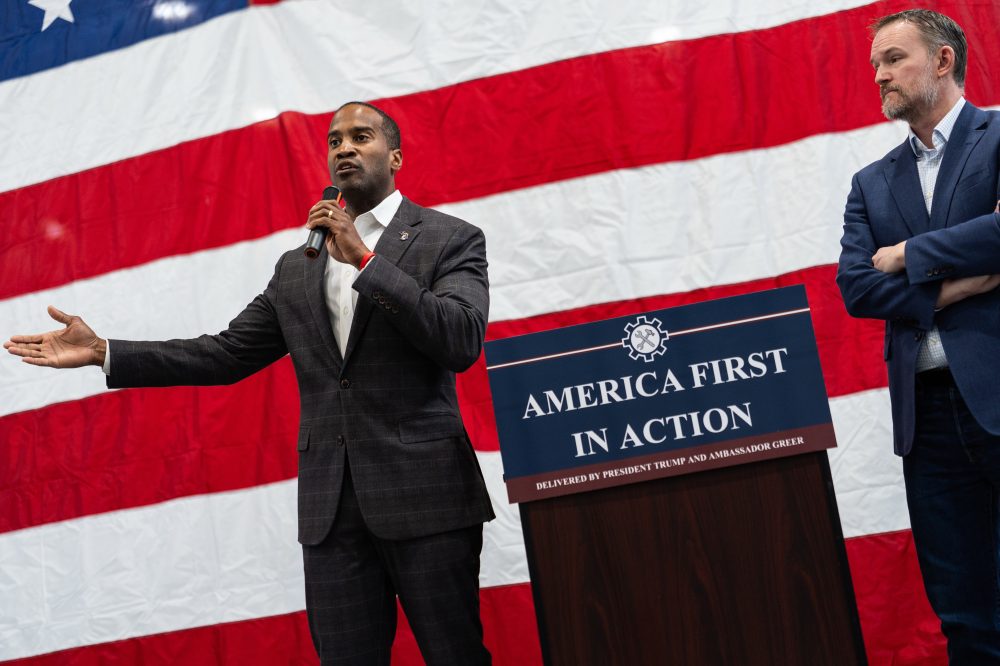
Representative John James, a military veteran representing a competitive congressional district, had emerged as the primary frontrunner with previous Trump endorsements in two unsuccessful Senate campaigns. However, party dissatisfaction with his campaign strategy has intensified recently.
When James announced in April that he would skip a GOP debate in a crucial swing county while other major candidates participated, numerous Republicans voiced criticism.
“The data is clear: if John James wins the Aug. 4, 2026, primary, Republicans will almost certainly lose the general election in November,” declared Chris Long, a Michigan GOP leadership member, in a social media statement urging James to withdraw.
James has committed to participating in two July debates.
Democrats confront their own challenges. Secretary of State Jocelyn Benson leads their expected field, though Genesee County Sheriff Chris Swanson is also campaigning. Party members express concern that Detroit Mayor Mike Duggan, a former Democrat now seeking the governorship as an independent, could divide their vote share.
James’s campaign has been further complicated by Perry Johnson’s late entrance. The millionaire businessman, who previously mounted unsuccessful gubernatorial and presidential bids in 2022 and 2024, has launched aggressive attacks against James while announcing a $10 million television advertising campaign in February.
Republican strategist Dennis Lennox characterized James as conducting “an awful campaign,” while noting that any GOP nominee will face difficult circumstances.
“Anyone who isn’t being paid to say otherwise will concede that 2026 is going to be a very difficult year for Republicans,” Lennox observed.
James spokesperson Hannah Osantowske dismissed the criticism as “sore losers griping,” maintaining that James remains the GOP leader and “the only Republican beating both Democrats in November.” She also downplayed Johnson’s candidacy.
“Michiganders are not buying what he is selling,” Osantowske stated. “They want a trusted Trump ally, combat veteran and proven job creator. That is John James.”
Beyond the gubernatorial race, national Republicans are focused on capturing Michigan’s open Senate seat to prevent Democratic control of the chamber.
Former Representative Mike Rogers is mounting another GOP campaign after losing in 2024 by fewer than 20,000 votes to freshman Senator Elissa Slotkin.
Democrats are conducting a competitive and increasingly contentious Senate primary featuring three prominent candidates competing for the August 4 nomination.
Questions persist about Rogers’s ability to win a race he previously lost despite Trump’s ballot presence. No Republican has captured a Michigan Senate seat since 1994.
While Rogers maintains the largest cash reserves among Senate candidates due to an uncontested GOP primary, Democratic contenders state senator Mallory McMorrow and former health official Dr. Abdul El-Sayed outpaced his fundraising in 2026’s first quarter. The Senate Leadership Fund, the primary Republican super PAC, announced a $45 million initial investment in Michigan’s race during early April.
Czuba suggested that external spending might not benefit Rogers if it further nationalizes the contest.
“If the conversation is nationalized in Michigan, we see how poorly the president’s numbers look right now,” Czuba explained. “If undecided voters disproportionately view Donald Trump negatively, I’m not sure what the path is for Mike Rogers.”