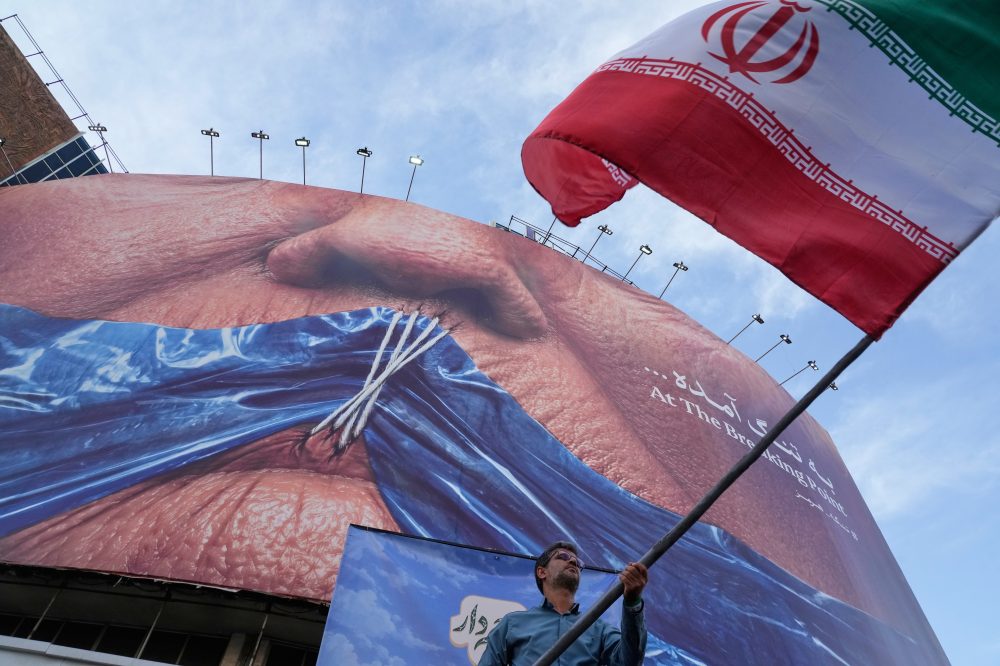

DUBAI, United Arab Emirates (AP) — Tehran announced Thursday it is examining fresh American proposals to conclude their ongoing conflict, while President Donald Trump warned Iran of intensified military strikes if negotiations fail to produce an agreement that reopens the vital Strait of Hormuz shipping corridor.
International markets showed optimism Thursday over prospects that the two-month conflict might conclude soon, despite U.S. forces targeting an Iranian oil tanker that attempted to break through the American naval blockade of Iranian ports just hours before. These events came after days of inconsistent communication from the Trump administration regarding its approach to ending the hostilities.
Trump announced on social media that the two-month conflict could conclude soon and that disrupted oil and natural gas deliveries might resume. However, he stated this outcome depends on Iran accepting a reported deal he chose not to elaborate on.
“If they don’t agree, the bombing starts,” Trump wrote.
A tentative ceasefire between Washington and Tehran has mostly remained intact since April 8. However, face-to-face negotiations between both nations, facilitated by Pakistan last month, failed to produce an accord. The conflict commenced February 28, when the United States and Israel conducted strikes against Iran.
“We expect an agreement sooner rather than later,” Pakistan’s Foreign Ministry spokesperson Tahir Andrabi stated Thursday. “We hope the parties will reach a peaceful and sustainable solution that will contribute not only to peace in our region but to international peace as well.”
However, he refused to provide a specific timeframe, stating Pakistan would not reveal details of the continuing diplomatic initiatives.
“What I can tell you and this is what I have stated before that we remain positive, we remain optimist, and we hope the settlement will be soon rather than later,” he said.
When questioned whether Pakistan anticipated any response from Iran later Thursday, Andrabi responded: “I will not comment on specifics or the movement of the messages.”
The Trump administration’s communication during the Iran conflict has been inconsistent and frequently conflicting. This week, the president and his advisors presented a confusing account of U.S. strategy to clear the Strait of Hormuz and conclude the war that dramatically evolved within just hours.
Iran has essentially blocked the strait, a critical passage for transporting oil, gas, fertilizer and other petroleum goods, while the United States maintains a blockade of Iranian ports.
On Wednesday, an American fighter aircraft disabled the steering mechanism of an Iranian oil tanker in the Gulf of Oman as it attempted to break the American blockade, according to U.S. Central Command’s social media announcement.
Trump maintained Wednesday that Iranian leadership desires to conclude the war.
“We’re dealing with people that want to make a deal very much, and we’ll see whether or not they can make a deal that’s satisfactory to us,” the president said.
He indicated the United States could eventually impose a resolution.
“If they don’t agree, the bombing starts,” Trump posted on social media, “and it will be, sadly, at a much higher level and intensity than it was before.”
The White House believes it is close to reaching an accord with Iran on a single-page document to end the war, according to Axios reporting. Terms include halting Iranian uranium enrichment, removing U.S. sanctions, releasing frozen Iranian assets and reopening the strait for vessels.
The White House did not immediately respond to inquiries about the potential accord.
Iranian Foreign Ministry spokesman Esmaeil Baghaei informed state television that Tehran had “strongly rejected” U.S. proposals reported by Axios, but confirmed it was still reviewing the most recent American proposal.
Trump has attempted to intensify pressure on Tehran after halting on Tuesday a brief U.S. initiative, called Project Freedom, designed to establish safe passage for commercial vessels through the Strait of Hormuz.
Only two American-flagged commercial ships are confirmed to have transited the U.S.-protected route after it opened Monday. The U.S. military reported destroying six Iranian small vessels that threatened civilian ships.
Hundreds of commercial vessels remain trapped in the Persian Gulf, unable to reach open waters without traversing the Strait of Hormuz. The strait’s closure has caused fuel costs to surge, disrupted the global economy and created massive economic strain on nations, including major powers like China.
Hapag-Lloyd, among the world’s largest shipping corporations, announced in a statement that the strait’s closure costs approximately $60 million weekly, with increasing fuel and insurance expenses creating particular hardship.
On Thursday, Brent crude oil prices stabilized around $100 per barrel as investors awaited news on whether the strait would reopen.
Meanwhile, French President Emmanuel Macron announced Wednesday that France’s aircraft carrier battle group was advancing into the Red Sea to prepare for a potential French-British operation to restore maritime security in the Strait of Hormuz when circumstances permit.
China’s foreign minister requested a complete ceasefire Wednesday following his Beijing meeting with Iranian Foreign Minister Abbas Araghchi. Wang Yi expressed his country was “deeply distressed” by the conflict.
China’s strong economic and political connections to Tehran provide it with a distinctive influential position. The Trump administration is urging China to leverage that relationship to encourage the Islamic Republic to reopen the strait.
Araghchi’s China visit occurred before Trump’s planned Beijing trip, where he is scheduled to participate in a prominent summit on May 14-15 with Chinese President Xi Jinping. Trump was the most recent U.S. president to visit China in 2017.
Araghchi informed Iranian state television that his visit included conversations about the Strait of Hormuz, Iran’s nuclear program and sanctions imposed on Tehran.
Trump has insisted on a significant reduction of Tehran’s controversial nuclear program.