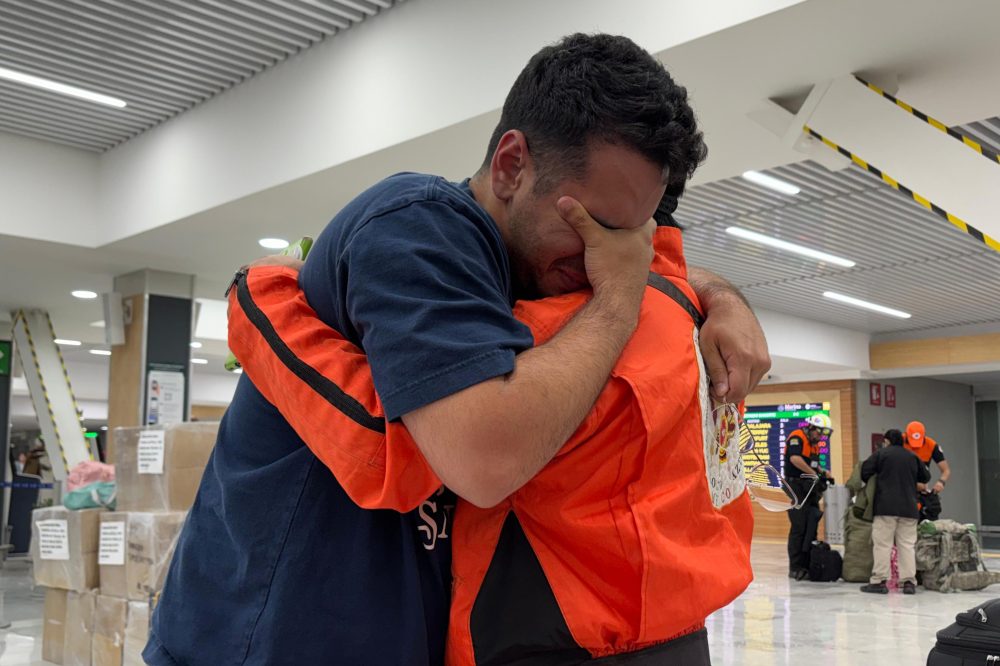

MEXICO CITY — A man clad entirely in bright orange carefully loads a stack of cardboard boxes onto a luggage cart at Mexico City’s international airport. He’s not just another traveler, and the contents of those boxes are far from ordinary.
Inside them are body bags.
The man is Germán Bello, a 39-year-old volunteer with the Brigada Internacional de Rescate Topos Azteca — one of Mexico’s most well-known civilian search-and-rescue organizations. The nonprofit group was born out of the catastrophic 1985 Mexico City earthquake and has since built a global reputation by responding to major disasters both at home and overseas.
On Tuesday night, Bello was on his way to one of Venezuela’s worst natural disasters in recent memory. Nearly a week after two strong earthquakes tore through the country’s Caribbean coastline, officials announced Wednesday that more than 2,200 people have lost their lives and upward of 11,000 others have been hurt.
International rescue teams are still combing through the wreckage of collapsed apartment buildings and homes in the hardest-hit state of La Guaira. But as the days pass, hope of finding survivors continues to dim, and the focus is gradually shifting from rescue to recovery.
Bello has no idea when he’ll be back home. In addition to rescue equipment, he packed body bags and other supplies that may be needed to recover victims of the earthquakes.
By profession, Bello is an electrical engineer who runs a small auto repair shop. Within the brigade, he goes by the nickname “La Secre” — short for secretary — because he serves as the right-hand man to the group’s founder, veteran rescuer Héctor “El Chino” Méndez.
Méndez, now 80 years old, helped organize grassroots civilian rescue operations following the 1985 Mexico City earthquake and has guided Topos missions across the globe for four decades. He was already on the ground in La Guaira, working to locate any survivors who might still be trapped under the rubble.
“The hardest part is telling someone that their loved one has died,” Bello said.
Fellow volunteers say that once they arrive in a disaster zone, keeping emotions under control is essential — because staying focused can be the difference between saving a life and losing one.
“There is no hunger, no heat, no sleep,” said volunteer Merry Valencia, who has been with the brigade for 14 years, reciting part of the group’s code of conduct. “There is no fear.”
Once rescuers evaluate the stability of a collapsed structure, they divide into small teams and take on different sections of the debris field. They squeeze through tight gaps and hollow spaces inside flattened buildings — a technique that earned the group its name, “Topos,” which means moles in Spanish. Thermal cameras and other specialized tools are frequently used to detect any signs of life.
Equipped with shovels, hand hammers, and various other tools, the rescuers chip away at rubble piece by piece, carefully working to avoid setting off further collapses.
“We are rescue workers from Mexico. If anyone is alive, make some noise or call out now!” a Mexican Army rescuer shouted on Saturday while searching the ruins of a collapsed building in La Guaira.
Seconds later, he raised a clenched fist into the air.
That gesture is a command for total silence — a search technique that originated during the 1985 Mexico City earthquake and was later formalized by the Topos. Variations of the method are now standard practice for rescue teams around the world.
The signal ripples instantly through the disaster zone. Rescue workers, soldiers, volunteers, and journalists all go quiet. For a brief but tense stretch of time, silence is the only sound.
Rescuers then listen with intense focus for any trace of life — using sensitive microphones, telescopic cameras, or simply pressing an ear to the rubble, hoping to catch a voice, a knock, or even the slightest movement.
Back at the Mexico City airport, a young man wearing glasses spotted Bello and approached after learning he was bound for Venezuela. He asked if Bello and his colleague were part of the rescue mission.
When Bello confirmed they were, the man broke down in tears.
“Thank you for going. My family is in Caracas,” said Venezuelan engineer Diego Bejarano.
Bello pulled him into a tight embrace. It would likely be the first of many such moments in the days ahead, as he joins other international teams working in Venezuela’s disaster zone.
After Bejarano walked away, Bello wiped the tears from his own eyes and explained what keeps driving him to volunteer for missions like this one.
“That’s my reward,” he said. “Being able to give someone a little hope.”