
GUADALAJARA, México (AP) — Under Mexico’s scorching heat, Raúl Servín spends countless hours digging through soil mixed with anguish, determination and often disappointment. His mission: finding his son who vanished eight years ago and “all the other missing people” throughout Mexico.
Each Tuesday, Servín fills a vehicle with digging tools, shovels, drinking water and meals. After asking for divine protection, he gathers three fellow volunteers. Together they travel to dangerous territories where the earth may conceal bodies of those killed in a Mexican region plagued by drug trafficking violence.
This group calls itself the Guerreros Buscadores — the “Searching Warriors.” Their task is enormous, shared by dozens of similar organizations: Official data shows over 130,000 individuals have vanished since 2006.
Juggling search missions with everyday responsibilities proves challenging. Servín lost his employment after beginning his quest for his missing child. He now earns money serving tables during weekends.
Yet the most heartbreaking moments also provide paths forward — discoveries revealed through skeletal remains, damaged bodies, evidence that brings various forms of resolution. Occasionally there’s even happiness — despite it emerging from excavated holes.
During these challenging times, the 54-year-old Servín confronts a disturbing reality: Sometimes the most feared outcome becomes the most hopeful result possible.
Servín’s existence contains emotionally complex situations difficult to observe. Recently, these Warriors allowed an Associated Press photographer to document their activities — showing their work and its significance. They planned to visit multiple sites around Guadalajara, Jalisco state’s capital and a World Cup venue.
Servín and his female colleagues work independently, without any security escort. Their sole protection involves a “panic button” carried by Servín that links to a federal system protecting human rights advocates.
This dangerous work occurs in a hazardous setting. Despite Mexico not experiencing war or military rule, thousands vanish annually due to cartel conflicts. Hidden burial sites are regularly uncovered; over 70,000 unidentified bodies have accumulated in morgues and graveyards.
Previous leadership acknowledged this crisis and established official search agencies, but widespread impunity and government inaction continue. Current officials state that missing data for one-third of disappeared individuals makes searching impossible. Families drive most search efforts and discoveries.
The team travels to various locations following anonymous information received through the Guerreros Buscadores website. These reports often come from people who heard screaming or gunfire or witnessed suspicious activity but fear contacting police.
During their last expedition, they excavated over three feet deep at four sites. They found nothing. Sometimes they discover blood evidence or bullet shells. They investigate every lead regardless. Servín explains: “There cannot be room for doubt.”
He gets a phone call. A source reports a body buried in a neighborhood. The intelligence appears credible, prompting them to alter their schedule. This time they cannot scout the location beforehand, a safety protocol to avoid meeting cartel guards or armed criminals who might force them away with warning shots. This has occurred previously.
Gateway arches mark the entrance to the housing development the informant identified. It borders a commuter rail line outside Guadalajara, a city covered with missing person flyers. Jalisco state, controlled by the Jalisco New Generation Cartel, represents a disappearance hotspot.
Mexican President Claudia Sheinbaum toured the region after February violence following the cartel leader’s death. She promised World Cup security would be ensured.
Search organizations want to use global attention on Mexico to highlight their situation. “I love soccer,” Servín states, “but that’s not going to stop me from going out to search.”
Hats and cloth coverings protect searchers from sunlight. Each wears a customized shirt featuring their loved one’s photograph. Servín’s displays “Searcher Dad.”
The team prepares their gear. A metal probe they term “the seer” proves essential: For more than ten years, this basic yet crucial instrument has aided searchers. They insert it into soil and smell. Organic odors provide clues.
They start excavating in a small dirt patch at a residential corner. They continue digging extensively. Nothing appears.
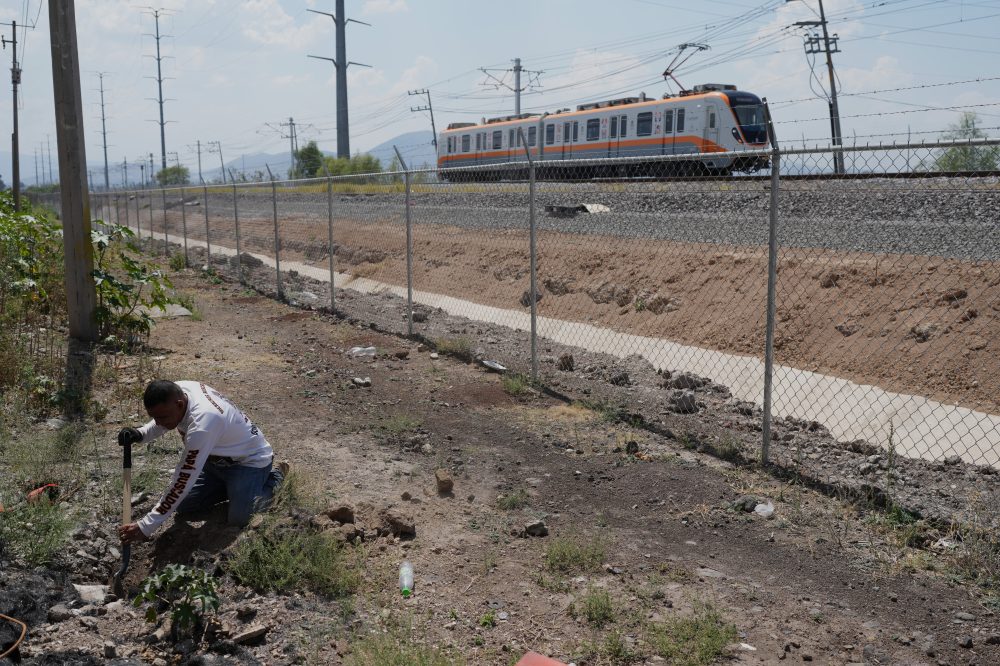
After hours without results, Servín exits the housing complex and walks between the barrier and railroad tracks. The earth feels loose. “I saw a hole with small rocks; it was strange.”
Previously, his pulse would have quickened. Now he reports, “I don’t get nervous anymore.”
He crouches and grabs his shovel. A train rolls by. Initially he spots skull fragments. He starts removing dirt with his tool and hands.
“We’ve got a positive!” he calls out.
All four put on protective masks and gloves. A jawbone emerges. No question exists: This is human remains.
Servín displays the skull to his teammates, handling it with extreme care. They decide to continue excavating seeking the complete skeleton. A bag containing bones surfaces. Then footwear. Then hip bones. They gently position each item outside the hole. Any duplicate bone gets placed separately since it might belong to another victim.
The women’s voices blend like gentle songs. “Hi baby, you’re going home soon.” “Your family is waiting for you.” Someone places a candle beside the excavation.
To those unfamiliar with violent situations, this scene might appear disturbing. To witnesses, it represents tremendous compassion and unity performed by people repeatedly victimized by officials for years. In 2021, a prosecutor gave a woman her relative’s remains in garbage bags. A photograph of her blank expression over the large black bag at her feet became widely shared.
Criminals conceal victims because without bodies, no crimes exist. Nearly 20,000 missing individuals have been recovered dead since 2010. Therefore discovering bodies can be risky.
Servín triggers his panic device that many searchers possess. Since 2010, at least 36 searchers have been murdered, according to civil organizations. The most recent occurred in mid-March.
Servín communicates with federal personnel, verifies his identity using a code, describes his discovery and provides coordinates. He requests hourly check-ins, meaning calls confirming their safety.
Next he contacts police.
One woman prepares for live Facebook broadcasting. This creates documentation. Without livestreaming when they discovered a ranch used by the Jalisco Cartel, convincing people about their findings would have been difficult. It also helps people identify items.
“There’s a pair of gray underwear that says ‘Sport’ in orange letters, some size 5 brown boots,” one searcher describes. “There’s the skull, it still has some hair. … There’s the pelvis.”
The camera focuses on shoe details and the toothless jawbone. Every detail might assist identification. One woman hopes the “little person” will soon reunite with family. They offer prayers.
Servín responds to online questions. Though not an expert, his experience suggests the body was buried approximately 18 months earlier. This cannot be his son, but hope never completely disappears; two weeks prior, a mother located her son after seven years searching. He thanks God that remains exist for DNA analysis.
When the Guerreros discover bodies “in pieces,” Servín wants to weep. “What hits us hardest is to think that our children might be in those conditions.”
Yet he also feels satisfied. Because he knows answers exist there.
While awaiting officials, the searchers rest. This becomes an intimate discussion among people connected by loss and their purpose.
A neighborhood woman arrives with her son. She has a missing child and wants to see if he recognizes anything. An hour later, another mother appears. The searchers hug her and recommend visiting the prosecutor’s office for DNA testing. Emotions overflow.
When police arrive, Servín answers their inquiries. Suspicion remains because he knows some officers work for cartels. He says “some time ago” authorities accused them of contaminating crime scenes, but the groups have slowly gained credibility.
As darkness approaches, the forensic team begins working. In Mexico, genetic test results can take days or years. The remains of one searcher’s brother — a searcher who is also Servín’s partner — have been at the forensic institute for six years. A match exists, but experts haven’t finished processing remains from all bags found then. “It’s illogical,” he says. His frustration is obvious.
At 9 p.m., Servín presses the panic button again to confirm he’s home safely. “I arrive feeling at peace,” he says, “knowing the day was fruitful.”