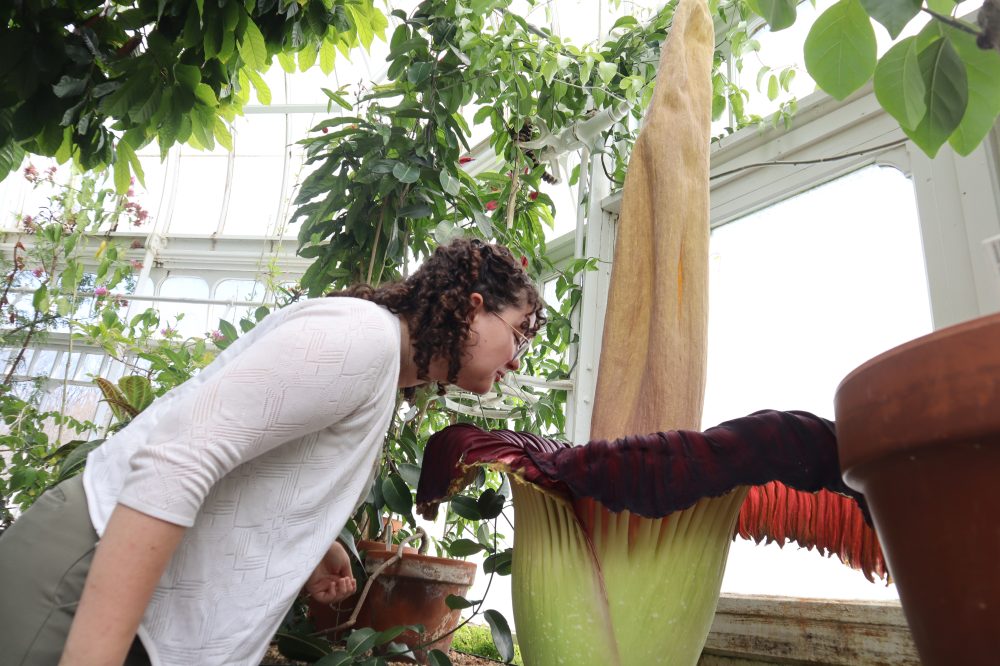

SOUTH HADLEY, Mass. — Visitors to a historic greenhouse at Mount Holyoke College this week experienced a range of nauseating odors as they witnessed the rare blooming of a corpse flower. Some described the smell as rotten eggs, while others likened it to dissecting a dead animal or a dirty diaper left in hot sun.
“I was expecting it to smell bad, but it smelled genuinely like rotting flesh,” said Nyx DelPrado, a first-year student at Mount Holyoke College who visited its Talcott Greenhouse this week to see the blooming of a corpse flower. “Its name is accurate,” DelPrado added with a laugh, nose wrinkled.
The unusual plant, scientifically known as Amorphophallus titanum, originates from Sumatra’s rainforests and rarely flowers. When it does bloom, the event lasts only days while producing a disgusting smell designed to attract flies and beetles for pollination. The college’s specimen, dubbed ‘Pangy,’ previously flowered in 2023, and this recent blooming has again attracted curious crowds wanting to experience the unusual phenomenon.
The impressive display consists of numerous small flowers clustered around a tall central spike called a spadix, all encased by a deep purple, soft outer leaf. While the spectacular flower structure dies within days, the plant’s underground portions remain alive and may produce future blooms.
Tom Clark, director and curator of the Mount Holyoke College Botanic Garden, explained that the plant’s notorious smell fulfills a crucial biological function and has prompted various reactions from guests.
“A few people who have come in since have described the smell as being unbearable, tangy, like a trash can — it’s overwhelming,” Clark said. “But that odor is there for a purpose. It’s there to attract pollinators, flies in particular.”
Predicting when these flowers will emerge proves challenging, as they often remain dormant for years. During the previous six weeks, Pangy experienced rapid growth, sometimes extending several inches daily before opening. The bloom finally emerged Monday night, greeting staff with its intense aroma when they arrived Tuesday morning.
“Walking through the front door, we could smell it,” he said. “As we walked back to the greenhouse where it’s growing, the smell became stronger and stronger. It was just overwhelming — literally unbearable — to be back there with it. If you weren’t aware of this plant and walked into the greenhouse, you’d say, ‘What died in here?’”
The unusual event attracted visitors from considerable distances, including Michael Breton, who traveled two hours and used vacation time to witness the bloom after monitoring news reports for years.
“If you see a news article, and it’s from two days ago, it’s gone, so you gotta run quick,” Breton said. He compared the scent to “a stinky diaper that’s been left out in the sun,” adding that despite the odor, the plant was “bright, beautiful and colorful. It’s a lovely plant.”
Some visitors found the aroma less shocking than expected.
“I would say it smells kind of like a compost pile, a little bit like a working farm,” said Caroline Murray, a senior. “I’m from Vermont, so I’m very used to the smell of the farm and manure.”
Clark noted that this flowering demonstrates the broader purpose of the Talcott Greenhouse, which he described as a ‘plant museum’ containing approximately 2,000 plant varieties — representing just a tiny portion of the world’s estimated 350,000 to 400,000 plant species.
“When anyone comes to the greenhouse, it’s an opportunity to engage them with some facet of the plant world,” he said. “When it’s a plant that’s so dramatic as the corpse flower, it’s this special opportunity to impress upon them the diversity and some of the amazing adaptations that plants have to survive in their environment in unique ways.”
By Tuesday afternoon, the smell had started weakening as greenhouse ventilation systems were activated, providing visitors with a less overwhelming but still notable experience. Following the short blooming phase, the plant will slowly decay and collapse. Since corpse flowers require cross-pollination, seed production only occurs when pollen from another specimen is present.
For Namuuna Negi, a junior, the temporary nature of the bloom enhanced its appeal.
“The impermanence of it, I think. People like to be in on what’s happening,” Negi said. “If they hear something’s going to die soon, they want to go see it before that happens so they can talk about it later.”