
Maryland environmental officials have unveiled a sweeping new climate adaptation program designed to help the Eastern Shore cope with rising sea levels and increasingly severe weather patterns.
The “Roots for Resilience: Strong Roots for a Changing Landscape” program, announced Wednesday at the University of Maryland Center for Environmental Science’s Horn Point Campus in Dorchester County, will channel $42.5 million in federal grant money toward environmental restoration projects throughout the region.
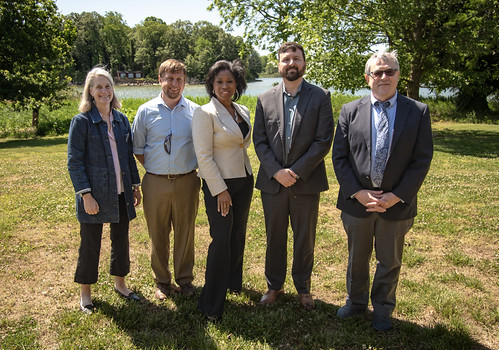
State officials formally introduced the initiative during a ceremony overlooking the Choptank River, bringing together representatives from multiple conservation organizations and government agencies.
“Roots for Resilience will be a major initiative for the environment and people of Maryland,” DNR Secretary Josh Kurtz said. “This work will focus on the Eastern Shore, where vulnerable rural areas are already managing the effects of rising sea levels and more intense storms. The new investments will make ecosystems and communities more resilient by protecting people, homes, and infrastructure while also improving wildlife habitat.”
The comprehensive program will target several key environmental challenges through nature-based solutions. Projects will include establishing living shorelines, restoring coastal wetlands, reconnecting tidal systems, expanding tree planting efforts, and implementing sustainable forest management practices.
Scientists predict that rising waters could eliminate one-third of the Eastern Shore’s high marsh areas by 2050, according to research models. The region has already experienced saltwater contamination of agricultural lands that were previously productive.
The funding comes through a Climate Pollution Reduction Grant from the U.S. Environmental Protection Agency, distributed to the Atlantic Conservation Coalition – a partnership involving environmental agencies from four coastal states, including the Maryland Department of the Environment.
“Maryland’s climate plan recognizes that nature is one of our strongest allies. These investments under Maryland’s Atlantic Conservation Coalition Climate Pollution Reduction Grant will help us restore our coastlines, reduce climate risks like flooding and erosion, and deliver real benefits to the communities that live there,” said Maryland Secretary of Environment Serena McIlwain. “Nature-based solutions help us cut pollution, protect people, and strengthen resilience all at once—and that’s exactly the kind of integrated climate action Maryland is committed to delivering.”
The program has established ambitious restoration targets over the coming years. Officials plan to restore tidal connectivity across 400 acres of marshland, rehabilitate 200 acres of tidal wetlands, and install protective living shorelines around 400 acres of tidal marshes. Additionally, the initiative aims to restore 500 acres of forest habitat while improving forestry management practices on 1,000 acres.
State environmental officials will also expand the existing nursery facility in Preston to increase production of locally-sourced trees for restoration projects.
“Roots for Resilience initiatives will protect communities by improving buffers against storms to reduce flood impacts and by enhancing local air and water quality,” said Jackie Specht, DNR’s Resilient Systems Officer. “This initiative builds on strong partnerships and local efforts to foster ecological and social resilience in a rapidly changing environment.”
The program involves collaboration with several regional conservation organizations, including Audubon Mid-Atlantic, Lower Shore Land Trust, and Eastern Shore Land Conservancy. These partnerships will help implement various restoration projects and community outreach efforts.
“We’re grateful for this investment and for Maryland DNR’s partnership in supporting Marshes for Tomorrow, a collaborative, science-driven effort to confront salt marsh loss in Maryland,” said Suzanne Biemiller, Vice President and Executive Director of Audubon Mid-Atlantic. “This support will help deliver large-scale marsh restoration that benefits birds, fisheries, and coastal communities, and shows what’s possible when Maryland comes together to protect these irreplaceable landscapes.”
“Conservation has always been about thinking beyond our own time,” said Matt Heim, executive director of the Lower Shore Land Trust. “This initiative allows us to work with landowners to protect and restore their land in ways that honor its history while ensuring it remains productive and resilient for the next generation and those that follow.”
The initiative will create new employment opportunities at DNR and support jobs with partner organizations working on environmental restoration projects in vulnerable coastal areas.
“The Chesapeake Bay region is one of the most impacted areas due to climate change’s acceleration of sea level rise,” said Mike Sieracki, Director of the University of Maryland Center for Environmental Science’s Horn Point Lab. “Using the best available science and long-term monitoring will help guide restoration efforts well into the future.”
State officials are currently accepting applications from nonprofit organizations interested in partnering with county governments on community outreach programs and from contractors who can help achieve forest management objectives. The department is also reviewing proposals for living shoreline projects, with award announcements expected this summer. Approximately $17 million in total funding is available specifically for living shoreline restoration work.