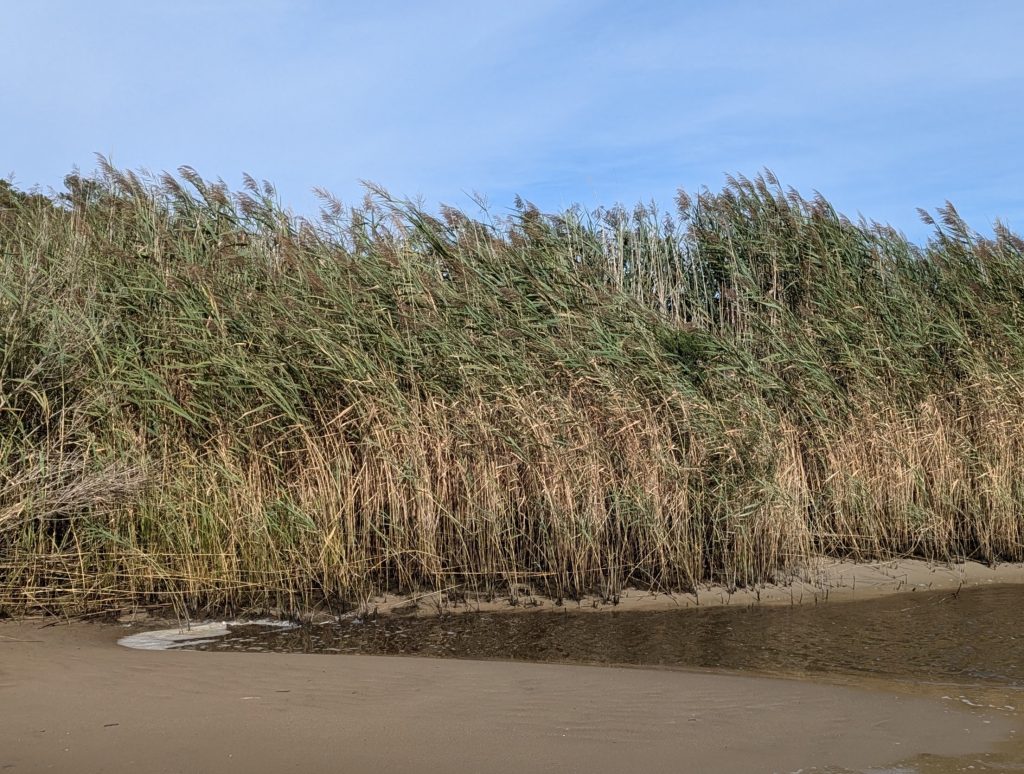

The towering grass known as phragmites has long been considered a major threat to Chesapeake Bay wetlands, but new research from Maryland scientists suggests the invasive plant may not be entirely harmful.
A study published in March by the Maryland Department of Natural Resources examines both the positive and negative impacts of Phragmites australis australis, the common reed that has spread throughout the region’s marshes since the 1800s.
“People often assume that phragmites is harmful,” said Dr. Elliott Campbell, DNR’s director of the Office for Science and Research and lead author on the paper, published in Wetlands Ecology and Management. “But we wanted to look at what the science actually says, and what we found is that it’s a much more complicated picture.”
The invasive reed, which grows rapidly in dense thickets of pale green stalks, has drawn criticism from environmentalists and waterfront property owners for displacing native vegetation and transforming marsh landscapes. The plant arrived in North America from the Middle East via Western Europe, likely through ship ballast water or bedding materials, with the first documented Bay area specimen collected at Chesapeake Beach in 1883.
Campbell and NASA research scientist Dr. Anthony Campbell analyzed existing scientific studies to compare phragmites with native marsh plants across several environmental functions, including carbon storage, nutrient filtering, wave protection, and wildlife habitat support.
Their findings reveal surprising benefits: phragmites excels at capturing atmospheric carbon, storing up to three times more than native marsh vegetation due to its rapid growth, year-round stalks, and extensive underground root networks.
The researchers also discovered that phragmites performs similarly to native plants in removing nitrogen from water and protecting shorelines from wave damage and storm surge.
Wildlife impacts proved more complex. While the invasive grass supports many animal species and shows little negative effect on fish, mammals, amphibians, and soil organisms, it falls short for certain birds of conservation concern. Species like salt marsh sparrows, willets, and rails prefer native high marsh areas and typically won’t nest in phragmites stands.
These findings suggest a more strategic approach to managing the widespread plant, rather than attempting removal everywhere it appears.
“Once you consider all those factors, in many areas of high phragmites concentration, it’s probably not worth controlling for phragmites because your probability of successful removal and the net benefit of doing so is low,” Campbell said. “Where that starts to flip is if you’re in one of these areas with a species of concern or where phragmites is in low abundance, then it could make sense to control for phragmites.”
Campbell plans to develop a mapping tool to help DNR and other land managers identify priority areas for phragmites control by showing where the plant overlaps with sensitive species habitats and high-value native marshes.
The study represents a shift in invasive species management philosophy, moving away from universal eradication efforts toward targeted interventions based on specific ecological costs and benefits.
“It challenges the widely held belief that we always need to be fighting invasive species everywhere,” he said. “There’s no going back to the ecosystem that’s like the one that existed in the past, particularly pre-Western colonization. So we need to think about what’s the most realistically achievable and beneficial ecosystem in our novel environment.”
The Maryland Department of Natural Resources continues its phragmites management programs but will incorporate this research into future decision-making about where and when to focus control efforts.
Interestingly, the invasive phragmites coexists with a native subspecies, Phragmites australis americanus, which still grows in Maryland but has become less common than its invasive relative.
The researchers noted that more study is needed to understand how phragmites compares to native plants in helping marshes adapt to rising sea levels and increased erosion.