
While the murky waters of the Chesapeake Bay may look empty from the surface, Maryland’s Department of Natural Resources routinely uses specialized techniques to study the aquatic life thriving beneath.
In fall 2025 during Maryland Science Week, DNR scientists joined with Huntingtown High School’s AP environmental science students and researchers from the Smithsonian Environmental Research Center at Reed Education Center to showcase how marine biologists collect information about Bay wildlife through seine net sampling.
The students got hands-on experience with this research technique while learning how human development, especially the building of impermeable surfaces like roadways and parking areas, affects aquatic habitats. Scientists explained that locations with 10% or greater impervious coverage can harm fish environments by decreasing water quality and oxygen levels.
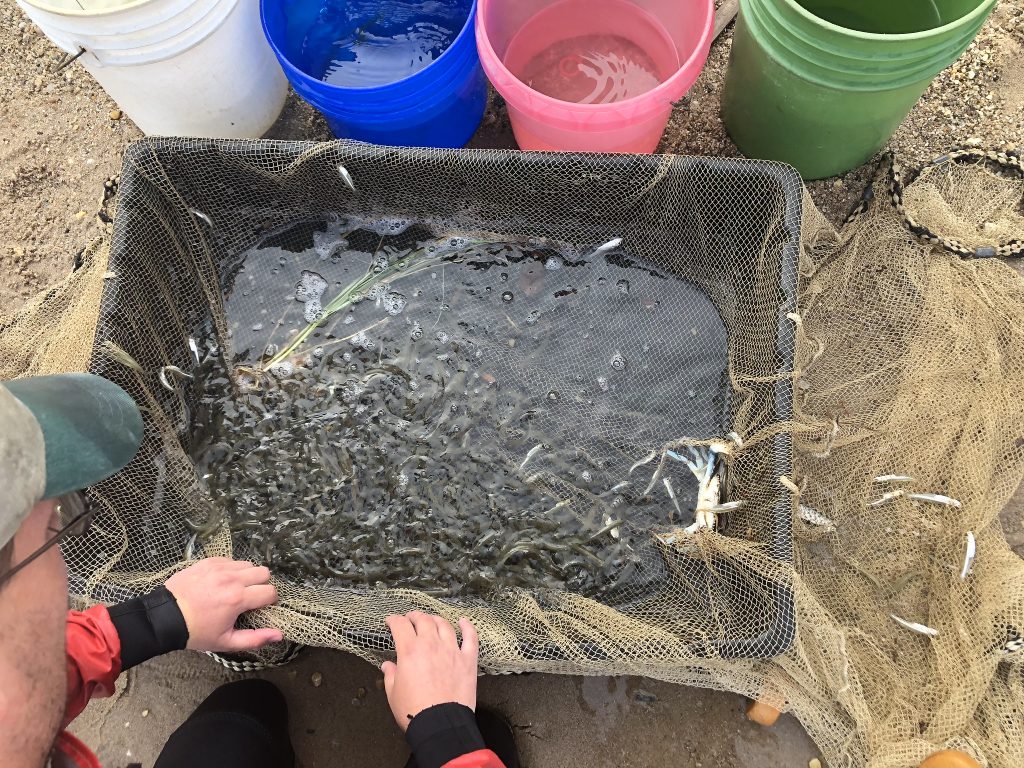
Watching from the research center’s shoreline, the group observed as the team used a 100-foot-long, 4-foot-deep beach seine net in the Rhode River. The crew first walked into the water to stretch the net across a broad area, then slowly moved closer together, concentrating the marine life into an increasingly smaller space before finally gathering the entire net and transferring it to a water-filled container on land.
The sampling captured multiple native species, including striped bass, blue crab, menhaden, silversides, and a horseshoe crab.
These sampling methods have proven valuable for marine biologists studying fish populations in shallow coastal areas. The department employs seine net research for numerous yearly and ongoing scientific projects. Using various mesh dimensions and study locations, these surveys can target specific fish types for detailed examination or gather important population data.
Multiple DNR seine studies receive funding from the Sport Fish Restoration Fund. Revenue from fishing licenses, equipment, boats, and marine fuel supports DNR’s fish conservation programs. Anglers can buy fishing licenses online through MD Outdoors or at authorized dealer locations.
Estuarine Fish Community Sampling Study
Every summer, DNR marine biologists from the Fisheries Ecosystem Assessment Division deploy beach seine nets 130 times across various sites in the shallow tributary waters of Chesapeake Bay. Captured fish are sorted by age group, tallied, and select species undergo measurement. Water quality measurements are also recorded.
Scientists analyze this information to evaluate nursery and mature habitats for recreationally significant fish species. The survey examines striped bass, yellow perch, white perch, alewife, blueback herring, American shad, hickory shad, spot, Atlantic menhaden, bay anchovy, spottail shiner, silvery minnow, and gizzard shad. During 2025, the survey’s beach seines collected 50 different species, including freshwater varieties like largemouth bass, chain pickerel, and black crappie, plus saltwater species such as bluefish, black drum, and northern puffer.
Juvenile Striped Bass Survey
Striped bass, known locally as rockfish, serve as Maryland’s official state fish. These fish hold recreational and commercial significance from Maine through North Carolina, with the Chesapeake Bay functioning as the main breeding area for the Atlantic Coast population.
DNR has operated the Maryland Juvenile Striped Bass Survey continuously since 1954, making it among America’s longest-running fish population studies. Throughout its history, researchers have collected over 100 fish species during this survey. The study evaluates striped bass breeding success from the prior year while documenting the relative numbers of other fish species observed in summer seine nets. Tracking young fish populations over time helps scientists forecast future adult fish numbers as these juveniles mature.
DNR researchers use seine nets at 22 sites across Maryland’s Chesapeake Bay waters, repeating the process at each location to improve sample reliability. These locations and techniques stay constant annually, enabling scientists to develop yearly comparisons of young fish populations over time.
Recent survey findings have raised concerns. Researchers have documented persistently low counts of striped bass under one year old when compared to the seven-year survey average. While the adult breeding population of striped bass remains healthy, the data collected from counting hundreds of two-inch juvenile striped bass each summer serves as an early indicator that population numbers could drop in upcoming years.
Shad Restoration
Maryland DNR has pursued American and hickory shad restoration in Chesapeake Bay waters since the late 1990s. To gauge these restoration efforts’ effectiveness, scientists perform haul seine surveys each year from late summer through early fall. The seine nets used in this research are launched from boats because of deep waters and sometimes unreachable shorelines along the Choptank River and Patapsco River sampling areas.
At ten sites, one end of a 200-foot net is brought ashore by a researcher in the water, while the opposite end is pulled in a circular pattern by a colleague in a small vessel. A research team manually pulls in the remaining net until fish become trapped in a net pocket. Scientists tally fish by species and gather shad samples for additional laboratory examination. Survey information helps calculate wild population estimates, larval death rates, and evaluate stocking program success.
DNR’s fish stocking programs have successfully restored hickory shad populations in both the Patuxent and Choptank rivers. Nevertheless, survey data indicates that insufficient spawning adults continue to present a major obstacle to population expansion in other waterways.
Coastal Bays Seine Surveys
Along Maryland’s Eastern Shore ocean coastline, Assawoman, Isle of Wight, Sinepuxent, Newport, and Chincoteague Bays sit protected behind Assateague Island and Ocean City. Approximately 175 square miles of Maryland’s coastal region drains into these bay systems. Below the surface, these environments function as nursery areas for species including summer flounder, black sea bass, weakfish, spot, croaker, menhaden, American eels, and bluefish.
Twice yearly in June and September, the Coastal Fisheries Program performs 38 seine net deployments using a 100-foot-long, 6-foot-deep bag seine with 0.25-inch mesh, floating buoy line, and weighted bottom rope in the coastal bay waters. Researchers identify and measure the first 20 specimens of each fish species and blue crabs encountered.
Plant life and invertebrates, including jellyfish, are also recorded. Submerged Aquatic Vegetation serves as critical habitat that young fish require for shelter and food sources. The department started SAV bed sampling in 2012, with standardized methods beginning in 2015. These surveys measure water temperature and pH levels to create comprehensive data about Maryland’s Coastal Bays conditions.
Information gathered from this survey supports various applications, including fish population assessments, federal reporting requirements, and academic research. This data offers insights into fish community composition and population levels in Maryland’s coastal bays, helping guide management decisions that safeguard these specialized environments where fish live and reproduce. For instance, tautog population data led the department to work toward including the juvenile index in the next Atlantic States Marine Fisheries Commission benchmark population assessment.
Since beginning in 1972, the survey has documented over 130 adult and juvenile fish species, 26 mollusk varieties, and 11 types of macroalgae. The most recent published survey findings showed that coastal bay fishery stability differs among species. Generally, finfish represented the most numerous group captured in both the seine survey and the related trawling component of this research.