
NEW YORK — The San Antonio Spurs and Oklahoma City Thunder both made moves to address a shared problem: how to deal with Victor Wembanyama. Meanwhile, a pair of smaller scoring guards — Darius Acuff Jr. and Mikel Brown Jr. — are already being set up as a fascinating long-term rivalry.
Those were among the biggest storylines to emerge from the two-day NBA draft held in Brooklyn, which got underway Tuesday night when the Washington Wizards selected AJ Dybantsa with the top overall pick. The second round wrapped up Wednesday night with several trades adding more drama.
The Thunder ran into Wembanyama during the Western Conference finals, while the Spurs struggled whenever Wembanyama was off the floor during the NBA Finals. Both franchises used the draft to find answers.
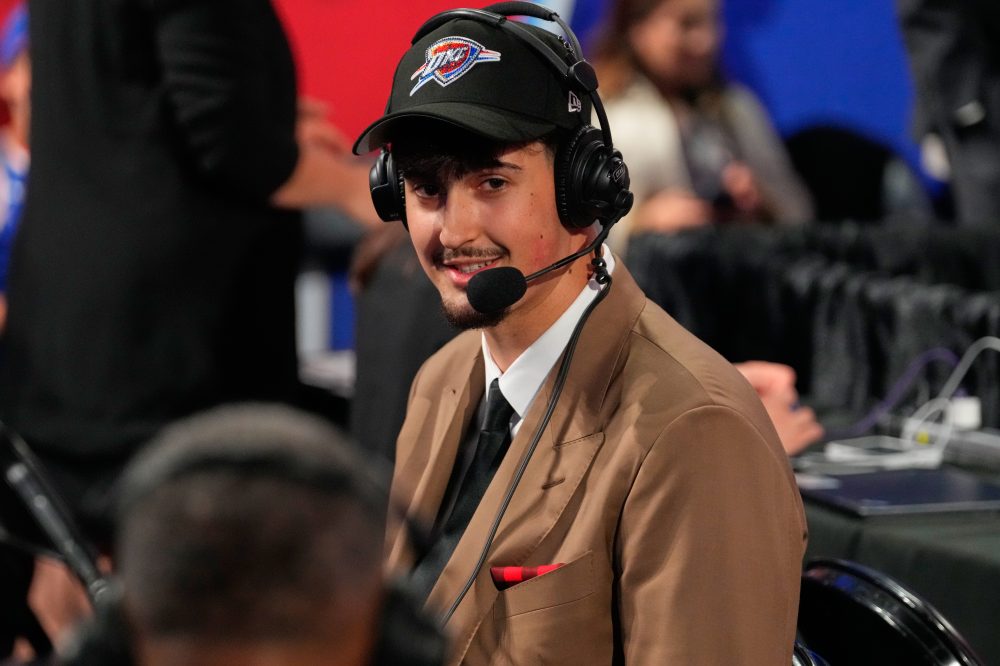
Oklahoma City addressed its size concerns by selecting 7-foot-3 center Aday Mara out of Michigan at No. 12. The 260-pound Mara, who earned Big Ten defensive player of the year honors while playing for Spain’s national program, could offer the physical presence that Chet Holmgren — the No. 2 pick in 2022 — was unable to provide in the playoff series that ended the Thunder’s title run.
Mara acknowledged the obvious matchup on the horizon. “I’m excited to play against him, obviously, to play in the NBA,” he said of Wembanyama. “But I feel like I’m going to play against him a lot. If it’s not NBA, it’s going to be on the national team.”
The Spurs, who fell to the New York Knicks in five games in the NBA Finals, watched Wembanyama appear worn down at times — possibly because backup Luke Kornet was being dominated whenever he stepped onto the court. San Antonio drafted 6-foot-9 Jayden Quaintance from Kentucky and also acquired the rights to Tarris Reed Jr., the physical big man who helped carry UConn to the national championship game, giving the team more reliable options to spell their star.
One of the most talked-about questions heading into the draft was which scoring guard would go first. That answer came at pick No. 6, when the Brooklyn Nets selected Mikel Brown Jr. from Louisville — a choice that drew cheers from the home crowd at the arena hosting the event.
Nets general manager Sean Marks explained the thinking behind the pick. “I think something that we saw with Mike was just how anxious and excited he was at getting out there in the NBA. ‘I got something to prove.’ It’s hard to measure,” Marks said. “I think that’s something that will translate when you have a chip on your shoulder, you’re an extreme competitor.”
Darius Acuff Jr. landed one spot later, going to Sacramento at No. 7. Some observers felt Acuff deserved to go higher based on his college résumé, and the debate will only intensify if he outperforms Brown at the pro level.
Acuff seemed unbothered by where he landed. “I was good wherever I went,” he said. “It wasn’t like a bad reaction on it.”
Both players bring serious offensive firepower. Brown, who stands 6-foot-4, set an ACC freshman scoring record with a 45-point performance that included 10 made three-pointers, though a back injury sidelined him for 14 games. Acuff averaged 23.5 points per game — third in the country — and led the SEC in both scoring and assists. He was named SEC Tournament MVP after guiding Arkansas to the conference title.
For years, the NBA draft’s first pick was almost guaranteed to be a one-and-done college freshman. From 2010, when Washington selected John Wall, through 2022 when Orlando chose Paolo Banchero, every No. 1 pick had spent exactly one year in college. That streak ended in 2023 when San Antonio took Wembanyama, followed in 2024 by Atlanta selecting fellow Frenchman Zaccharie Risacher — marking back-to-back years with international players who never attended a U.S. college going first overall.
This year, however, the one-and-done model came roaring back. The first eight picks were all college freshmen, tying the record set a year ago, and nine of the top 10 were first-year college players — another record-tying mark.
Utah’s No. 2 pick Darryn Peterson reflected on the bond among the top prospects. “We don’t know each super personally, but we spent a good amount of time around each other. So we know each other kind of well,” he said. “We’re going to continue to compete. I’m coming for these guys like I’ve been coming for them my whole career.”
The New York Knicks, meanwhile, raised eyebrows with their cautious approach. Owner James Dolan had previously stated in a radio interview on WFAN in New York that he wanted to avoid crossing into the second luxury tax apron. After winning the franchise’s first championship in 53 years, many wondered whether the team would truly hold back spending.
Their draft activity suggested they would. The Knicks originally held the No. 24 pick but traded back and eventually out of the first round entirely. They entered the second round with pick No. 31 and traded back from there as well, ultimately finishing the draft with selections No. 39 and No. 47 — German guard Jack Kayil and Vanderbilt forward Tyler Nickel. The team needs to preserve salary flexibility to re-sign key players including Mitchell Robinson, Landry Shamet, Jose Alvarado, and Deuce McBride.
Kayil expressed confidence that he fits the Knicks’ winning culture. “I think also one of my strengths is that I love winning and I give everything for that, and to come in this organization shows that they also want winners,” he said. “So I think it’s a good fit.”