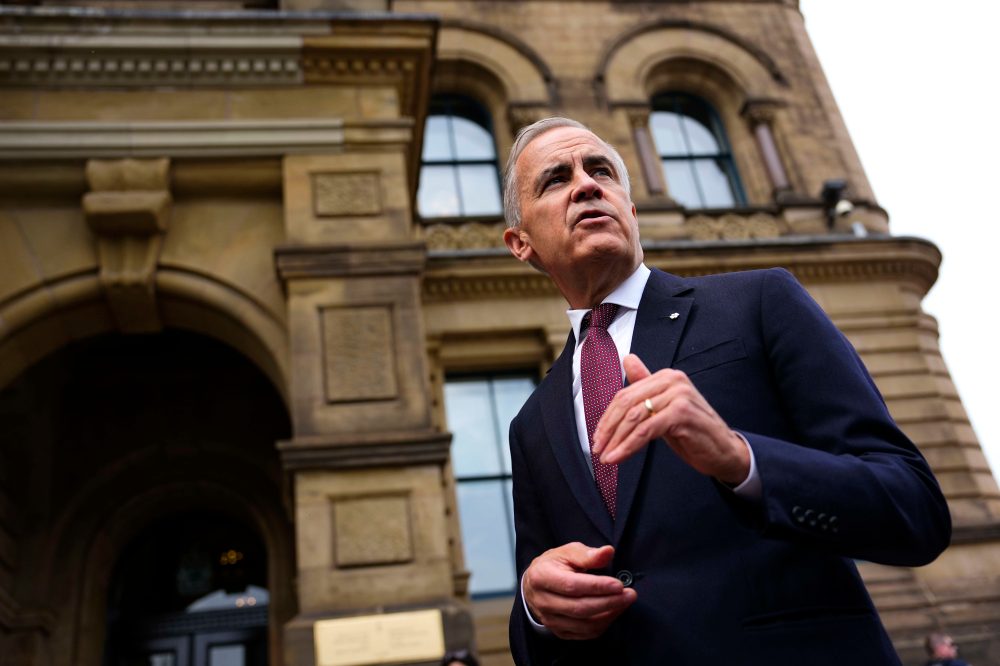

VANCOUVER, British Columbia — Canadian Prime Minister Mark Carney announced Tuesday that he and U.S. President Donald Trump have agreed to accelerate trade talks between Canada, the United States, and Mexico — just one day after Trump announced sweeping 50% tariffs on most Canadian goods.
Carney’s remarks followed Trump’s declaration that Canada has unfairly discriminated against American automobiles, alcohol, and dairy products. The new tariffs are scheduled to kick in 30 days from Monday.
“I spoke this morning with the U.S. president and we agreed to deepen and speed up our negotiations over the next few weeks,” Carney said from Ottawa. “Canada will do all that is necessary to support our jobs, our workers, our farmers and to make Canada stronger, more independent and more resilient.”
The tariff announcement has raised fears of renewed economic turmoil, including the possibility of higher inflation and a further deterioration in relations between the two neighboring nations — countries that shared close ties before Trump’s return to the White House. A U.S. administration official noted Monday that Canada was among the few countries besides China to retaliate against earlier Trump tariffs, saying it must face consequences for doing so.
The 50% tariffs would spare energy products, potash, fish, and critical minerals, but would apply to goods that were previously shielded from import taxes under the United States-Mexico-Canada Agreement, known as the USMCA. That 2020 trade deal was not renewed by the U.S., setting off a new round of negotiations that could stretch until 2036.
Carney said he planned to hold a virtual meeting with Canada’s provincial premiers later Tuesday. British Columbia Premier David Eby offered a blunt assessment of Trump’s approach while speaking in Charlottetown, Prince Edward Island, where premiers and territorial leaders had gathered.
“This feels like an increasingly desperate and flailing approach to relationships with our country,” Eby said. “There’s no question it will hurt families in British Columbia.”
Eby went on to say that Trump is mistaken if he believes he can “bully us into whatever he wishes.” He also expressed sympathy for Americans caught in the middle of the dispute.
“I feel sorry for Americans,” he said. “If you can’t be friends with Canada, then you almost certainly do not have friends anywhere in the world, and that is a very lonely place to be.”
Saskatchewan Premier Scott Moe argued that tariffs create pain on both sides of the border. “When tariffs are applied it increases the cost for families and to do business on both sides of the border,” he said. “These tariffs do nothing for making a more competitive North American economy.”
Ontario Premier Doug Ford called on Canada to take a more aggressive stance. “We always seem to be on our back heels,” he said. “We need to be on the offense. Not constantly on the defense with President Trump. We need to stand up to the bully, and we need to hit him tariff to tariff, all the way across the board.”
Speaking to reporters in the Oval Office on Tuesday, Trump said he has affection for Canadians but claimed the country depends on the United States to survive. “Canada’s been very, very tough on us over the years, for many years, and no other president’s done anything about it,” he said.
Trump also clarified that the new tariffs are separate from additional levies he has threatened to impose on Canada related to wildfire smoke that impacted millions of people across the Great Lakes, Northeast, and Mid-Atlantic regions of the U.S. He repeated his assertion that Canada is failing to properly manage its forests.
Canadian economists say the tariffs are more targeted than initially feared, potentially affecting around 5% of Canada’s exports to the United States. Products in that range include honey, liquor, cement, and hockey sticks.
Robert Kavcic, a senior economist with the Bank of Montreal, said in a client note that the proposed tariffs would cover roughly $28 billion Canadian — about $19.8 billion U.S. — in annual Canadian exports to the U.S. That figure represents approximately 0.8% of Canada’s overall economy.
Kavcic said chemicals, plastics, electronics, and industrial equipment appear to be the primary targets, followed by consumer goods and forestry products. Agricultural and food products, along with miscellaneous manufacturing machinery, round out the affected categories.
One key point of friction for the U.S. is that eight Canadian provinces have banned the sale of American alcohol at provincially run liquor stores. Carney said the decision to maintain or lift that ban rests with each province individually.
Eby was unequivocal about where British Columbia stands on the matter. “There is not a chance in hell that U.S. alcohol is going back on the shelf in British Columbia,” he said.