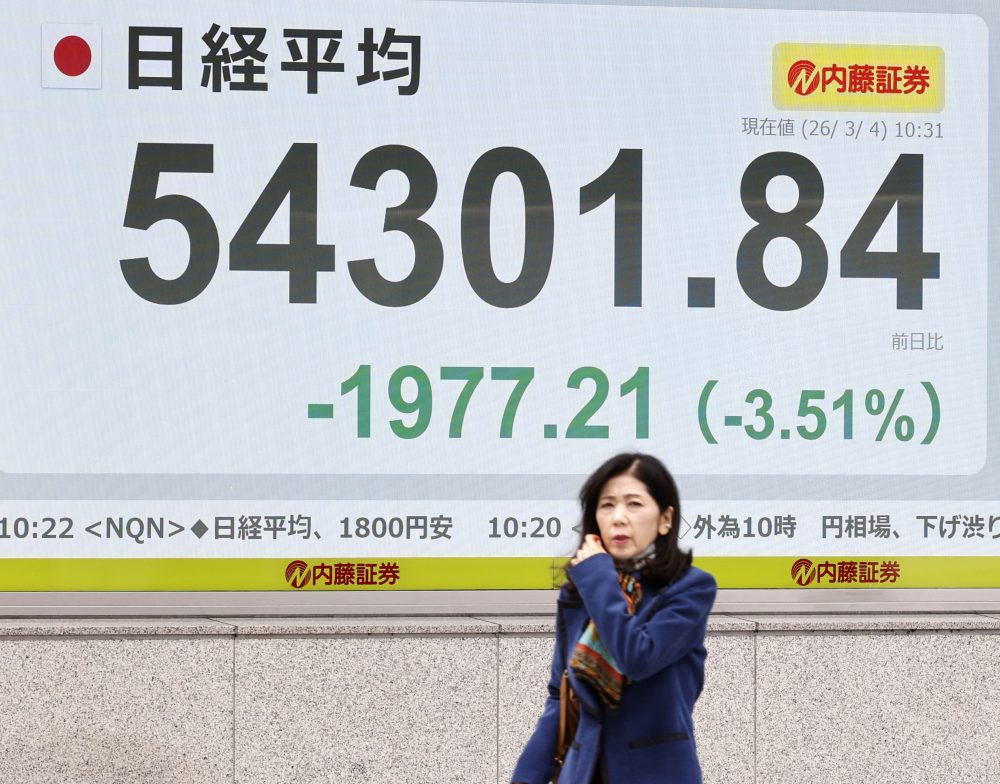

BANGKOK (AP) — Stock markets throughout Asia continued their steep decline Wednesday following a global selloff that impacted Wall Street, with South Korea’s primary index crashing 8% as crude oil prices surged to new heights.
Escalating tensions in the Middle East conflict involving Iran have battered financial markets worldwide. Investors are increasingly concerned about rising energy costs and their potential to fuel inflation, which could slow global economic growth and hurt company earnings.
South Korea’s Kospi index experienced the region’s steepest decline, dropping 8.1% to close at 5,321.38, prompting authorities to halt trading temporarily. Energy supply worries overshadowed positive sentiment about technology giants Samsung Electronics and SK Hynix benefiting from growing artificial intelligence demand.
Tokyo’s Nikkei 225 dropped 3.4% to finish at 54,346.73. Both Japan and South Korea rely heavily on oil and natural gas imports from Middle Eastern nations, with supplies now trapped in the Persian Gulf region.
Other Asian markets also posted significant losses, with Hong Kong’s Hang Seng declining 1.4% to 25,408.27 and Shanghai’s Composite index falling 0.5% to 4,100.46.
Australia’s S&P/ASX 200 dropped 1.8% to 9,130.90, while Taiwan’s Taiex retreated 2.9%.
Wall Street suffered losses Tuesday, with the S&P 500 ending down 0.9% after falling as much as 2.5% during trading on economic concerns related to the conflict. The Dow Jones Industrial Average trimmed its decline to 0.8%, while the Nasdaq composite dropped 1%.
Rising inflation linked to the conflict could limit the Federal Reserve’s ability to reduce interest rates. The central bank cut rates multiple times last year and signaled additional reductions could come in 2026. While lower rates typically stimulate economic growth and employment, they can also contribute to inflationary pressures.
U.S. benchmark crude oil prices rose 1.2% to $75.46 per barrel, while Brent crude, the global benchmark, increased 1.5% to $82.61 per barrel.
Currency markets showed the dollar holding steady at 157.55 Japanese yen, while the euro weakened to $1.1599 from $1.600.