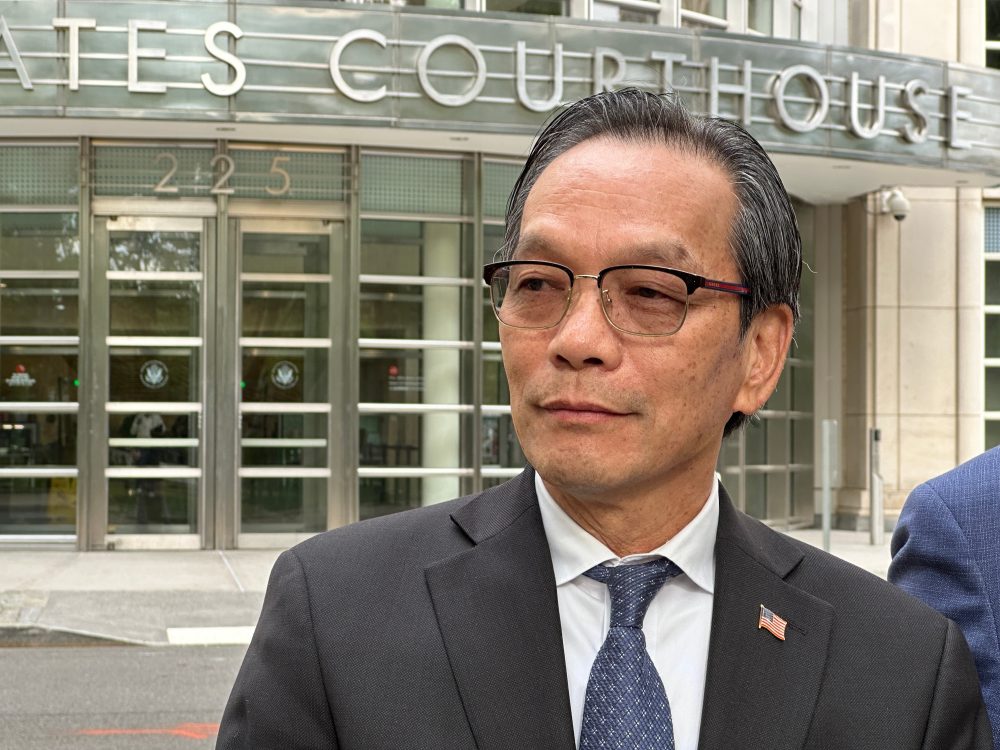

A federal jury in Brooklyn has found a 64-year-old man guilty of operating an unauthorized Chinese government facility from an unremarkable office building in Manhattan’s Chinatown district.
Lu Jianwang was found guilty Wednesday of serving as an unregistered foreign agent and destroying evidence by erasing text messages that federal prosecutors claimed contained directives from Beijing to target, harass and threaten pro-democracy activists. The jury cleared him of a conspiracy charge.
The week-long trial in Brooklyn federal court highlighted tensions between American concerns over China’s suppression of dissidents and defense arguments that prosecutors transformed a well-intentioned Chinese American community leader’s administrative oversight into a criminal case.
“A police station operating in New York City at the direction of the Chinese government has been exposed, its sinister purpose disrupted, and its founder held accountable for blatantly disregarding the law and our country’s sovereignty,” U.S. Attorney Joseph Nocella Jr. said.
Following the verdict, Lu addressed supporters in his native Fujianese dialect but refused to take questions from the media. His attorney, John Carman, announced plans to appeal.
Carman argued that federal prosecutors transformed a routine paperwork matter into an international espionage drama. The foreign agent conviction stems from Lu’s failure to notify the U.S. government about his activities on China’s behalf, which his legal team maintains was restricted to assisting Chinese diaspora members with renewing their Chinese driver’s licenses.
“This is not espionage. This is not spying. This is not intelligence gathering,” Carman said while standing with Lu outside the courthouse. “He wasn’t charged with any of that.” The underlying message of the prosecution’s case, Carman argued, was that Lu “associated with a lot of Chinese people.”
“Is that window dressing or dressing up a paperwork case? A hundred percent,” Carman said.
Lu, a decades-long U.S. citizen who also uses the name Harry Lu, remains on bail pending sentencing, which hasn’t been set.
He could receive up to 10 years in prison for the foreign agent charge and up to 20 years for evidence destruction.
Prosecutors alleged that Lu and co-defendant Chen Jinping created the Chinatown facility in 2022 following Lu’s attendance at a ceremony in his home province of Fujian, where China’s Ministry of Public Security announced plans to establish 30 covert police stations worldwide.
China’s communist leadership utilizes these facilities to surveil individuals it considers threats to its agenda, Assistant U.S. Attorney Antoinette Rangel argued during Tuesday’s closing statements.
Throughout the trial, jurors viewed a prominent sign from the Chinatown site reading: “Fuzhou Police Overseas Service Station, New York USA.” They also heard from Xu Jie, a Chinese dissident, activist and YouTuber residing in California whom prosecutors claimed was targeted by Lu’s operation.
“The police station wasn’t the defendant’s idea or initiative, this was the Chinese government,” Rangel told jurors during her closing argument. “This was the Chinese government’s plan and the defendant made it happen.”
Chen admitted guilt in December 2024 to conspiring to act as a foreign agent.
Lu’s defense team maintained the facility functioned as a community center where individuals could remotely renew their Chinese driver’s licenses without returning to China during COVID-19 travel limitations.
Carman noted that people also gathered there for ping-pong and mahjong games. However, prosecutors argued that even if Lu’s sole connection to China involved driver’s licenses, that would still constitute a legal violation.
The Manhattan facility, located between a hotel, spa and coffee shop, operated within offices shared with the America ChangLe Association, a community group that Lu and his brother, Jimmy, helped manage. The organization identified itself on tax documents as a “social gathering place for Fujianese people.” ChangLe translates to “eternal joy,” Carman explained.
“Harry’s motives were pure. Harry’s support in the community is enormous for a reason — not because he’s some underworld operative,” Carman said. “His support is there because he’s helped a lot of people in the 45 years that he’s been in the United States of America, becoming a citizen and reaching out to members of his community to help them.”
The FBI, prompted by a report from an organization tracking Chinese transnational repression, searched the Chinatown facility on Oct. 3, 2022. The following day, prosecutors said, Lu confessed to FBI agents that he created the outpost, maintained contact with his handler through WeChat and had erased those communications.
The messages, some recovered through phone screenshots, demonstrated he was “in lockstep with what the Chinese government tasked him to do,” Rangel said.