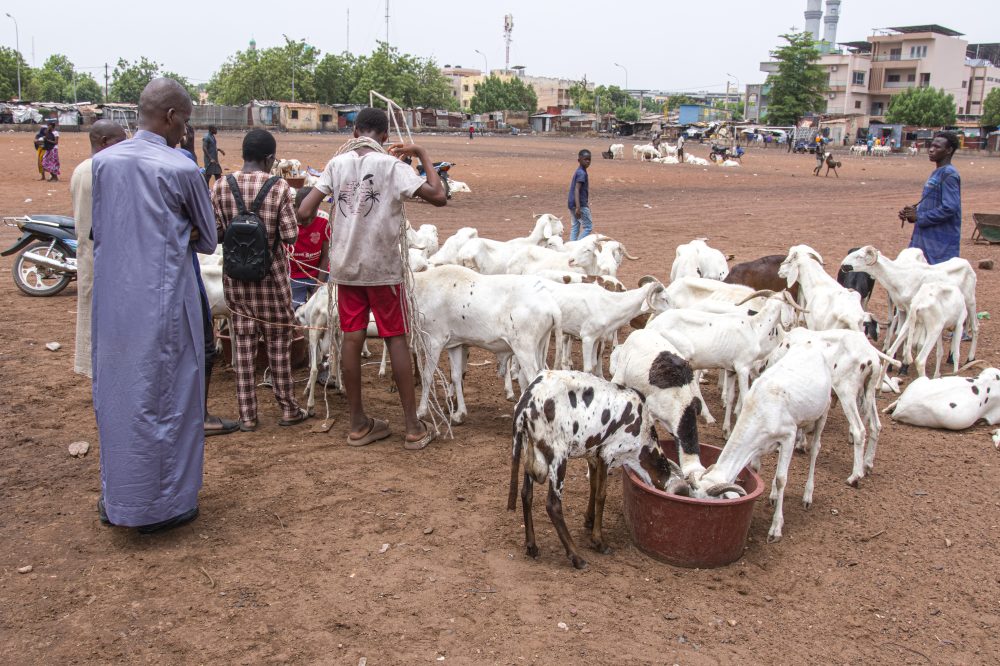

BAMAKO, Mali (AP) — Muslims worldwide are preparing for Eid al-Adha, the feast of sacrifice, but celebrations in Mali’s capital carry a somber tone this year. An economic blockade imposed by armed militants connected to al-Qaida has caused sheep costs to skyrocket, making the holiday’s traditional practice of slaughtering an animal and distributing meat to those in need financially impossible for many households.
The supply crisis and inflated costs stem from a blockade targeting Bamako that was declared this month by members of Jama’at Nusrat al-Islam wal-Muslimin, a group with al-Qaida ties. These fighters routinely assault truck convoys and vehicles bringing supplies to the capital, frequently burning them completely.
Mali, which has no coastline, relies extensively on fuel and merchandise transported by truck from neighboring coastal countries including Senegal and Ivory Coast. According to analysts, the militants’ economic siege aims to cripple the nation’s financial stability and weaken the military government’s authority.
The siege isn’t complete, since the armed factions avoid maintaining roadblocks for extended periods due to concerns about Malian military retaliation, allowing some supplies to continue reaching Bamako and preventing complete food scarcity for the time being.
However, the blockade has increased costs for certain products like meat and created fuel shortages, compelling citizens to wait in long lines at the limited gas stations still operating.
Since September 2025, the group had already enforced a stifling road blockade on oil imports.
Mountaga Touré, 38, a teacher, explained he searched multiple livestock markets before abandoning his plan to purchase a sheep for the celebration, noting that sheep costs have nearly doubled since the blockade began.
“The small sheep that used to cost $177 are now $266 or more,” Touré said.
In certain areas of Bamako, citizens have replaced the customary sheep with cattle, combining their resources to buy one animal so they can obtain meat for this significant Muslim observance in West Africa.
The blockade comes after extensive, synchronized attacks by separatist and extremist forces throughout Mali last month, representing the most significant assault in the nation in more than ten years.
Mali has endured insurgencies waged by extremists associated with al-Qaida and the Islamic State group, along with a separatist uprising in the northern region, for more than a decade.
After a 2020 military takeover, the governing junta shifted away from Western partners toward Russia for assistance in fighting Islamic extremists. However, security conditions have deteriorated recently, analysts note, with a unprecedented number of militant attacks. Military forces and Russian mercenaries have also faced accusations of killing civilians they believe are working with militants.
The Malian military and its Russian Africa Corps mercenaries are working around the blockade by providing protection for truck convoys transporting goods and fuel to supply Bamako markets. The armed forces also frequently report striking positions controlled by armed groups.
However, residents report that the protective escorts and military strikes haven’t been sufficient to properly supply the capital.
“Usually, I bring up to 200 sheep to Bamako to sell during Tabaski,” said Amadou Cissé, 45, a livestock trader specializing in Eid sheep, using the West African word for the holiday. “But this year I barely brought 50 because there is not enough space in army-escorted trucks.”
Cissé explained that the sheep he requested remain in Diema, a community approximately 345 km (215 miles) west of Bamako, where many animals destined for the capital are sourced.
“I was told more escorted convoys would be organized, but so far none have left Diema, so I doubt the sheep will arrive before the holiday,” he said.
Drissa Traoré, who has sold sheep in Bamako for more than ten years, reported that available inventory has decreased substantially in recent times. “This year, we have barely half the number of sheep we usually have during Tabaski,” he said.
The dangerous conditions have also impacted travel arrangements for many people.
Sidi Diarra, who works at a prominent financial company in Bamako, mentioned he typically observes the holiday with his family in Segou, approximately 240 km (150 miles) from the capital.
“This year, I am afraid to go because of attacks by extremist groups. It is safer to stay in Bamako,” he said.