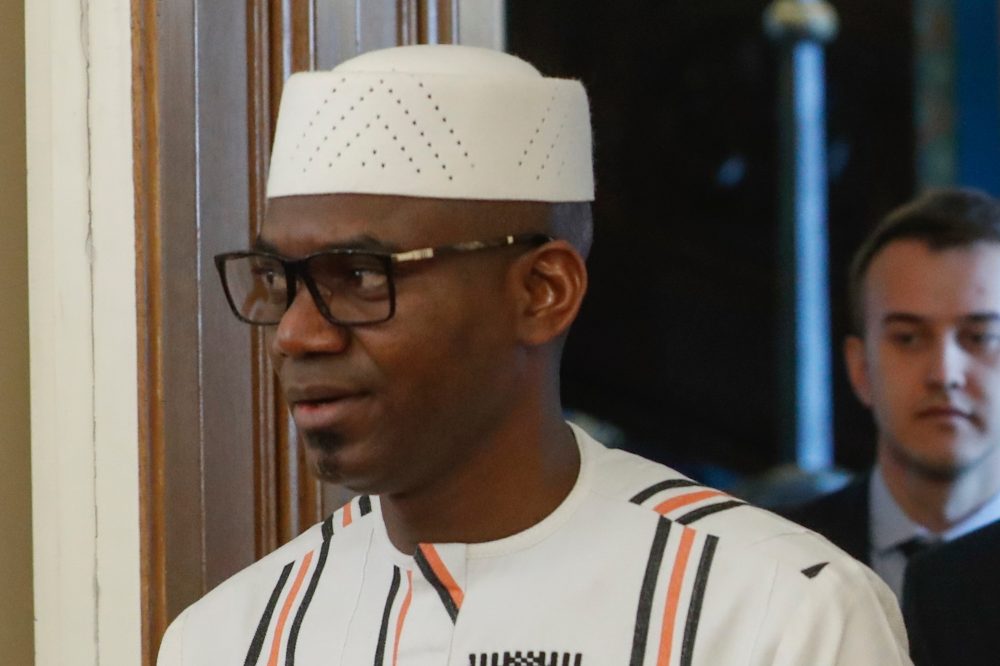

Mali conducted a state funeral Thursday for Gen. Sadio Camara, the former defense minister who orchestrated the West African nation’s military alliance with Russia following recent coups.
Camara died during a weekend series of coordinated militant strikes that marked the most significant assault on the country in more than ten years.
Experts suggest his death, along with the substantial losses suffered by Mali’s military forces and their Russian mercenary partners, may cause rifts within the ruling military government and potentially force a reassessment of ties with Moscow.
Following two days of official mourning, military leader Gen. Assimi Goita attended Camara’s funeral service, which was televised nationally. Officials placed the casket beneath Mali’s green, yellow and red flag while oversized photographs of the deceased minister surrounded the ceremony venue.
Born in 1979 in the garrison community of Kati near capital city Bamako, Camara was killed at that same location when a vehicle bomb detonated near his residence Saturday.
During his early military career, he served in northern Mali during the late 2000s as armed insurgencies connected to Al-Qaeda began emerging. Following his graduation from military school, he completed multiple international training programs, including coursework at a Russian military institution.
Malian citizens first encountered Camara in August 2020 when he appeared on state television as a colonel alongside four other military officers who had removed President Ibrahim Boubacar Keita from power.
The military group criticized Keita for accepting French support while failing to adequately address widespread militant violence throughout the nation. They promised enhanced security measures.
After seizing control, the new military government established Russia as its primary security ally, removing French forces and United Nations peacekeeping personnel.
Camara became instrumental in developing Russia as Mali’s principal security collaborator. He held the defense minister position under both military administrations — initially after the 2020 takeover and again following a second coup in May 2021 that elevated Goita to leadership.
Ulf Laessing, who directs the Sahel program at Germany’s Konrad Adenauer Foundation, described Camara as the “architect of cooperation with Russia,” noting his role in bringing Russian mercenaries in 2021 and removing the U.N. peacekeeping operation called MINUSMA.
According to Laessing, Camara’s regular visits to Moscow and his crucial involvement in both coups made him essential to the military government despite worsening security conditions across the country.
The newly established Africa Corps — a Russian military formation answering to Moscow’s defense ministry with approximately 2,000 personnel in Mali — announced Monday that its forces had retreated from Kidal, following separatist claims of capturing the strategic northern city.
Rida Lyammouri, a senior fellow at Morocco’s Policy Center for the New South think tank, suggested Camara’s death combined with increasing dissatisfaction among citizens and military officials regarding Russian mercenaries’ failure to control insurgencies might prompt the junta to reconsider its Moscow partnership.
Laessing noted that Goita, who met with Russia’s Mali ambassador Tuesday, “seems open to collaboration with some Western countries, such as the United States.”