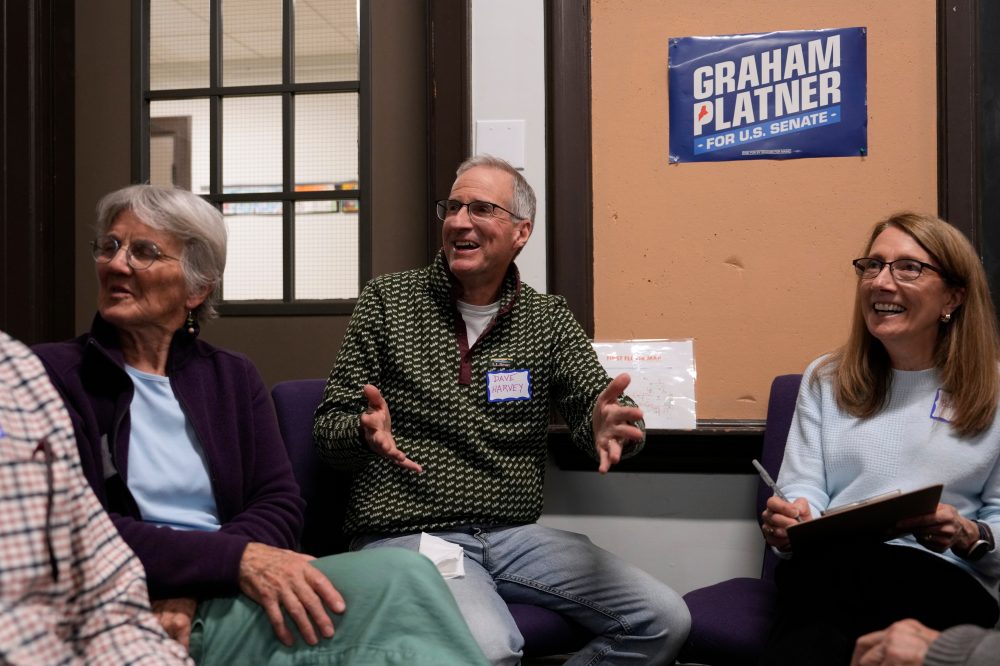

KITTERY, Maine — A Democratic Senate hopeful in Maine is taking an unusual approach to campaigning, turning his controversial background into trivia questions at community events.
Graham Platner, a 41-year-old oyster farmer seeking his first elected office, recently held a campaign trivia night where supporters answered questions about his past controversies, including a tattoo he received during military service that resembled a Nazi symbol.
“What was the nature of the controversy of Graham’s tattoo he received while in the Marines?” an event host asked participants at a local community center.
“It was claimed to be a Neo-Nazi tattoo (totenkopf),” came the response.
The military veteran is challenging incumbent Governor Janet Mills, 78, in the June 9 Democratic primary. The winner will face five-term Republican Senator Susan Collins, 73, in a contest that could influence which party controls the Senate.
“Graham Platner’s campaign gave me a place to put my energy in a positive way,” said Beth Knight, a 63-year-old educator who participated in the Kittery trivia event. “I believe he has a true redemption story.”
Attendees enjoyed refreshments while listening to music from Dropkick Murphys, a Boston punk group favored by Platner. Many demonstrated detailed knowledge about the previously unknown candidate, from his pet’s name to his former workplace in Washington, D.C.
One trivia question asked participants to identify what makes Platner the strongest candidate against Collins. While “he is handsome and has a deep voice” was listed as an option, the designated correct response was “he has grown as an individual and is honest.”
Mills, currently serving her second gubernatorial term, has backing from Senate Majority Leader Chuck Schumer and other party officials who consider supporting an unproven candidate like Platner too dangerous. Maine’s aging electorate typically favors politicians known for moderate positions.
However, Platner has energized certain supporters with his anti-establishment messaging that his team believes could lead to victory.
“What specific group did Graham identify as the primary enemy in his campaign launch video?” the trivia host inquired. The answer was “the oligarchy and the billionaires.”
While Platner focuses his platform on cost-of-living concerns including housing and healthcare, media attention has largely concentrated on his troubled history. He continues facing scrutiny over the skull-and-crossbones tattoo that resembled Nazi imagery, which he claims he obtained during a drinking episode while on military leave in Croatia.
Platner maintains he didn’t understand the image’s Nazi connections at the time and has since had it covered with a different design. Additional concerns have emerged regarding inflammatory statements in previous online posts, which he has rejected. Recently, questions arose about his appearance on a podcast hosted by Nate Cornacchia, a former Green Beret facing antisemitism accusations.
Despite ongoing controversies, Platner continues drawing crowds to theaters, community centers, and rallies. Between his August campaign launch and late March, Platner conducted 50 town halls across Maine. His campaign claims Mills and Collins held zero such events.
His activities range from standard voter outreach and volunteer training to brewery happy hours and sign-making sessions before No Kings demonstrations. This extensive presence has boosted Platner’s recognition. During the recent Kittery trivia night, Platner simultaneously held a town hall more than 350 miles north in Fort Kent.
“He’s bringing an energy of wanting to create something in this race, win or lose. He wants to create a lasting connection in communities where people can get together and can actually talk to their neighbors face to face again,” said Megan Smith, a community organizer with the Maine People’s Alliance, which has endorsed Platner.
Both the Mills and Collins campaigns disputed claims that Platner offers better voter access, citing their candidates’ demanding schedules as current officeholders.
“As the only Democrat to have won statewide in 20 years, voters trust Janet Mills, they know she is the only candidate who has delivered progress for Maine people, and they see her leading our state every single day,” Mills campaign spokesperson Tommy Garcia stated.
Collins spokesperson Blake Kernen noted that “town halls are often organized by partisan or dark money groups.”
“She prefers smaller group meetings, rather than holding town halls where very few people get to speak, and the level of civility is often not that high,” Kernen explained.
Since entering the race in August, Platner has dramatically outspent Mills on advertising, investing $4.8 million compared to Mills’ $1.5 million according to AdImpact analysis.
The increased spending coincides with campaign escalation as the primary approaches. Mills recently released a video featuring women reading Platner’s old social media posts that minimized sexual assault.
Platner’s supporters seem unconcerned about heightened scrutiny, arguing that Democrats increasingly accept candidates who acknowledge past errors while demonstrating personal growth.
“In this environment, you know, where we have people like Donald Trump in public office who have done terrible things, there is more appetite in the Democratic Party to have people that are not just purely polished and have been on an election track their whole lives,” said Senator Martin Heinrich, a New Mexico Democrat endorsing Platner.
Smith, the community organizer, noted some voters resent assumptions that outsiders like Schumer understand Maine better than residents.
“Mainers are kind of stubborn and we don’t like to be told what to do,” she observed. “They’re not thrilled to have D.C. Democrats weighing in on our primaries.”
Nevertheless, Platner must overcome historical patterns to defeat Mills.
“Historically, there’s been an inclination of Democratic primary voters in Maine to pick the known candidate,” explained Michael Franz, a government professor at Bowdoin College. “Oftentimes, that is an older candidate who’s been in office for a while.”
Franz characterized Platner as “a high-risk, high-reward type of candidate.”
“He might end up being the new national figure that captures everyone’s attention if he’s elected to the Senate,” Franz said. “Or he might just be the candidate that everyone thought could come out of nowhere but ended up only getting 42% of the vote.”