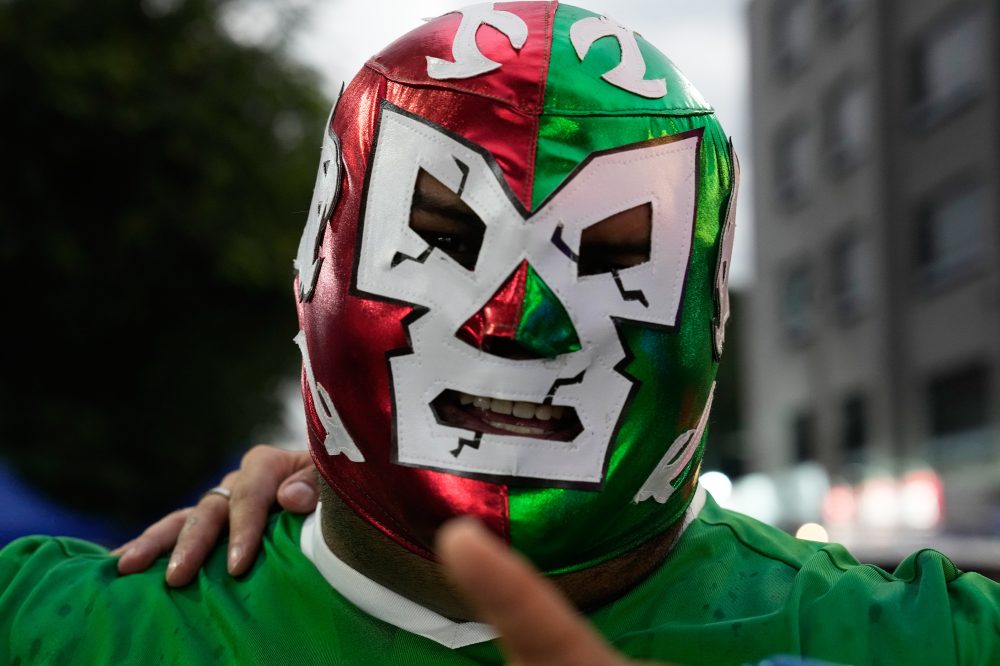

MEXICO CITY — Wherever you look during the World Cup in Mexico, you’re likely to spot one: a masked wrestler wandering near stadiums, mingling at bars, or marching through city streets surrounded by fellow lucha libre enthusiasts. The iconic figure has emerged as one of the tournament’s most memorable symbols.
Visitors from across the globe have been drawn into the spectacle of lucha libre, a sport that — alongside soccer — sits at the heart of Mexican national identity. On the same evening that Spain and Uruguay faced off in a tense World Cup match in Guadalajara, tens of thousands of fans chose a different kind of showdown: a lucha libre card at the legendary Arena México — known as the cathedral of the sport — featuring Místico and Máscara Dorada taking on The Beast Mortos and Sammy Guevara.
“It was simply fantastic, we enjoyed it immensely,” said Andy Winston, originally from Manchester, who has followed England through all three World Cup host nations — Canada, the United States, and now Mexico — bringing his family along for the journey. “You can’t come to Mexico and not come to watch lucha libre. It’s a great tradition, a classic.”
Inside the arena, the crowd was a patchwork of international soccer jerseys — England, Japan, South Korea, Brazil, Colombia, Spain, and Mexico among them — as fans cheered for their favorite wrestlers. “It was a wonderful night, much better than I imagined,” said Henrique Nunes dos Santos, a visitor from Brazil. “You connect with the spectacle in a way that makes it all seem real. … There’s a gigantic energy.”
Lucha libre traces its roots to the early 1900s, blending techniques from American and Greco-Roman wrestling with high-flying acrobatics and theatrical performance. Over time, this combination developed its own distinct identity and became woven into the fabric of Mexican culture. Mexico City officially recognized lucha libre as part of its cultural heritage in 2018.
“Lucha libre is in our roots. For almost 93 years, it has been part of us Mexicans and has also become a calling card for Mexicans,” said Julio César Rivera, a spokesperson for the World Wrestling Council.
Each match is built around the timeless battle between good and evil — with the heroic “técnicos” squaring off against the villainous “rudos,” or bad guys. The sport blends athletics, theater, and tradition, with the colorful masks serving as its most recognizable element. These masks — sometimes bold and vibrant, sometimes fearsome — depict everything from superheroes to animals to mythological figures. Far more than a disguise, each mask represents the wrestler’s alter ego, cultural roots, and power in the ring, carefully crafted to carry deep personal and cultural meaning.
Behind those masks, wrestlers take on secret identities and transform into national icons. Most guard their real names closely, preserving the air of mystery that surrounds the sport.
“Lucha libre is my life,” said Star Black, a 30-year-old wrestler who grew up helping his grandparents sell masks at a small family shop. “I started to fall in love with the masks, the capes, the aerial maneuvers, the moves of lucha libre, and one day I decided to train.” That passion eventually turned him into an idol in his own right.
While lucha libre already attracted tourists before the World Cup, the arrival of the planet’s biggest soccer event has pushed the sport’s visibility to new heights, with masks and spontaneous wrestling moments spilling out well beyond the arena walls.
With costs rising sharply in other parts of the world, Mexico has become a popular base for international fans who travel to other host countries to watch their teams play, according to José Ángel Garfias Frías, a lucha libre expert at the National Autonomous University of Mexico.
“Lucha libre was already popular, but now with the World Cup, the arenas are much more crowded, and we see many tourists there wearing their jerseys and shirts of their respective national teams,” Garfias said.
Outside Mexico’s World Cup venues, masks are nearly as common as national flags, with street vendors selling both side by side. Although FIFA’s security rules prohibit masks inside stadiums, some fans were spotted wearing them anyway. FIFA pointed to its code of conduct when asked about the issue and did not respond to a follow-up question about how the rule is being enforced.
The bond between lucha libre and soccer runs deep, Garfias noted. One well-known example is Argentine soccer player Gabriel Pereyra, who famously donned Místico’s mask after scoring for Mexican club Cruz Azul. In the ring, wrestlers like América Salvaje — a 1970s icon inspired by Club América who wore the team’s colors on his mask — have long bridged the two worlds.
“Lucha libre is Mexico. It’s part of our identity. And it’s as popular as soccer,” said Claudio Díaz, one of many masked figures who hit the streets of the capital to mark Mexico’s second win and advancement to the knockout stage of the tournament.
And while soccer remains the country’s top passion, lucha libre holds a special place for many — drawing devoted fans of all backgrounds to Friday night events week after week.
“I feel that soccer doesn’t represent us Mexicans as much; lucha libre represents us way more,” said wrestler Dragón Legendario. “People from all walks of life come here: from grandmothers to businessmen to the women who run small restaurants — it has all kinds of fans.”