
A Tennessee shooting case involving a white content creator who built an online following through racist provocations has sparked renewed conversations about the boundaries between free expression and public safety in digital spaces.
The incident has highlighted growing concerns about livestreamers who generate income through hateful content, as the distinction becomes less clear between protected speech and the right of individuals to feel secure in public spaces. Within online streaming communities, opinions vary between those who claim unrestricted speech rights and revenue generation, and others who advocate for establishing limits.
Civil rights advocates express concern that financial incentives will only amplify and make racist behavior more commonplace. Regarding oversight, the social media environment often operates without clear governance, typically leaving platforms to police themselves and enforce consequences for offensive and harmful language. However, legal experts note that existing laws governing real-world conduct can override online protections.
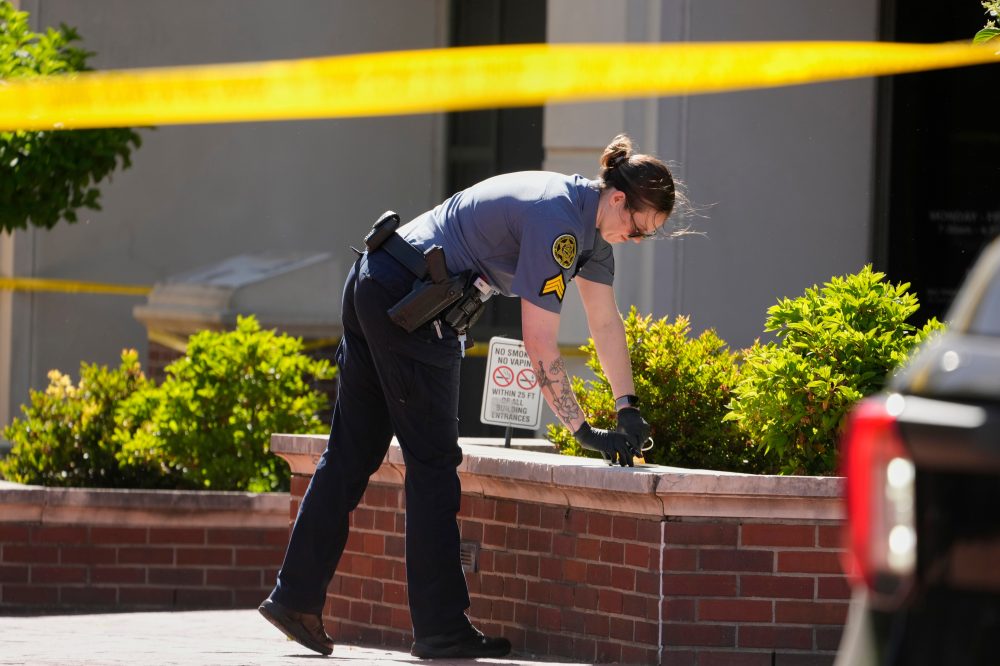
Dalton Eatherly, who uses the online name “Chud the Builder,” faces charges including attempted murder following allegations he shot another individual last week near the Montgomery County Courthouse in Clarksville, Tennessee, according to law enforcement. Eatherly, currently detained on a $1.25 million preliminary bond, has a complete bond hearing set for Thursday.
The 28-year-old Eatherly and the injured party became involved in a “physical altercation that escalated to gunfire,” according to the local sheriff’s department. A bystander described the shooting victim, who sustained multiple gunshot wounds, as Black. Eatherly is white.
In audio recorded immediately following the shooting, Eatherly claimed he fired in self-defense. Whether the individuals spoke before the altercation remains unknown. His legal representative, Jacob Fendley, declined to discuss the charges when approached by The Associated Press two days following Eatherly’s detention.
A digital fundraising campaign for Eatherly collected more than $100,000 in a single day to support his legal costs. He has also justified his video content on the fundraising platform as “mild jokes, unfiltered thoughts.”
Though he has previously justified using racial slurs as “edgy, harmless humor,” Eatherly stated, “I know it’s controversial, but it’s my right to speak freely.”
This situation echoes an event from the previous year when a white Minnesota woman was recorded on mobile video acknowledging she used a racist slur toward a child. She collected over $800,000 on GiveSendGo and similarly cited her First Amendment protections.
The free speech defense lacks validity in these situations, according to the 41-year-old livestreamer and content producer known online as SendaRoni Sloscru.
“When you get to terrorizing and doing all this hate speech, that’s when the line gets drawn, especially when nobody is bothering you,” said Los Angeles-based SendaRoni. “Whatever platform is allowing him to get away with that is basically race-baiting, and I just think in this day and time you got people who are going to laugh at it or people who will beat you to death about it.”
“Race-baiting” material poses immediate danger to Black community members, according to Brandon Tucker, senior director of government affairs for civil rights organization Color of Change. A “power imbalance” exists with livestreamers who draw audiences.
“The same free speech that this individual wants to advocate for doesn’t recognize the chilling of my response to know that I cannot react in any reasonable way because my face, my safety, my family’s safety is in jeopardy and being broadcast to an audience that most likely aligns with this person’s views,” Tucker said.
These platforms cannot maintain neutrality while financially incentivizing users for employing racist language to provoke others, he stated.
Eatherly was broadcasting on Pump.fun, a service where users develop and exchange cryptocurrency tokens. Token developers have utilized the livestream function to attract attention through extreme methods including dangerous activities and violence threats. In November 2024, Pump.fun suspended the feature due to users violating service terms by posting abusive, obscene or dishonest content.
“It’s not clear what was done to improve that situation before it was reinstated,” said Kate Ruane, director of the free expression program at the Center for Democracy and Technology. “If you’re relying on users to report and none of the users that are viewing these livestreams disagree or have a problem with what they’re seeing, you might not be getting the user reports that you should.”
Pump.fun did not respond to an email sent Wednesday requesting comment.
Brandon Golob, a criminology, law and society professor at University of California, Irvine, noted that while livestreaming platforms have multiplied, self-regulation can still resemble ‘the Wild West.’
The First Amendment does not provide complete protection from existing laws addressing harassment, hate crimes and provocation.
“The reality is that when it involves two private individuals, state law is going to govern,” Golob said. “We just want to make sure that we’re not conflating government responsibility or government censorship with private accountability.”
SendaRoni reports he has been livestreaming for several years and maintains “tens of thousands” of followers across multiple social media platforms.
“I usually talk about social issues. I speak on trending events, news,” he explained, noting that numerous livestreamers discussed Eatherly’s behavior after the Clarksville shooting.
“I think he tried to find people he’d get a reaction out of,” SendaRoni said. “When you do things such as that the end results are not going to be exciting. You’re acting like no one has a reason not to be disgusted and you made a mockery of yourself.”
Major livestreaming services including YouTube and Twitch maintain content moderation systems and community standards prohibiting hate speech and slurs. They employ automated detection and user reporting mechanisms.
Both Golob and Ruane recommend people understand their rights when dealing with livestreamers who make them uncomfortable. Ruane suggests it’s acceptable “to film them right back.”
“Make sure that you’re sharing a different version of the story because whatever First Amendment rights they might be exercising, you have them too,” Ruane said. “Make sure that is being published at the same time and that can serve as a form of pushback in and of itself.”