
ATLANTA (AP) — Donald Trump appears unwilling to move past the 2020 presidential race, particularly when it comes to Georgia.
The former president’s persistent false assertions that his loss to Democrat Joe Biden resulted from widespread fraud continue to influence elections in this key swing state. These claims are expected to factor significantly into the upcoming four-week runoff period as Republican voters select their nominees for governor, secretary of state and U.S. Senate.
The candidate field includes one of Trump’s alternate electors from his effort to reverse Biden’s Georgia victory, a Trump supporter who secured his initial congressional seat while claiming Trump actually won in 2020, and a secretary of state candidate who promotes Trump’s conspiracy theories while seeking to become the state’s chief elections officer.
For the record, Georgia’s presidential ballots were tallied three separate times, including one hand recount, with each count confirming Biden’s win.
The primary occurred during ongoing legal and political disputes about election administration in Fulton County — which includes heavily Democratic Atlanta. Trump’s challenges to Georgia’s results and his long-standing criticism of Fulton County elections intensified this year after the FBI conducted a search of the county’s election office, confiscating ballots and documents from 2020.
Initial primary results demonstrated that aligning with Trump, including his election falsehoods, remains politically advantageous within the Republican Party. Georgia candidates who resisted Trump’s 2020 efforts suffered decisive defeats. However, some conservatives express concern that mishandling this issue — or highlighting it too much — might alienate general election voters come November.
“We’re going to look stupid,” cautioned Debbie Dooley, an early tea party organizer who backed Trump from his first presidential campaign’s beginning. “What are you going to say — Trump won, and he was always the president? It serves no purpose.”
She argued Republicans should concentrate on economic issues instead, and any discussion of election processes should focus on “securing future elections, looking forward.”
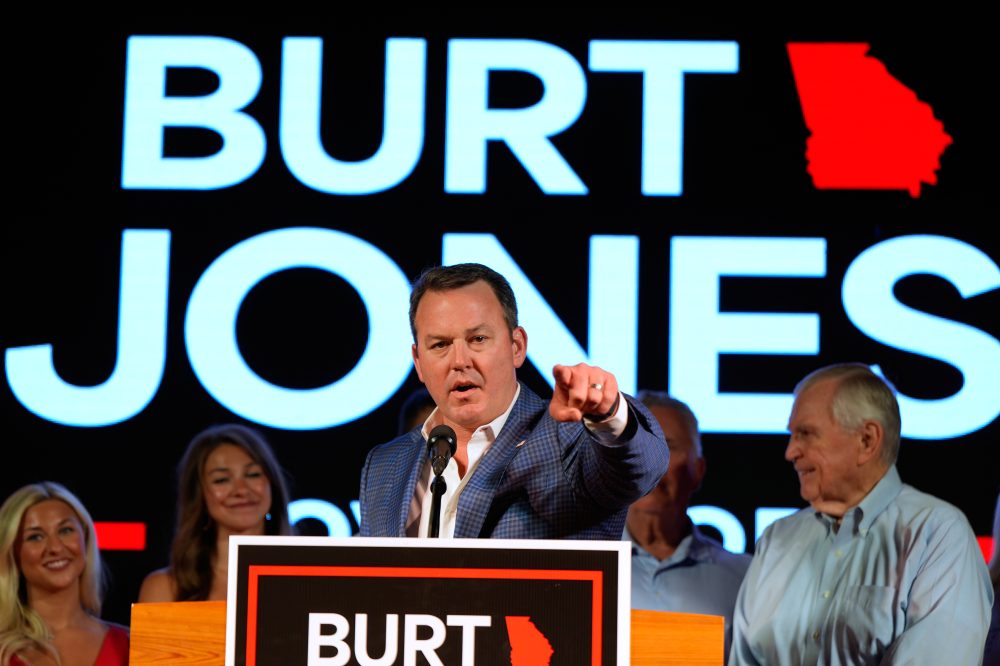
Whether Trump shares this perspective remains unclear. The former president has already backed Burt Jones, one of his 2020 alternate electors, for the governor’s race. Dooley, who supports Jones, said she expects Trump might visit Georgia to campaign — and voice his 2020 complaints once more.
“I don’t know if the president gets it or not,” she remarked.
Jones served as a state legislator in 2020 when he joined Trump’s effort to reverse Biden’s 11,779-vote Georgia margin. He leveraged that allegiance to secure the lieutenant governor position in 2022 and earn Trump’s early backing for his current advancement bid. On Tuesday, he captured approximately 40% of Republican votes.
While Trump and Jones avoid revisiting specifics, Trump has repeatedly commended Jones on his Truth Social platform for his loyalty, while Jones has championed “election integrity.”
Jones’ runoff opponent, billionaire political newcomer Rick Jackson, represents Republicans who rarely discuss the 2020 election. However, he used part of the $83 million he put into his own campaign for an advertisement targeting outgoing Secretary of State Brad Raffensperger, another GOP gubernatorial candidate who refused Trump’s request to help “find 11,800 votes” to overturn Biden’s 2020 victory.
The advertisement showed a child asking his mother about choosing the name Brad. The mother responded that her second option was “Judas” — referencing the New Testament disciple who betrayed Jesus to Roman authorities. The complete name “Brad ‘Judas’ Raffensperger” appeared on screen as the spot concluded.
Raffensperger placed a distant third in this week’s primary, earning only 15% of votes.
Rep. Mike Collins, who topped the Senate GOP primary with roughly 40% of votes, has maintained his false assertions that Biden’s victory was fraudulent, an argument he highlighted during his initial 2022 congressional campaign.
“You count the legal votes that were cast in the state of Georgia, Donald Trump won this state. Period,” he declared in one advertisement, while holding a long gun and criticizing the “federal hijacking” of the 2020 election. He ended by shooting a mock voting machine.
Collins’ runoff challenger, former college football coach and political newcomer Derek Dooley, has been more cautious. Both candidates are pledging loyalty to Trump, though the former president hasn’t endorsed anyone in the race to challenge Democratic Sen. Jon Ossoff.
Notably, Dooley’s primary political supporter is outgoing Gov. Brian Kemp, who like Raffensperger angered Trump in 2020 for certifying Biden’s electors.
Kemp sought and won reelection in 2022, advocating that Republicans should move forward rather than relitigate the 2020 election. Trump eventually reconciled with Kemp during the 2024 presidential campaign, and advisers to both indicate Kemp has discussed the Senate race with the former president.
State Rep. Tim Fleming, a former deputy secretary of state, and former state Rep. Vernon Jones, a Trump loyalist and repeat candidate, received the most votes in the secretary of state race and will compete next month.
Jones, a former Democrat, supported Trump’s “stop the steal” movement and stated during an Atlanta Press Club debate last month, “I stand with those who believe there was election fraud.”
Fleming, who served under Kemp when the governor held the secretary of state position, has cited “irregularities” in the 2020 election — a term used by Republicans who avoid fully echoing Trump while not contradicting him. Fleming said he believes the state has made significant improvements in election procedures since then and wants to concentrate on future elections.
Fleming and Jones significantly outperformed one of Raffensperger’s top assistants, Gabriel Sterling, who gained prominence in December 2020 for asking Trump to help discourage violence threats against election workers. Sterling received 12% of primary votes, finishing fourth.
Trump has consistently focused on Fulton County, claiming it was the hub of Georgia fraud in 2020. The FBI confiscated 2020 ballots and records from county election offices in January, and the county remained a target for Republican criticism through Tuesday’s vote counting.
During voting hours, two polling locations closed for four hours in an Atlanta suburb after police received reports about possible gunfire and a suspicious individual in military-style clothing. Though unrelated to the primary, a judge required the precincts to remain open until 11 p.m. to compensate for lost time, and Fulton officials said legal requirements prevented releasing any results until those locations closed.
State Sen. Greg Dolezal, a Republican lieutenant governor runoff candidate, attempted to exploit the delay, despite seeking an office with no ballot counting or election certification responsibilities.
“Here we are on Election Night, Georgians are anxiously awaiting the results, and which county hasn’t even started reporting? It’s always Fulton County,” Dolezal wrote on social media. “It’s time for Georgia to takeover the process. We will not have another 2020 this November!”