
Eastern Libya’s military commander Khalifa Haftar has obtained what experts identify as Chinese and Turkish combat drones, violating a United Nations weapons embargo that has been in effect since 2011, according to new Reuters reporting.
Satellite imagery reveals at least three unmanned aircraft stationed at Al Khadim airbase, positioned approximately 62 miles east of Benghazi in the desert. The drones appeared at the facility between late April and December, marking the first time their presence has been disclosed publicly.
Three weapons specialists who examined the satellite photographs confirmed that ground control equipment for operating the aircraft remained visible into this year.
During Libya’s civil conflict from 2014 to 2020, drone warfare became a defining feature as Haftar’s Libyan National Army attempted to remove the UN-backed government in Tripoli. Haftar justified his campaign by claiming the western administration was sheltering armed militias and extremist groups, allegations the government rejected.
The conflict drew international involvement, with UAE, Egypt and Russia backing Haftar’s forces while Turkey supported the Tripoli administration, according to UN investigators. China maintained neutrality during the fighting.
Although the opposing sides reached a ceasefire agreement in 2020, Libya continues to operate under divided rule, with Haftar controlling the east and Prime Minister Abdulhamid Dbeibah’s government governing from Tripoli in the west.
Anas El Gomati, director of the Sadeq Institute, a Libyan research organization, described the new drone acquisitions as potentially “a huge symbolic win” for Haftar. The weapons would strengthen his control over eastern Libya and significant southern oil facilities while enhancing his position in talks aimed at establishing a unified national government.
El Gomati suggested the drones could also protect supply routes to Sudan’s Rapid Support Forces militia, though Haftar has rejected claims of supporting that group.
A critical question remains unanswered, according to Gomati, who noted that Haftar’s forces lack the technical knowledge to operate such advanced equipment. “The question remains: who’s operating them?” he told Reuters.
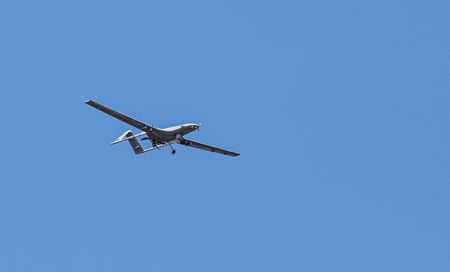
Weapons experts who analyzed the satellite images identified one drone as likely being a Chinese-manufactured Feilong-1, an advanced surveillance and attack aircraft. The remaining two appear to be less powerful Turkish-made Bayraktar TB2 drones, though experts acknowledged other models couldn’t be completely ruled out.
Reuters was unable to determine the source of the drones or their delivery timeline. The Libyan National Army, Chinese and Turkish governments, and the manufacturers – Xi’an-based Zhongtian Feilong and Istanbul-based Baykar – did not respond to detailed inquiries. The Tripoli government also declined to comment.
The news organization could not confirm whether China, Turkey or other UN member nations requested exemptions to supply drones to eastern Libya. The Security Council committee responsible for handling such requests did not answer questions about the aircraft.
The UN peacekeeping department referenced a Security Council resolution from last year expressing serious concerns about ongoing embargo violations. The embargo requires UN approval for all weapons transfers to Libya.
The arms restrictions were implemented in 2011 following a NATO-supported uprising that removed longtime leader Muammar Gaddafi. However, sophisticated military equipment continued flowing into the country during subsequent fighting, with UN monitors noting that Libya became Africa’s first major battlefield for drone warfare.
While current tensions have decreased, evidence suggests both sides are working to strengthen their air capabilities, according to five Libya analysts, weapons experts and UN investigators.
In December, the LNA signed a $4 billion military equipment agreement with Pakistan, including JF-17 fighter aircraft developed in partnership with China, as Reuters previously reported.
Pakistani officials maintained the agreement didn’t violate the embargo, though UN sanctions officials and Pakistan’s foreign and defense ministries haven’t responded to questions about these claims.
The new Chinese and Turkish drones would significantly enhance LNA capabilities following the 2020 removal of Chinese-made Wing Loong II drones that had been stationed at Al Khadim, as documented by UN investigators.
The UAE, viewing Haftar as protection against Islamist organizations, assisted in building LNA air power, including supplying and “most probably” operating the Wing Loong aircraft, according to a 2017 UN panel report.
Abu Dhabi has consistently denied providing military assistance to the LNA. The UAE foreign ministry didn’t respond to questions regarding the new drones.
Turkey provided the UN-recognized government with TB2 drones and air defense systems that helped repel Haftar’s 2020 Tripoli offensive, creating a stalemate that largely continues today.
The air power balance shifted further toward Tripoli in October 2022 when the western government agreed to acquire more advanced Turkish Bayraktar Akinci drones, capable of carrying nearly triple the payload and reaching higher altitudes than Wing Loong II aircraft.
However, Turkish-Haftar relations have recently improved as Ankara seeks to protect economic and energy interests in Libya and secure eastern parliament approval of a controversial 2019 maritime boundaries agreement with western authorities.
Ibrahim Kalin, Turkey’s National Intelligence Organization chief, met with Haftar and his son Saddam in Benghazi last August to explore enhanced cooperation on intelligence and security issues, according to an LNA statement.
Saddam, serving as LNA deputy commander, visited Ankara three times last year for meetings with senior officials including Defense Minister Yasar Guler. Turkey’s defense ministry characterized its LNA engagement as progress toward a “unified Libya.”
Reuters couldn’t establish whether these discussions included drone provisions.
Satellite imagery shows a previously unseen drone type appeared at Al Khadim between late April and July last year, parked outside a hangar on the northern section. The same aircraft also appeared on the runway in a May 3 image from Vantor, a U.S. satellite company, suggesting active use, according to Wim Zwijnenburg, a military technology expert with Dutch peace organization PAX.
While the aircraft’s dimensions and shape resemble a Wing Loong II, the wing configuration suggests it’s more likely a Feilong-1, Zwijnenburg explained. Jeremy Binnie from defense intelligence firm Janes and Joseph Dempsey from London’s International Institute for Strategic Studies agreed with this assessment.
Limited available photographs and lack of previous satellite imagery make definitive identification challenging.
A new protective shelter was constructed in November over the drone’s parking location, which Binnie suggested might explain its absence from later imagery. A truck carrying satellite equipment, likely used for aircraft control, remained near the area as recently as January 12.
Justyna Gudzowska, executive director of watchdog organization The Sentry, said Haftar has apparently sought Chinese military drones for years, citing international law enforcement operations targeting sanctions violations.
Chinese drones were connected to two alleged attempts to smuggle unauthorized military equipment into eastern Libya since 2019, according to U.S., Canadian and Italian investigators.
In June 2024, Italian authorities acting on U.S. intelligence seized drone components traveling from China to Benghazi. UN experts who examined the parts determined they matched components from two Feilong-1 drones, concluding the model falls under embargo restrictions, according to a draft 2025 panel report reviewed by Reuters.
China has disputed the parts’ military classification, previously informing the UN panel they appeared to come from a discontinued model used for emergency rescue and disaster response operations.
Two smaller drones appeared on the same Al Khadim section in a December 17 Vantor image. Their length, wingspan and twin-boom tail configuration match Turkish TB2 drones, said Dempsey, who brought the image to Reuters’ attention.
The model gained recognition when Ukraine deployed them against Russian invasion forces and has been exported to numerous countries, including the UAE.
Defense manufacturers in China, UAE and Belarus have also produced similar-appearing models. However, two ground control units with distinctive double-antenna configurations, visible in satellite imagery between July and March, strongly indicate TB2 operations in the area, all three experts agreed.
California-based Planet Labs satellite images show Al Khadim has undergone extensive renovations since early last year, including addition of at least three new hangars in the area where drones were observed.
Another structure under construction in the analyzed images is likely designed for “stationing and launching of Turkish Bayraktar UAVs,” according to the UN panel’s draft report.
Russian forces, who use Libya as a base for operations across West and Central Africa, maintain a presence at Al Khadim. However, experts who spoke with Reuters don’t believe they’re operating the drones in the imagery.
Baykar CEO Haluk Bayraktar told CNN in a 2022 interview that his company would never provide drones to Russia because “we support Ukraine, support its sovereignty.”
While Moscow is known to use some Chinese-made surveillance drones and components, there’s no record of it deploying fully assembled Chinese combat drones, military expert Zwijnenburg noted.
Russia’s defense and foreign ministries didn’t respond to comment requests.