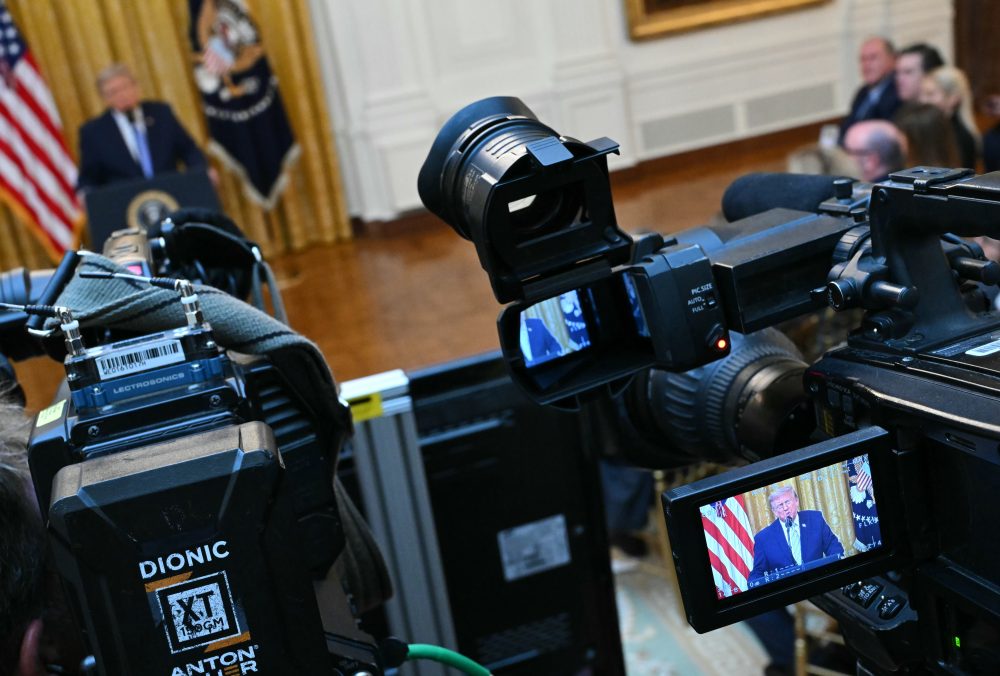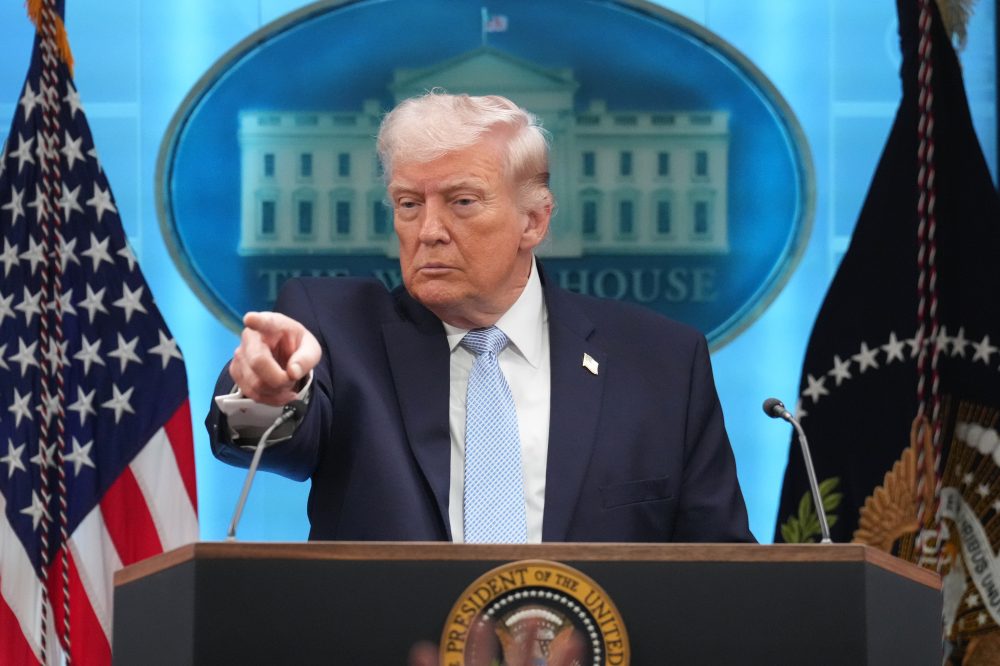

WASHINGTON — Military law experts and international officials are questioning whether President Donald Trump’s recent threats to destroy Iranian infrastructure could violate international law after his broad declarations during Monday’s news conference.
Trump’s warnings to target every bridge and electrical facility in Iran have raised concerns among legal scholars about potential harm to civilian populations, with some suggesting such actions might constitute violations of international law.
The legality of such strikes would depend on several factors, including whether the facilities serve legitimate military purposes, if the attacks would be proportionate to Iranian actions, and whether civilian harm would be kept to a minimum.
Critics argue Trump’s sweeping threats don’t appear to consider the impact on non-combatants, leading Congressional Democrats, United Nations representatives, and military law experts to question whether such strikes would comply with international standards.
While the president’s actual policies sometimes differ from his public statements, his warnings about targeting infrastructure have been clear and direct both Sunday and Monday, as he established Tuesday night as the deadline for Iran to reopen the Strait of Hormuz.
Stephane Dujarric, speaking for U.N. Secretary-General Antonio Guterres, cautioned Monday that striking such infrastructure violates international law.
“Even if specific civilian infrastructure were to qualify as a military objective,” Dujarric said, an attack would still be prohibited if it risks “excessive incidental civilian harm.”
Rachel VanLandingham, who teaches at Southwestern Law School and previously served as a judge advocate general in the U.S. Air Force, warned that cutting power to medical facilities and water treatment centers would likely result in civilian deaths.
“What Trump is saying is, ‘We don’t care about precision, we don’t care about impact on civilians, we’re just going to take out all of Iranian power generating capacity,’” the retired lieutenant colonel said.
Maritime traffic through the Strait of Hormuz, a critical Persian Gulf passage that typically handles 20% of global oil shipments, has nearly stopped, causing oil prices to spike and creating stock market turbulence.
When asked Monday about potential war crimes, Trump said he’s “not at all” worried about such concerns while continuing his threatening rhetoric. He also stated that every power facility will be “burning, exploding and never to be used again.”
“I hope I don’t have to do it,” Trump added.
White House spokeswoman Anna Kelly, when contacted for additional comment Monday, said “the Iranian people welcome the sound of bombs because it means their oppressors are losing.”
“The Iranian regime has committed egregious human rights abuses against its own citizens for 47 years, just murdered tens of thousands of protestors in January, and has indiscriminately targeted civilians across the region in order to cause as much death as possible throughout this conflict,” Kelly wrote in an email.
With the conflict now in its second month, Trump has intensified his threats against Iranian infrastructure, including Kharg Island, which is vital to Iran’s petroleum industry, and desalination facilities that supply drinking water.
In a Truth Social message posted March 30, Trump warned that the U.S. would destroy “all of their Electric Generating Plants, Oil Wells and Kharg Island (and possibly all desalinization plants!), which we have purposefully not yet ‘touched.’”
On Easter Sunday, Trump used profanity in a post threatening Iran would face “Power Plant Day, and Bridge Day, all wrapped up in one,” while adding that “you’ll be living in Hell” unless the strait reopens.
“This strikes me as clearly a threat of unlawful action,” said Michael Schmitt, a professor emeritus at the U.S. Naval War College and an international law professor at the University of Reading in Britain.
According to Schmitt, power facilities can be legitimate targets under military conflict laws if they supply electricity to military installations in addition to civilians. However, the attack must not “cause disproportionate harm to the civilian population, and you’ve done everything to minimize that harm.”
Harm doesn’t include inconvenience or fear, explained Schmitt, who has instructed military commanders. But it does encompass severe mental suffering, physical injury or illness.
Military leaders should explore alternatives, such as hitting substations or transmission lines serving military bases, before destroying entire power plants, Schmitt noted.
“If you look at the operation and you’ve got a valid military objective, but it’s going to cause harm to civilians and you go, ‘Whoa, that’s a lot,’ then you should stop,” Schmitt said. “If you hesitate to take the shot, don’t take the shot.”
Republican Sen. Joni Ernst of Iowa stated Monday that Trump is “absolutely not” threatening war crimes when discussing potential bombing of civilian infrastructure.
The infrastructure also serves military purposes, Ernst noted, and “it’s an ongoing operation.”
“If he needs leverage, he’s using that leverage,” she said while overseeing a brief pro forma Senate session.
However, Democratic Sen. Chris Van Hollen of Maryland, also present for the brief session, called it a “textbook war crime.”
“If you target civilian infrastructure for the purposes the president was talking about, it clearly is a war crime,” Van Hollen said.
Dujarric, the U.N. spokesman, noted that determining whether attacks on civilian infrastructure constitute war crimes would require a court decision.
Katherine Thompson, a senior fellow in defense and foreign policy studies at the CATO Institute, a libertarian think tank, suggested any accountability would more likely come from Congress.
She said believing otherwise would mean assuming the U.S. would allow its president to face accountability from foreign entities.
“This is the persnickety, inconvenient truth about international law: It only works if sovereign nations are willing to cede their sovereignty to a foreign body for accountability,” she said.
However, Congress would need to determine the president has overstepped boundaries. Both chambers would then need to act with sufficient support to override a presidential veto, which is highly unlikely.
Trump also appears to have extensive legal protection under the Supreme Court’s decision in his criminal case before his reelection, VanLandingham noted. The president could also issue preemptive pardons to senior officials if necessary.
Even if technically legal under warfare laws, strikes that harm civilians could damage U.S. interests long-term, VanLandingham warned.
“There’s a lot of violence that can still be justified as lawful, but lawful can still be awful,” VanLandingham said. “How far did that get us in Iraq? How far did that get us in Afghanistan? How far did that get us in Vietnam?”
Trump’s rhetoric risks frightening ordinary Iranians and suggesting the U.S. doesn’t care about their welfare, VanLandingham said. The country’s leadership could use it as propaganda to generate and strengthen opposition, leading to a longer, more difficult war.