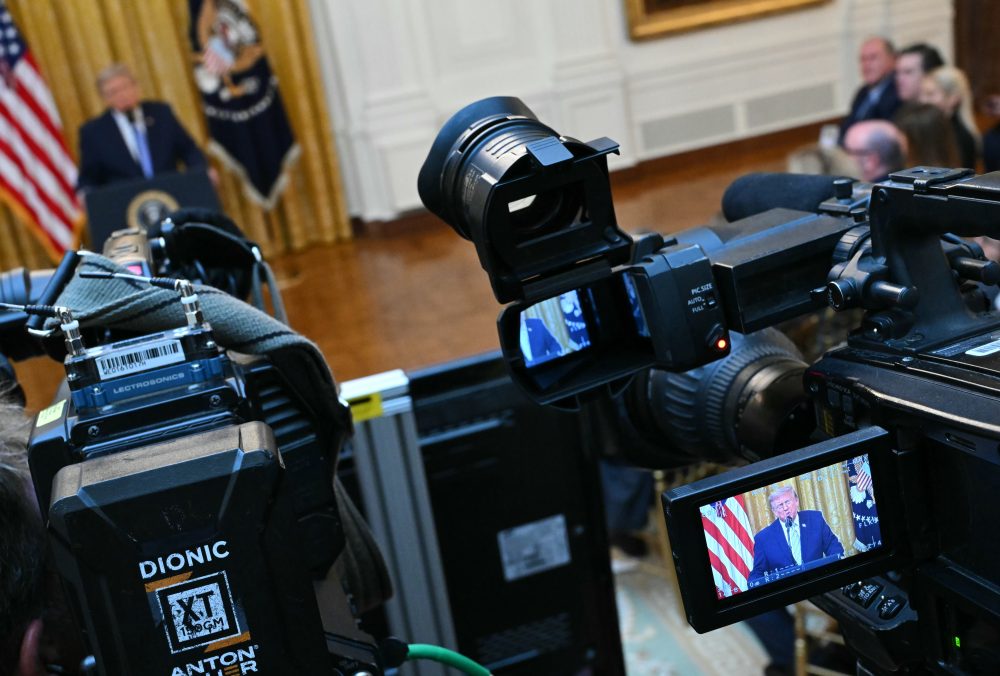

As President Donald Trump threatened sanctions against networks that refused to broadcast his address live Thursday evening, television outlets across the country faced one of their most difficult editorial decisions in recent memory: whether to air the speech at all.
Both broadcast and cable news organizations spent the hours before Trump’s address debating how to handle coverage, trying to strike a balance between informing the public and potentially amplifying what many feared could be false claims about the 2020 elections.
When the dust settled, networks had taken a range of different approaches, though most shared one common thread: fact-checking the president’s remarks in real time, even while he was still speaking.
The decision-making unfolded amid deep and growing friction between the press and a president who has made controlling media coverage a clear priority. Trump used the speech itself to go after networks that declined to carry it live, singling out “NBC and ABC fake news” and claiming they skipped it because they “don’t like the topic.” He then went further, suggesting the networks deserved to be punished for their choices.
“They and others in the media are part of a plot,” Trump said, without providing any evidence to support the claim. It should be noted that there is also no evidence of fraud in the 2020 elections.
“They want to continue this fraud for whatever reason. They want to keep it going,” he said. “Fraud like this should mean a revocation of their licenses. They use our public multibillion-dollar-in-value airwaves for absolutely no money. They pay nothing. All we want is honesty in our elections and honesty in reporting.”
The conflict between Trump and the press during his second term has played out in multiple arenas, including sanctions against White House press corps members, regulatory moves through the Federal Communications Commission, and court battles.
Many networks appeared to finalize their coverage plans at the last minute, announcing decisions just minutes before the 24-minute address began, resulting in a wide variety of approaches.
CNN anchor Kaitlan Collins hosted her regular nightly program rather than airing the speech. “We aren’t taking it live,” she explained, citing the president’s “well-documented history” of making false statements. Analysts were present to offer commentary and fact-checking. Veteran correspondent John King told viewers, “Sadly, we have no choice to be skeptical when this president talks elections.”
Fox News and Fox Broadcasting chose to carry the speech in full. ABC and NBC, however, kept their regular programming running — ABC aired “Press Your Luck” while NBC showed an animal program featuring alligators — though both were prepared to break in if events warranted and aired special reports following the address.
Despite skipping the live broadcast on their main channels, both ABC and NBC streamed the speech live on their digital platforms — NBC News NOW and ABC News Live — along with ABC News Radio. In an era when streaming continues to grow, that approach allowed both networks to effectively cover both bases.
CBS took a different path, pulling a summer rerun of “Georgie & Mandy’s First Marriage” to air a special report anchored by Tony Dokoupil. The CBS broadcast joined the speech already in progress at 9:06 p.m. and cut away before it concluded at 9:23 p.m.
MSNBC began carrying the speech live on host Jen Psaki’s program but switched to analysis and commentary after 17 minutes. Psaki briefly used a split screen, with her on the right side and a muted Trump visible on the left.
By the time the address wrapped up, Fox News was the only major network still airing it live.
Robert Thompson, director of Syracuse University’s Bleier Center for Television and Popular Culture, described the evening as unusual, noting that reporters were quoting and describing the speech while showing very little of the actual footage. Thompson argued that full coverage was the right call — especially if the speech was expected to contain inaccurate statements.
“When the president of the United States makes an announcement that there is going to be a major speech with major information, however cynical we are … I think that is, by definition, important civic news significant to the citizenry,” he said. “It’s the president making the speech, and if the president does what everybody’s worried about him doing, that is a real reason to be covering it, to bear witness on exactly what gets said.”
Earlier in the day, White House press secretary Karoline Leavitt had called on networks to carry the speech live. Fox News Channel’s Sean Hannity also weighed in on his program, calling it “pretty unheard of for a primetime address for a president” that major networks would opt out of live coverage.
However, broadcast networks have passed on live primetime coverage before. They previously declined to air a 2014 immigration speech by President Barack Obama and President Joe Biden’s 2022 democracy address, “Battle for the Soul of the Nation.”
Thursday’s events took place against a backdrop of increasing tension between the media and the current administration. Broadcast networks have been under heightened scrutiny from the Trump-appointed chair of the FCC, Brendan Carr, who has initiated early reviews of licenses for some ABC-owned stations and floated the idea of stripping the popular talk show “The View” of its long-standing exemption from equal time rules.
Trump’s hostility toward news organizations that don’t align with his agenda is nothing new, but during his second term he has escalated those efforts — often using the machinery of the federal government as a tool — both in the courts and in the broader public arena.