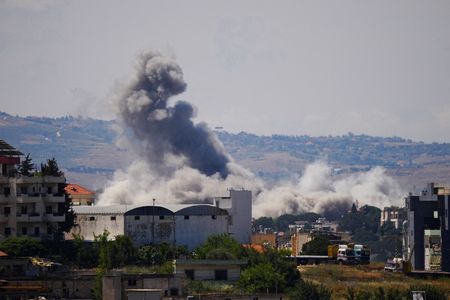

A ceasefire reached last month in Lebanon has provided minimal relief for civilians, as Israeli military operations continue to force residents from an ever-widening area of the country through ongoing air strikes and evacuation directives.
The April 16 truce, facilitated by U.S. negotiators following approximately six weeks of combat, has not succeeded in stopping hostilities between Israeli forces and Hezbollah. Both sides continue launching near-daily attacks while each blames the other for breaking the agreement.
This ongoing conflict has left hundreds of thousands of southern Lebanese civilians without homes. Following the ceasefire announcement, Israeli authorities released a map showing a buffer zone spanning nearly 600 square kilometers that ground forces had taken control of, along with a list of 57 communities where residents had been told to leave.
However, Israeli military forces have since conducted hundreds of air attacks across a much larger region beyond the occupied territory and have issued departure orders for more than 100 additional Lebanese communities, according to an analysis of Israeli military statements.
Combined with the occupied territory, these directives cover approximately 2,000 square kilometers of Lebanon – roughly 20 percent of the nation – most of which has become essentially inaccessible to residents, based on the analysis and conversations with local leaders, humanitarian workers and displaced individuals.
This conflict is connected to broader regional tensions following the October 7, 2023 attacks on Israel led by Hamas. Israeli leadership seeks to push back its adversaries – Iran and allied forces including Hezbollah and Hamas – through a declared strategy of establishing buffer zones along its borders with Gaza, Syria and Lebanon to protect Israeli citizens.
The expanding evacuation zone, combined with uncertainty about continued attacks and the final size of the Israeli buffer area, has created fears among many residents that they may never return home.
“There is no way we are coming back now,” said Iyad Watfi, a mukhtar – elected official – in Bazouriye, who said the town once home to 13,000 people had been hit by multiple air strikes and evacuation orders since the truce. “Last week, we had 20 buildings destroyed in the town in one night.”
Only a small fraction of residents remained, with most others living in tents further north, he explained, noting that few felt secure enough to return anytime soon.
The current Lebanese conflict began March 2 when Hezbollah launched rockets at northern Israel in support of Iran, which was facing Israeli and U.S. attacks. Israeli forces responded with a ground invasion of Lebanon, resulting in fighting that has killed more than 3,000 people and displaced hundreds of thousands, according to Lebanese government figures.
The Israel Defense Forces told reporters that its air campaign in Lebanon following the ceasefire was not intended to displace civilians but rather designed to eliminate Hezbollah threats, accusing the group of positioning forces and weapons in civilian areas. Military officials described the evacuation notices as “recommendations” issued before air strikes, allowing citizens to leave if they choose.
Southern Lebanon “remains an active combat zone where IDF troops continue to engage with terrorist elements on a daily basis,” they added.
Hezbollah’s media office did not respond to requests for comment. The group, a Shi’ite Muslim political and military organization, has conducted regular attacks including kamikaze drone strikes since the ceasefire. The organization has stated that despite the truce, it maintains the right to resist continued Israeli aggression and denies placing military assets in civilian areas.
Reporters contacted mukhtars from 20 communities subject to Israeli evacuation orders since the ceasefire, areas with pre-conflict populations ranging from hundreds to thousands of people. Most estimated the percentage of remaining residents in single digits, saying most had moved north or to the coastal cities of Tyre and Sidon.
“People’s nerves are shattered. They can’t take it anymore so they left,” said Ali Nazzal, a mukhtar in Srifa who said the village was virtually deserted. “The ceasefire is a lie.”
The situation appears increasingly dire for Lebanese civilians. Israeli Prime Minister Benjamin Netanyahu announced Monday that Israel would intensify its strikes, causing residents to evacuate southern suburbs of Beirut, further north. Israeli forces have since issued additional evacuation orders, covering more than a dozen new communities and declaring a large southern section a “combat zone.”
The continuing conflict could affect broader U.S.-Israeli tensions with Iran, as Tehran demands an end to Israeli attacks in Lebanon as a condition in peace negotiations.
On March 31, Netanyahu announced his country’s occupation area in Lebanon would extend to the Litani River, approximately 30 kilometers north of the Israeli border. He characterized it as “a vast buffer zone” to prevent anti-tank fire and invasion threats.
By the April 16 ceasefire, Israeli forces had occupied only about half that area. However, the subsequent wave of air strikes and evacuation orders has forced people from areas well beyond the river. Only about half the communities subject to evacuation orders since the ceasefire are south of the Litani, with the remainder north of the river, some more than 20 kilometers from the waterway, the analysis found.
On May 12, Israeli military officials said they had attacked more than 1,100 targets since the ceasefire, including weapons storage facilities, launchers and Hezbollah operational sites. Reporters identified locations of more than 300 strikes during the first month of the ceasefire by reviewing reports from Lebanon’s state news agency.
An examination of nighttime lights data from the satellite-based VIIRS sensor, conducted by Professor Hadi Jaafar at the American University of Beirut, revealed a significant decrease in light emissions across south Lebanon since the conflict began. Light levels have remained reduced in some areas during the ceasefire, strongly indicating that many displaced residents have not returned, Jaafar said.
Israeli forces have used explosives and bulldozers in demolitions that effectively eliminate many villages in the 600 square kilometer zone occupied by ground forces before the ceasefire, after the defense minister promised March 31 to destroy “all homes” near the border.
In areas outside Israeli occupation, many residents attempted to return during the ceasefire but were forced out again, often within days, by renewed evacuation orders and air strikes, according to local officials, displaced people and aid workers.
Hawraa Yousef Ghadbouni, 39, said she fled from the southern town of Qlaileh to the coastal city of Sidon after the latest conflict began March 2, sleeping in a car with her husband and three children.
After the ceasefire, they returned and found their home partially standing, with two rooms still intact, amid destroyed houses and shops. Within a day, shelling and air strikes forced them to flee again, this time to the coastal city of Tyre, about 10 kilometers north. When Tyre was also bombed, they returned to Sidon, taking shelter in a school converted to a refuge center.
“We want to return, even if we have to sleep on the ground,” Ghadbouni said. “What matters is going back. Life here is not sustainable.”
In the town of Bedias, about a half-hour drive north of Qlaileh, Wael al-Amin, a 48-year-old medic, was sitting outside his brother’s home on May 10, drinking coffee and watching his children play despite the steady buzz of a drone overhead.
“I thought, ‘Let them play’,” he said from a hospital in Tyre. “These are children. Who would target them?”
Moments later, a blast tore through his brother’s house, sending a cloud of debris into the air. Amin stumbled through the smoke until he found his eight-year-old son, wounded amid the rubble.
“He told me, ‘I’m here’,” he said.
Amin pulled the boy to safety before discovering that his brother had been killed in the strike.