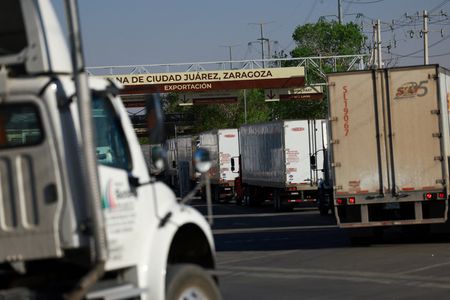

American and Mexican trade officials kicked off formal negotiations Thursday in Mexico City aimed at revising the North American trade agreement, with Washington pushing for tougher regional content standards that would include specific U.S. minimum requirements for vehicles manufactured in Mexico.
According to two sources with knowledge of the American negotiating stance, the proposed changes to the U.S.-Mexico-Canada Agreement (USMCA) include this new automotive standard, though the exact percentage being sought remains undisclosed.
The modification represents a notable departure from the current USMCA framework. The existing six-year-old agreement, along with its predecessor, has fostered a deeply interconnected regional marketplace that supports approximately $1.6 trillion in annual three-way commerce. However, the pact’s continuation depends on the outcome of negotiations scheduled over the next several months.
Under present rules, North American-manufactured vehicles must contain 40% to 45% of their value from higher-wage production facilities, primarily those in the U.S. or Canada. This requirement applies to essential components such as engines, transmissions, body panels and chassis parts.
The current negotiations deliberately exclude Canada, with American and Mexican representatives planning three separate bilateral discussion rounds extending through late July, according to Wednesday’s announcement from the U.S. Trade Representative’s office. The present round of talks in Mexico City concludes Friday.
U.S. Trade Representative Jamieson Greer expressed his intentions Tuesday to enhance North American content regulations to strengthen American manufacturing capabilities.
“I think that over the course of these negotiations, we are going to be talking about rules of origin in a way that enhances U.S. content in these goods,” Greer said.
The discussions face additional complexity due to the Trump administration’s worldwide tariffs of 25% on automobiles and automotive components, plus 50% on steel, aluminum and copper, effectively terminating three decades of tariff-free North American commerce.
Greer indicated Washington plans to maintain some tariffs on Mexican and Canadian industrial products, though potentially at reduced rates.
Dan Ujczo, an attorney with Canadian oil and gas producer Cenovus Energy who focuses on North American trade matters, remains hopeful that the U.S. and Mexico, and ultimately Canada, can resolve their disagreements to update and extend the trade agreement with enhanced regional content standards and increased protections against non-market economies like China.
“The end game continues to be that Canada and Mexico have to be able to walk away with the most preferential access to the United States of any countries in the world in the medium term to long term,” Ujczo said.
Barry Zekelman, CEO of steel tube manufacturer Zekelman Industries, revealed that steel producers were informed Wednesday that USTR negotiators will advocate for requiring Mexican and Canadian steel receiving preferential American tariff treatment to be melted and poured within North America.
No such provision exists in the current USMCA, and Zekelman explained to Reuters that this change would curtail the influx of Chinese steel components entering Mexican manufacturing facilities.
According to Zekelman, USTR also seeks Mexico’s agreement to align with American tariffs on steel imports and steel-derivative products from nations outside North America.
“What they’re going to do now is start to close all of the loopholes that still exist,” he added.