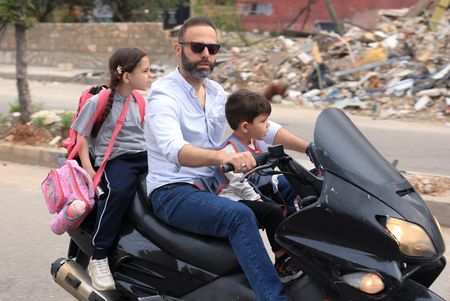

QASMIYEH, Lebanon – Children waved victory signs from car windows Friday as families traveled across a hastily-built temporary crossing over the Litani River, returning home after a ceasefire agreement with Israel brought an end to six weeks of intense conflict.
The journey home revealed the devastating toll of war, with approximately 25% of Lebanon’s population having been displaced from southern regions and other areas with large Shiite Muslim communities. Israeli forces had ordered evacuations while conducting military operations that destroyed entire neighborhoods and villages.
Israeli officials maintain their military actions targeted only combatants in what they called essential operations to defend Israeli citizens from attacks by Hezbollah, the Iran-supported Shiite organization based in Lebanon.
Thursday’s announcement of a 10-day pause in hostilities has provided hope for families eager to assess damage to their properties, though many are praying the temporary truce will become permanent.
However, thousands of residents face the reality that they cannot return home – either because their houses no longer exist or because Israeli forces continue to occupy their areas.
Among the returning families, the Halabis navigated crowded coastal highways to cross the Litani River, where Israeli forces had destroyed the final bridge connecting southern Lebanon to the rest of the country just one day earlier.
Construction crews worked throughout the night using heavy machinery and floodlights to create an earthen crossing where the destroyed bridge once stood, its mangled steel remains visible nearby.
What normally would have been a one-hour drive stretched to 10 hours as the family made their way through massive debris piles into Tyre, an ancient Lebanese coastal city, seeking to reunite with relatives.
‘These are the first two children to arrive – my son’s children,’ said Sobhi Halabi, 80, embracing his grandchildren as they entered his apartment, which displayed family photos alongside images of Hezbollah leadership.
Many returning residents encountered heartbreaking scenes of destruction. Collapsed buildings left streets unrecognizable, while memorial posters honoring local fighters killed in combat with Israeli forces covered remaining walls.
The most shocking evidence of warfare appeared early in many families’ journeys as they passed through Beirut’s southern districts.
Destroyed and burned vehicles filled roadways alongside wreckage from targeted structures. Some buildings had their facades completely blown away by airstrikes, exposing interior rooms like oversized dollhouses.
In Nabatieh, among Lebanon’s most severely damaged towns, resident Fadel Badreddine struggled to comprehend the extensive destruction surrounding him. While other families drove past carrying mattresses and personal belongings, he concluded that he, his wife, and young child could not remain.
‘We’re gathering our belongings and departing once more,’ he explained. ‘May God provide us comfort and bring this situation to a complete conclusion – not just temporarily – so we can truly come home.’
Lebanese officials report that more than 7,000 residential units in Nabatieh alone have suffered destruction or significant damage.
Some displaced families have chosen not to attempt returning home yet. Kodor Mouzannar, 62, originally from the southern village of Souaneh, has spent the conflict living in a blue tarp shelter at Beirut’s Camille Chamoun Stadium.
‘The village represents my home, where I was born, and holds tremendous meaning for me. It contains my childhood, my existence, my grandparents, my family, and my community. I long for all of them. We share deep bonds,’ he shared.
Despite his desire to return, Mouzannar doubts Israel will honor the ceasefire agreement and cease bombing operations. Following a previous truce in 2024, Israeli air attacks resumed in southern areas as both sides accused the other of violating the agreement.
He also recalls the challenges his family faced finding accommodation in Beirut when the conflict began. They spent two nights sleeping in their vehicle while waiting for shelter space and worry about experiencing similar hardships if they return home to find it destroyed and must flee again.
‘I wish for the ceasefire to hold and for conditions to stabilize so people can return to their homes. But only under the condition that they can actually live in their homes – without facing the daily risk of someone going to work and being killed,’ he stated.