
The head of pharmaceutical company Eli Lilly believes that popular weight-loss medications will eventually serve only around half of Americans who could benefit from them, citing healthcare system barriers and financial obstacles.
David Ricks, CEO of Eli Lilly, shared this projection during a Washington conference on Friday, noting that currently just one in ten overweight or obese individuals are using GLP-1 medications.
“It’s never going to be a hundred,” Ricks explained. “For institutional reasons in healthcare and some other complexities in managing health, it’s never going to be that high.”
The executive drew comparisons to cholesterol-lowering statins, which despite being affordable and widely available, are used by only 40-50% of patients who would benefit from them. “Between 40 and 50% of people who should be on them, are on them. I think of that as maybe a ceiling,” he said.
Eli Lilly and competitor Novo Nordisk are battling for dominance in the rapidly expanding GLP-1 market, which industry experts predict could exceed $100 billion annually within the next ten years.
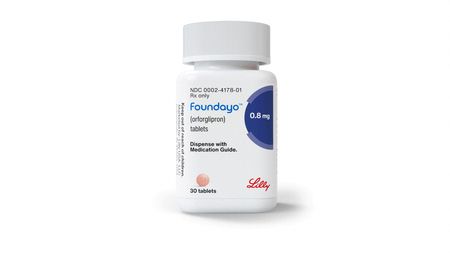
Lilly’s newest oral weight-loss medication, Foundayo, generated 1,390 prescriptions during its debut week in the United States, according to industry data from IQVIA. This compares to Novo’s competing oral medication Wegovy, which recorded 3,071 prescriptions in its first four days after launching in January.
Manufacturing capacity presents another significant challenge, according to Ricks. He estimates that serving 50% of potential candidates worldwide would mean treating approximately 500 million people.
“Today we’re treating 21 or 22 million,” the CEO said. “So, can we basically 20-fold that production? Not anytime soon.”
“It will take a long time to do that. There is no real efficiency gain left, we’ve just got to put in more units of capacity. And we will do that, but that capex rollout is expensive and slow,” he said.
Cost remains a major barrier for many patients interested in these treatments. Monthly expenses for GLP-1 medications range from $149 to $349 for those paying out of pocket, making them unaffordable for many Americans.
Obesity medicine doctors told reporters that patients are particularly interested in pill forms as more affordable, injection-free alternatives to medications like Lilly’s Zepbound.
Ricks acknowledged the affordability crisis, stating that access has historically been limited to those with financial means. “The history has been, it’s really been for people with means and not for people without means,” Ricks acknowledged, “and I think we need to change that.”
“I think it’s a moral imperative, but also it’s a cost imperative. Obesity flows with poverty,” Ricks said.