
JDEIDEH, Lebanon (AP) — Rev. Maroun Ghafari never imagined he would spend this Holy Week away from his home parish. For years, the priest delivered Easter messages to his congregation in Alma al-Shaab, a Christian village in southern Lebanon close to the Israeli border.
Now he stands before worshippers in a Beirut suburb, speaking next to a cardboard replica of his actual church in Alma al-Shaab, which has become trapped in the ongoing battle between Israeli military forces and Hezbollah militants.
The conflict that began last month between Israel and the Iranian-supported Hezbollah organization — part of the broader regional tensions involving the U.S. and Iran — has resulted in more than 1,400 deaths in Lebanon and forced over one million residents to abandon their homes.
Thousands of Christians from the conflict zone in southern Lebanon are among those who have been uprooted. These families now find themselves separated from the historic churches where their communities have worshipped for generations, maintaining their faith through Byzantine, Arab and Ottoman rule, as well as numerous contemporary conflicts.
Lebanon’s Christian population represents approximately one-third of the nation’s 5.5 million residents. With twelve different Christian denominations, Lebanon has the highest percentage of Christians among all Arab nations.
Christian communities that remained in southern Lebanon, defying Israeli evacuation orders for the region, have become increasingly isolated as intense fighting surrounds their villages.
While residents of Alma al-Shaab had been displaced during the 2024 Israel-Hezbollah conflict, they were determined not to abandon their homes again this time, even as air attacks moved progressively closer to their village.
The community took shelter inside their church as Israeli aircraft bombarded extensive areas of southern and eastern Lebanon, while Israeli ground forces intensified their invasion and Hezbollah continued launching rockets toward Israel.
During his Easter address, Patriarch Beshara al-Rai of Lebanon’s Maronite Church criticized both Hezbollah and Israel for the devastation caused by the ongoing war.
“The country is going through a critical situation due to Iranian interference through Hezbollah and Israeli aggression,” he said. “Our hearts bleed for the victims of the conflict imposed on Lebanon.”
Among those who took refuge in the Alma al-Shaab church was Sami Ghafari, the 70-year-old brother of Rev. Maroun Ghafari.
However, he briefly left the church on March 8 to care for his garden and was fatally struck by an Israeli drone attack. His death convinced the remaining villagers — including his brother — to gather their possessions and leave.
United Nations peacekeepers in the region — the UNIFIL force that has supervised the area for nearly fifty years — transported them to northern Beirut suburbs.
“We wanted to stay, but it was always possible that one of us could be targeted or killed at any moment,” Rev. Maroun Ghafari told The Associated Press from St. Anthony Church in the northern Beirut suburb of Jdeideh, where displaced residents from Alma al-Shaab gathered for Saturday worship.
“Everyone is tired, and we see that war brings nothing but destruction, death and displacement.”
Lebanese Christians traditionally observe Holy Saturday — the day between Good Friday, which honors the crucifixion and death of Jesus, and Easter Sunday, which celebrates his resurrection according to Christian scripture — by visiting the burial sites of deceased family members.
This year, displaced Christians can only remember from a distance.
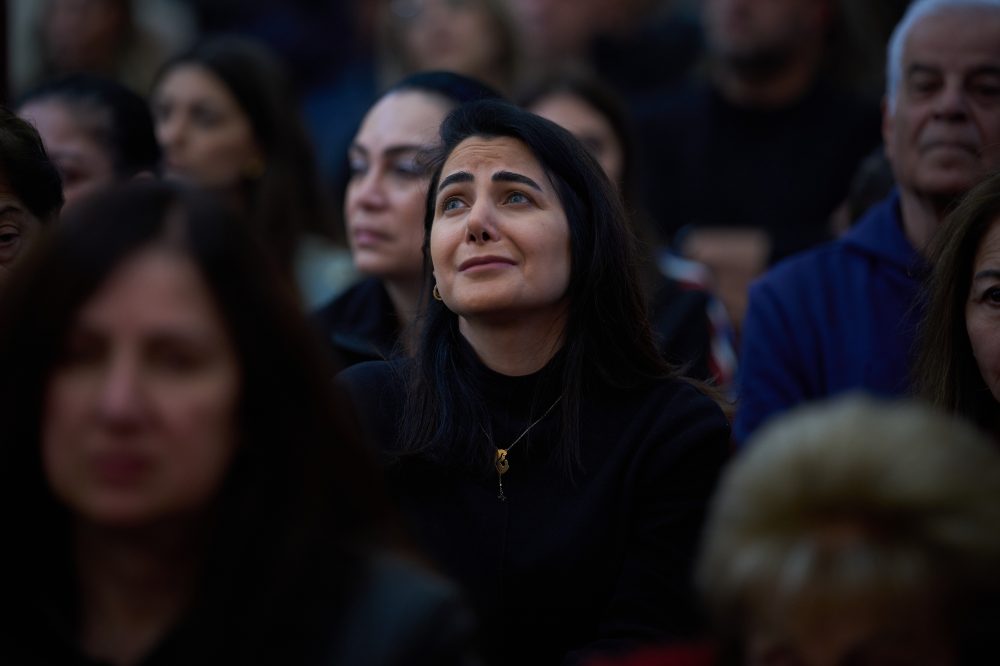
Nabila Farah, wearing black clothing for the Saturday service at St. Anthony Church, was among the final residents to evacuate Alma al-Shaab. She remains devastated one month after leaving.
“You miss the smell of home, the lovely traditions and customs, the sounds of the bells of three churches ringing,” she said, recalling her village. “As much as we experience the Easter atmosphere here, it will never be as it is over there.”
Those who have stayed behind encounter different difficulties.
Marius Khairallah, a priest in the southern Lebanese city of Tyre, where much of the Christian population has remained, explains that he and his parishioners are staying “not out of stubbornness, but out of a sense of mission, to remain alongside their fellow faithful, as witnesses.”
“A significant number of parishioners have been displaced or are absent,” he said. “Yet churches still open their doors. Prayers are still raised — even with fewer voices.”
Christians in the area are growing increasingly concerned as the Lebanese military — which attempts to remain neutral in the Israel-Hezbollah conflict — withdraws from portions of southern Lebanon, leaving them vulnerable to Israeli forces advancing further into the territory.
St. Antony’s lead priest, Rev. Dori Fayyad, used his Good Friday message to acknowledge the war’s expanding impact on southern Lebanese Christians, as congregants recited prayers in Arabic and Syriac, a form of the Aramaic language that Jesus spoke.
“Today, you understand what the cross means, not as an idea, not as a concept, but because you are going through it,” he told the packed sanctuary, with the crowd so large that many people had to stand or sit on the rear steps.
Some worshippers shed tears as Fayyad individually mentioned the southern churches, represented by the cardboard displays beside the altar.
“These churches in these villages are not only places of worship,” he said. “They are silent witnesses to suffering and to faith.”