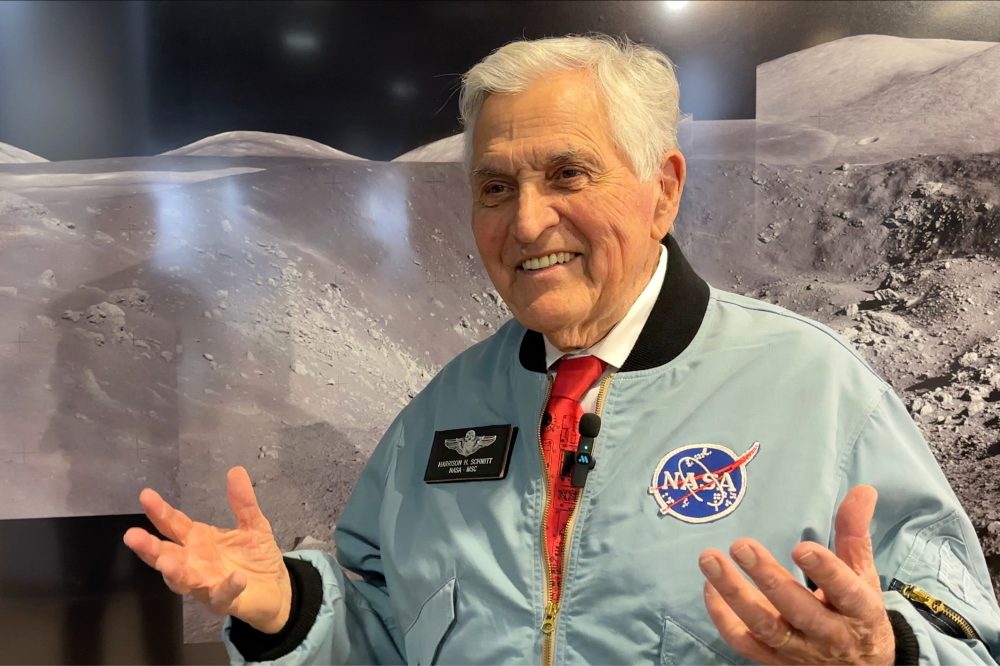

ALBUQUERQUE, N.M. — Back in 1972, when Apollo crew members Harrison “Jack” Schmitt and Eugene Cernan touched down on the lunar surface to gather rock and dirt samples, they were making history as the final moon mission of that era.
Even then, Schmitt was thinking ahead to future generations. Speaking through crackling radio transmissions to his fellow astronaut and mission controllers back on Earth, he issued a challenge.
“Well, I tell you Gene, I think the next generation ought to accept this as a challenge. Let’s see them leave footsteps like these someday,” Schmitt said.
Now 90 years old, Schmitt remains one of just four surviving Apollo astronauts who walked on the moon. As a field geologist, he became the first scientist to explore the lunar surface, and his scientific background proved crucial in understanding the moon’s origins and what those discoveries reveal about our solar system.
The veteran astronaut experienced renewed excitement watching the Artemis II crew launch on their recent historic lunar flyby mission. He remains optimistic about new generations returning to the moon and venturing even further into space.
During a recent Associated Press interview, the former New Mexico U.S. senator discussed topics ranging from establishing a lunar base to harnessing new energy sources and whether humanity is alone in the cosmos. He touched on dark matter and quantum entanglement, emphasizing that countless discoveries await us.
“You’ve just got to remember,” he said, “what used to be called supernatural probably should be called unknown physics.”
Schmitt believes establishing a lunar base makes perfect sense for multiple reasons, with geopolitical considerations being paramount. Having a presence in deep space serves as preparation for eventual Mars missions.
The moon contains resources that would significantly reduce Mars mission costs while providing valuable experience. He emphasizes that each new generation must gain both psychological and practical experience working in deep space. The Artemis II mission was particularly valuable because it gave ground personnel and Mission Control real-world experience rather than just simulations.
Schmitt brought extensive knowledge from previous crews and early sample analyses to his mission in the geologically complex Taurus-Littrow valley. This location extends deeper than the Grand Canyon, offering three-dimensional geological features unavailable on earlier missions. Having a field geologist aboard meant more efficient sample collection that could advance understanding of lunar origins and the moon’s relationship to both Earth and solar history.
The moon serves as a historical record of our solar system’s 4.5-billion-year evolution, providing a vast library of knowledge about solar system development and the sun’s activity over that timespan.
Schmitt’s recent research into the lunar debris layer reveals that increased solar activity coincided with an explosion of ocean life on Earth. The warming oceans likely supported this life expansion, leading to greater quantity and diversity, the emergence of mammals, and life’s migration to newly formed continents approximately half a billion years ago.
Lunar samples include titanium-rich basalt lava, similar to formations found in New Mexico but with higher titanium content. This titanium concentration proves crucial for lunar resources, particularly hydrogen and helium.
An isotope called helium-3 could become extremely important for energy production, quantum computing, and cancer therapy applications on Earth. Since Earth has limited helium-3 supplies, the moon could serve as our primary source for this valuable isotope.
Helium-3 offers the possibility of nuclear energy without nuclear waste, a concept scientists have understood for decades. The moon now presents an opportunity to develop this clean nuclear energy alternative.
Both China and the United States show interest in helium-3, making it a significant technological driver in the current space race and Cold War dynamics primarily involving China.
Working on the moon proved surprisingly comfortable for Schmitt. Despite being in a valley deeper than the Grand Canyon with equally high surrounding mountains, the one-sixth gravity made movement much easier than on Earth. Even wearing a pressure suit, walking felt like being a child again, with minimal impact from falls.
The moon provides an easy working environment with proper equipment and life support systems. Schmitt found himself getting somewhat lazy in the low gravity, able to let objects float while performing other tasks. However, this mental adaptation caused problems upon return to Earth, such as dropping a water cup on the aircraft carrier after splashdown. It took about three days to readjust to Earth’s gravity.
Long-term lunar living appears very feasible, though establishing permanent civilization would require addressing radiation concerns through available protective methods. Mars missions present different challenges, likely requiring fusion rockets to reduce travel time.
Given billions of sun-like stars in the universe, Schmitt believes life could statistically have originated elsewhere, though Earth’s life-supporting conditions are truly unique. The precise alignment of factors suggests involvement of an infinitely intelligent creator.
Regarding potential alien visitation, Schmitt remains skeptical. If advanced beings could reach Earth, he believes they would communicate more effectively than current evidence suggests. While he considers it plausible, he finds it unlikely.
Schmitt would eagerly travel to Mars, with one condition: his wife Teresa would accompany him. He believes Mars missions will prove fantastic for future explorers.
Youth education, particularly in mathematics, remains extraordinarily important for space exploration. NASA has become younger since the shuttle era, and the commercial sector has developed new technologies and approaches that NASA is integrating into deep space exploration strategies.