
IRBIL, Iraq (AP) — Turkey has effectively put peace negotiations with Kurdish militants on hold, according to a senior commander who spoke out Thursday about the stalled diplomatic efforts.
The militant leader, along with another official from his organization, claims Turkey’s government has not followed through on necessary legal and political changes required to advance the peace process. These accusations contradict recent positive remarks made by Turkish President Recep Tayyip Erdogan about the negotiations.
In an interview with the PKK-affiliated ANF news service, Murat Karayilan, who helped establish the Kurdistan Workers’ Party (PKK) and serves as one of its top commanders, stated his organization has made significant commitments to the peace efforts, including implementing a ceasefire and ending military operations.
“The process is currently frozen. That’s what we’ve been able to see and what has been reported to us,” ANF quoted Karayilan as stating. “We, as a movement, have fulfilled our responsibilities at this stage. It is clear that we have done everything necessary for the government to take action.”
Turkish officials have not yet responded to Karayilan’s statements.
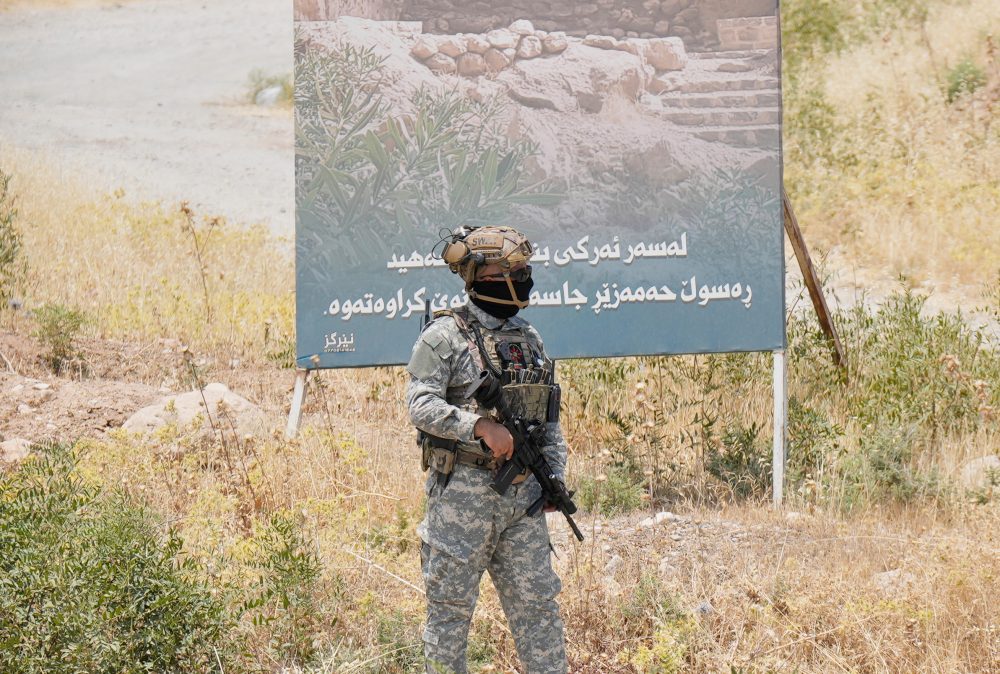
In the previous year, the PKK announced it would surrender weapons and dissolve following instructions from its jailed leader, Abdullah Ocalan. The organization conducted a ceremonial weapon surrender in northern Iraq and subsequently moved fighters from strategic Turkish positions back to Iraq.
A Turkish legislative committee proposed various reforms this year to support the peace initiative, including allowing former PKK members who reject violence to rejoin society. However, the committee emphasized that legal measures should depend on security agencies confirming the group has given up its arsenal.
According to Karayilan, Turkish government and ruling party representatives had designated April as when parliament would receive legislation to move the process forward. That timeframe has elapsed without any proposed law being submitted.
He criticized Turkey’s government for not implementing fundamental measures the committee suggested, such as freeing imprisoned opposition leaders and activists.
Ocalan continues to be incarcerated. Karayilan explained that the PKK’s 12th Congress decision to cease fighting and disband was conditional on Ocalan directly overseeing the disarmament process, which means the group’s internal authorization cannot proceed while their leader stays imprisoned.
Zagros Hiwa, who speaks for the Kurdistan Communities Union, a political group connected to the PKK, told The Associated Press separately that his organization had implemented multiple measures following Ocalan’s instructions. However, Hiwa noted that Turkish military forces remain active in northern Iraq, government-appointed officials still hold positions meant for elected Kurdish mayors in Turkey, and thousands of Kurdish and Turkish political detainees remain behind bars.
“The Turkish state has taken no legal and political steps towards peace and has been continuing war-time policies under new rhetoric,” he stated, noting that Ocalan remains in isolation on Imrali island near Istanbul, where he has been held since his 1999 capture.
Hiwa claimed Turkey’s government is “instrumentalizing” the negotiations to strengthen the ruling party’s control and improve its electoral prospects, rather than pursuing genuine resolution.
“What happens next totally depends on the attitudes of the Turkish state,” Hiwa stated, warning the deadlock could have “precarious implications.”
The PKK officials’ claims that peace efforts have reached an impasse conflict with Erdogan’s recent remarks to his party’s lawmakers, where he described the peace efforts as progressing positively.
“The process is proceeding as it should,” Erdogan stated. “Those who write pessimistic scenarios about the process are acting entirely on their delusions, not on facts.
Since 1984, the PKK has conducted an armed rebellion that has resulted in tens of thousands of deaths and extended into neighboring Iraq and Syria. Turkey, the United States, and the European Union classify it as a terrorist organization.
The organization originally pursued an independent Kurdish nation but later modified its goals to seek autonomy and greater rights within Turkey.