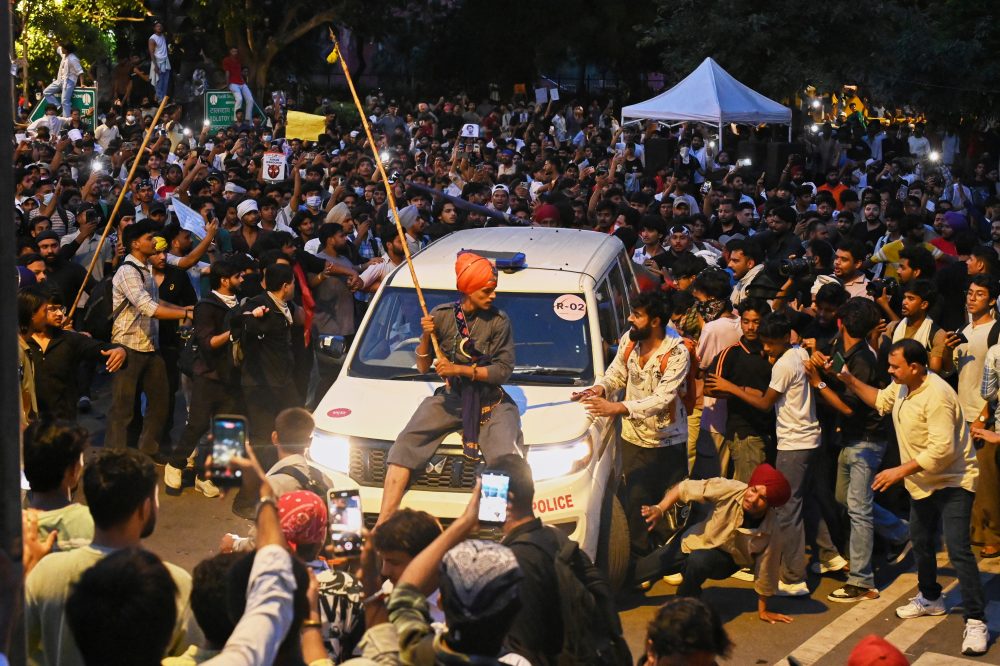

NEW DELHI (AP) — Thousands of young demonstrators set up camp on the streets of India’s capital Thursday, pushing back against new restrictions in what has become one of the most significant challenges to Prime Minister Narendra Modi’s administration.
Known as the “Cockroach” protests, the movement began more than a month ago in response to alleged leaks in some of India’s most competitive entrance exams — tests that determine entry into medical schools and government positions. Over time, the movement has grown well beyond those original concerns, attracting working professionals and families who share a broader sense of frustration with the government.
Thursday’s gathering at Jantar Mantar, a designated area for public demonstrations in New Delhi, came after overnight clashes in which police deployed tear gas and batons against crowds. It marked the second such confrontation in a single week. Earlier on Monday, thousands of protesters had ignored restrictions and attempted to march to Parliament before authorities dispersed them using the same tactics.
By Thursday morning, demonstrators had reorganized and returned to the protest site despite roadblocks set up by authorities. In an effort to reduce access to the demonstrations, officials suspended Delhi Metro service at 16 stations throughout central New Delhi.
The controversy surrounding exam leaks has struck a nerve with millions of young Indians. Demonstrators are calling for the resignation of Education Minister Dharmendra Pradhan, demanding reforms to the examination system, and seeking compensation for families of students who died by suicide following the paper leaks.
Facing growing pressure, Modi publicly addressed the issue for the first time on Thursday, announcing plans to establish fast-track courts — special courts designed to move cases through India’s notoriously slow legal system more quickly — to handle exam leak cases. “Nothing is more important than the welfare and future of our youth!” Modi wrote on X.
Leaders of the Cockroach Janta Party, the group behind the protest movement, made clear they have no intention of standing down until the education minister steps down. In keeping with the movement’s irreverent style, founder Abhijeet Dipke responded to Modi’s announcement by sharing a meme featuring Pradhan with the caption, “Hi, my name is Nothing.”
The Cockroach movement first emerged as an online satire campaign in May before moving into the streets in June with smaller demonstrations across various cities. It gained significant momentum when prominent activist Sonam Wangchuk joined the cause and launched a hunger strike that has now stretched beyond three weeks. Police forcibly removed Wangchuk to a hospital over the weekend.
For many young Indians, the protests represent one of the few visible opportunities to voice dissent in a political climate where demonstrations against Modi’s government have triggered a wider crackdown on activists, opposition figures, and public gatherings.
The movement’s rapid expansion beyond student groups reflects a deep well of frustration among young Indians and mirrors a broader pattern seen across South Asia, where young people have increasingly driven anti-government movements in recent years.
The protests have also attracted support from Indians of all ages, with many expressing concern over government accountability, rising unemployment, and shrinking economic opportunity.
India is home to one of the youngest populations in the world, with millions of people entering a labor market that has struggled to produce enough stable, well-paying jobs. Despite years of strong economic growth, many young people say their personal circumstances have not improved.
As one of the country’s largest voting blocs, India’s youth may also emerge as a growing political force heading into future elections.