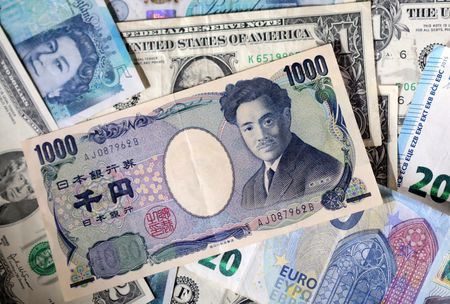

Japan’s currency pulled back modestly against the U.S. dollar on Friday, though it remained positioned for its largest weekly increase in more than two months following government intervention that lifted it from nearly two-year lows.
Market watchers stayed vigilant for additional intervention from Japan’s Ministry of Finance, particularly as May 1 holidays reduced trading activity and Tokyo prepared for a three-day closure next week.
Ken Crompton, head of rates strategy at National Australia Bank, commented on Japan’s intervention efforts: “The difficulty is they are sort of fighting against some underlying fundamentals there.”
He continued: “The weak yen is probably there for a reason and how successful the MOF will be in fighting against the tide on a sustained basis is sort of hard to see at the moment.”
The Japanese currency retreated 0.25% versus the dollar to 156.99 per dollar, though Thursday’s rally positioned it for a 1.8% weekly increase, marking its strongest performance since mid-February.
The dollar index, tracking the greenback against multiple currencies, showed minimal movement at 98.14. The euro declined marginally by 0.03% to $1.1727.
Sources with knowledge of the situation confirmed to Reuters that authorities had intervened by purchasing yen after it reached its weakest position against the dollar since July 2024. The dramatic shift in the dollar-yen exchange rate happened during London trading hours and came after Japanese Finance Minister Satsuki Katayama indicated that the moment for “decisive” action was approaching.
Katayama also instructed reporters to keep their phones accessible throughout the upcoming holidays.
Kristina Clifton, senior currency strategist at Commonwealth Bank of Australia, noted in a research report: “Past intervention has had only a temporary effect on the yen if the underlying fundamentals haven’t shifted. Continued yen depreciation may prompt several rounds of intervention, which in turn would cause larger two-way swings in USD/JPY.”
In energy markets, oil prices stayed high amid Tehran’s threats of “long and painful strikes” against U.S. positions should Washington resume attacks on Iran, while President Donald Trump confronts a deadline to conclude the conflict.
Currencies from Japan and other energy-importing countries had weakened since late February, when the U.S. and Israel began air strikes against Iran, resulting in the shutdown of the Strait of Hormuz oil shipping route.
Trump is anticipated to inform Congress of either a 30-day operation extension or complete disregard of the 60-day legal requirement, with his administration claiming that the current ceasefire with Tehran represents the conflict’s conclusion.
The dollar index dropped 1.76% in April following March’s surge that highlighted the U.S. economy’s relatively reduced vulnerability to rising oil prices compared to the eurozone and Japan.
The European Central Bank and Bank of England maintained unchanged interest rates Thursday, as anticipated, matching earlier decisions by the Federal Reserve and Bank of Japan. However, the ECB and BOJ indicated willingness to raise rates as early as June to address imported energy inflation.
Sakura Koike, an analyst at Mitsubishi UFJ Bank, wrote in a note: “Combined with the Bank of Japan’s ‘hawkish hold,’ if the market starts to price in a rate hike at the next meeting in June, yen buying could gather momentum.”
In digital currencies, bitcoin dropped 0.17% to $76,330.16, while ether fell 0.27% to $2,257.53.