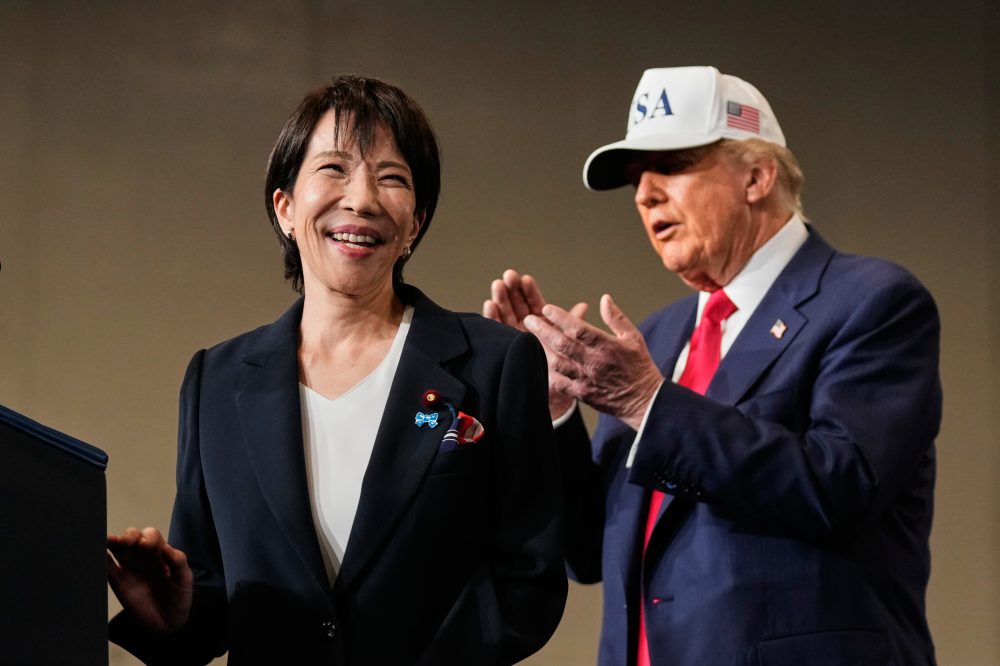

Japanese Prime Minister Sanae Takaichi departed Wednesday for Washington, D.C., anticipating challenging discussions with President Donald Trump following his request for Japan and allied nations to deploy naval vessels to protect the Strait of Hormuz.
The planned three-day Washington visit was initially designed to address trade issues and reinforce U.S.-Japan relations amid China’s expanding regional presence. However, the agenda is now dominated by the conflict between the United States, Israel, and Iran that began February 28.
“I think the U.S. visit will be a very difficult one, but I will do everything to maximize our national interest and to protect the daily lives of the people when the situation changes daily,” Takaichi addressed parliament Wednesday before her departure.
This marks Takaichi’s second encounter with Trump since their October meeting in Tokyo, which occurred shortly after she became Japan’s first female prime minister. The conservative leader follows in the footsteps of former Prime Minister Shinzo Abe, who maintained strong ties with Trump.
Originally, Takaichi planned to concentrate discussions on China and bolster bilateral relations before Trump’s scheduled diplomatic mission to China. The White House announced Tuesday that trip has been postponed due to Middle Eastern hostilities.
Takaichi faces pressure to determine appropriate commitments to offer Trump. Political analysts suggest demonstrating progress on investment agreements will be crucial for summit success.
Japanese representatives indicate both nations will work to expand collaboration on regional security, essential minerals, energy resources, and China-related concerns.
As a crucial Asian ally, Japan has avoided explicitly endorsing U.S.-Israeli military actions against Iran or committing to warship deployment. This stance reflects Japan’s constitutional limitations, legal concerns about U.S. actions, and domestic opposition.
Speaking to parliament, she expressed Japan’s desire for conflict de-escalation, noting disruptions to oil and gas supplies Japan heavily relies upon.
“Without early de-escalation of the situation, our economy will be in trouble,” she stated. “Early de-escalation is important for both the U.S. and global economy.”
Japan seeks to maintain its longstanding relationship with Iran, a primary source of Japanese oil imports.
Takaichi and her cabinet have disputed claims that Washington formally requested Japanese warships for the Strait of Hormuz. Trump posted on X asking multiple countries, including Japan, to volunteer before later stating he no longer required assistance due to lukewarm responses.
This development reduces pressure on Takaichi.
“We have no plans to send warships right now,” Takaichi informed parliament Wednesday. She indicated reconnaissance and intelligence missions might be possible only after a ceasefire. Japanese analysts suggest minesweeping operations could be feasible once hostilities conclude.
“I will clearly explain what we can do and cannot do based on the Japanese law,” Takaichi said. “I’m sure (Trump) is fully aware of the Japanese law.”
Takaichi aims to address China’s security and economic pressure tactics while securing U.S. commitment to the Indo-Pacific region, particularly as American forces stationed in Japan relocate to the Middle East—a shift Japan views as potentially risky given China’s growing influence.
She plans to reassure Trump regarding Japan’s military expansion, highlighting accelerated long-range missile deployment to strengthen offensive capabilities. This represents a departure from Japan’s post-war defense-only doctrine and demonstrates closer U.S. alignment.
During the summit, Takaichi expects to express Japan’s interest in participating in America’s “Golden Dome” multi-billion dollar, comprehensive missile defense program.
Japan views China as an escalating security concern and has promoted military development on southwestern islands near the East China Sea.
Takaichi has committed to updating Japan’s security and defense policies by December and aims to further strengthen Japan’s military with unmanned combat systems and long-range weaponry.
Her administration plans to eliminate restrictions on lethal arms exports in coming weeks to advance Japan’s defense sector and cooperation with the United States and allied nations.
As a resource-limited country, Japan seeks to diversify oil sources and is completing Japanese investment for expanded Alaskan oil production and domestic stockpiles, according to media accounts. Japanese investment in small modular reactors and American natural gas is also under consideration.
If approved, these projects would comprise part of a $550 billion investment commitment Japan made in October. In February, both sides announced Japan’s dedication to a $36 billion initial project phase—including an Ohio natural gas facility, a Gulf Coast crude oil export terminal, and a synthetic diamond production site—whose advancement will be discussed with Trump.
Japan reportedly intends to suggest joint rare earth development from undersea deposits near the remote Japanese island of Minamitorishima as part of the investment package.
Diplomatic and trade tensions have intensified since Takaichi’s statement that Chinese military action against Taiwan could justify Japanese military intervention.