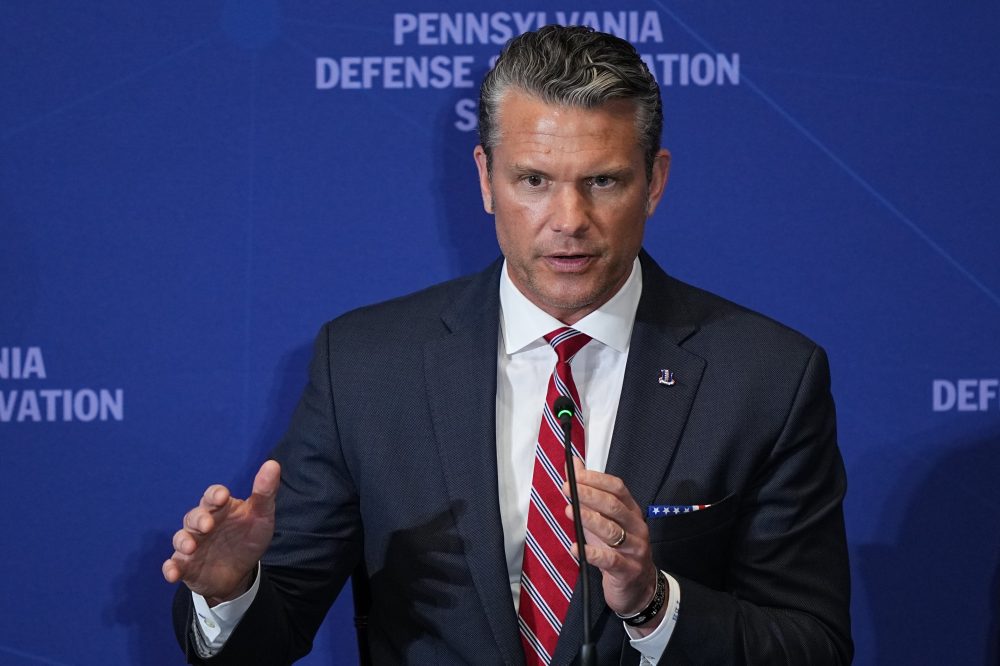

WASHINGTON — Defense Secretary Pete Hegseth is doubling down on his support for low-altitude military flyovers, even as a Navy demonstration jet’s close pass over a packed Florida beach this week has put a fresh spotlight on the Pentagon’s repeated dismissal of safety reviews tied to such maneuvers.
The most recent incident was captured on video that spread rapidly across social media, showing a Blue Angels jet from the Navy’s demonstration squadron skimming so low over a crowded Pensacola beach on Wednesday that beach chairs and tents were sent flying, sand swirled into the air, and children covered their ears from the noise.
Shortly after the incident, the U.S. Navy released a statement saying it was “conducting a thorough safety review.” But by Thursday morning, multiple Trump administration officials were publicly praising the maneuver.
“The flyovers will continue until morale improves,” Hegseth wrote on his personal X account, offering no further explanation.
Pentagon top spokesman Sean Parnell posted “Carry on Patriots” on social media alongside an image showing a Blue Angels jet with its wingtip just feet above the heads of people on the beach. The White House also shared a cartoon depicting beachgoers photographing a Blue Angels aircraft, accompanied by the phrases “Freedom” and “It’s okay to love America.”
This marks at least the third time Hegseth and other officials have publicly backed military aviators for performing maneuvers that, while often thrilling for onlookers, have drawn public concern and triggered military investigations.
In both previous cases, Hegseth’s public statements led to the termination of safety probes. In the Florida case, acting Navy Secretary Hung Cao, a Trump administration political appointee, declared the Navy had “no problem” with the flight and confirmed there would be no reprimands or firings. Hegseth retweeted Cao’s post.
Cao also stated Thursday that the Blue Angels conducted a “flight debrief,” though Navy officials declined to confirm whether that routine post-flight session was the same “thorough safety review” the Navy had pledged the day before.
Aviation safety consultant Jeff Guzzetti, who previously investigated crashes for both the National Transportation Safety Board and the Federal Aviation Administration, said low-altitude flights like these have historically been linked to crashes.
“It’s shocking to me as an aviation safety professional that the top leaders of the military would excuse this type of reckless behavior,” Guzzetti said. “A cavalier attitude like that can only lead to accidents in my view.”
The Pensacola flyover follows a March incident in which video surfaced of two Army helicopters hovering near musician Kid Rock’s Tennessee home during a training exercise while he clapped and saluted. The Army initially suspended the helicopter crews and launched a safety investigation.
Within days, Hegseth stepped in, lifted the suspension, and shut down the investigation, declaring, “No punishment. No Investigation. Carry on, patriots.” The singer is a well-known supporter of President Donald Trump.
Then, months later, eight South Carolina National Guard helicopter pilots were suspended after Army Apache helicopters made a low-flying pass over beachgoers during a July 4 event honoring military service members.
Less than a week after that event, Hegseth announced he was intervening again, posting on social media: “We’ll fix this.” The following day, Parnell announced that “effective immediately, the suspension of all involved South Carolina pilots has been lifted,” adding “Carry on Patriots” to his post.
When reporters asked Thursday whether the similar language used in those posts signaled that Hegseth’s office was once again halting a safety investigation, Pentagon spokesman Jacob Bliss said he had “nothing further to provide at this time.”
Guzzetti said the military’s top leadership is sending a troubling message by excusing what he described as dangerous and unprofessional conduct.
“That sends out a powerful signal that this type of deviant behavior is acceptable and, in fact, desired,” he said. “And that’s dangerous. That’s the antithesis of a good safety culture.”
Former Transportation Department Inspector General Mary Schiavo, also a licensed pilot who worked air shows in the past, said these flyovers likely don’t break military rules since the Pentagon isn’t bound by the same FAA restrictions that apply to civilian flights over crowds. Still, she said that doesn’t make them a wise choice — especially given the extreme nature of Blue Angels maneuvers.
“They are air demonstration teams, and what they do is exceedingly dangerous — amazing and wonderful — but dangerous,” Schiavo said. “And so it is really not something to be performed over people.”
Not everyone on the Pensacola beach was alarmed. Florida beachgoer Alexandra Belcher, 34, described the Blue Angels flyover as a once-in-a-lifetime moment.
“I didn’t realize how close it was, until everyone around me was like, ‘That was so cool,’” she said. “It was not normal, but it was such a blessing to be able to witness that with everybody that I was with.”
A Navy official, speaking anonymously to discuss internal planning, confirmed the Blue Angels’ next scheduled show on Saturday will proceed as planned.
The debate over military aviation safety comes in the wake of sharp criticism the Army received from the NTSB following last year’s deadly midair collision between a Black Hawk helicopter and an American Airlines jet near Washington, which killed 67 people. The NTSB concluded that “the Army’s aviation safety system failed to consistently detect, interpret, and act on signals of latent hazards, resulting in degraded safety assurance, organizational learning, and safety culture.”
Even routine flyovers have proven fatal in the past. In April 2025, a Japanese woman died after the propeller wash from an Air Force HH-60W helicopter knocked her onto a concrete walkway, causing severe head injuries. A subsequent Air Force investigation found that contributing factors included “allowing deviation from safe spectator distances” and “an operational mindset fostering a false confidence of safety.”
In 2011, the then-commander of the Blue Angels, Cmdr. Dave Koss, voluntarily stepped down just days after a performance at a regional air show where he executed a low-altitude maneuver the Navy publicly described as “unacceptable.” The Blue Angels were forced to cancel multiple air shows that year as a result.