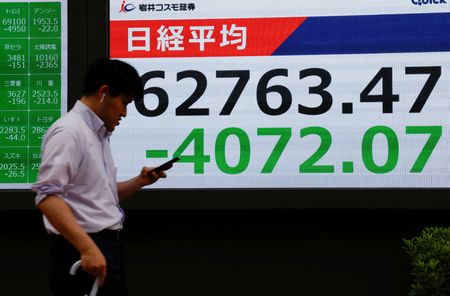

TOKYO — Asian financial markets suffered steep losses Friday as a sweeping global selloff in technology stocks intensified, dragging equity indexes in Japan and Taiwan down by as much as 6%.
Japan’s Nikkei 225 index officially entered correction territory, having shed more than 10% of its value since reaching an all-time closing high on June 25.
Takamasa Ikeda, a senior portfolio manager at GCI Asset Management in Tokyo, pointed to the close relationship between the Nikkei and the SOX semiconductor index as a key factor. “The Nikkei is highly correlated with the SOX index. The pace of the SOX’s gain was unsustainable, and there’s been a correction in it. A correction was anticipated, but it is happening earlier than market expectations,” he said. He added that investors are growing skeptical about whether major tech companies can generate returns large enough to justify enormous investments financed through heavily leveraged loans.
Christopher Forbes, head of Asia and Middle East at CMC Markets in Singapore, noted that even solid tech earnings weren’t enough to prop up prices. “They were good (tech) earnings. But it just shows how much was baked into the price. SpaceX is a pretty good proxy for market sentiment right now, and it’s below the IPO price,” he said. Forbes also observed that rising bond yields are weighing on markets, though he hasn’t seen outright panic yet, with investors instead moving toward gold and silver.
Johan Javeus, a senior economist at SEB in Stockholm, described the selloff as likely driven by a mix of forces. “Probably a combination of factors where the selloff is partly driven by profit-taking on many AI stocks, coupled with the recurring doubts of an AI investment bubble. The fact that the SpaceX IPO has done so poorly makes many investors extra nervous,” he said.
Kei Okamura, a portfolio manager at Neuberger Berman in Tokyo, suggested that signals from the Federal Reserve may have sparked the downturn. “I think the Fed was likely a trigger. Kevin Warsh and his comments and changing views towards what appears to be quite hawkish Fed policy started a cascading effect towards taking chips off the table,” Okamura said. He noted that heavy selling began with high-profile names like SK Hynix and Samsung before spreading more broadly, calling the situation a “bloodbath” that is “across the board.”
Fabien Yip, a market analyst at IG in Sydney, said investors are now focused on financial sustainability rather than just growth numbers. “Retail investors have borrowed to trade in this really impressive AI rally, so I think the unwinding of leveraged positions will definitely exaggerate the decline as well,” he warned. Yip cautioned that if the selloff carries into the U.S. trading session, South Korean markets could face a particularly rough reopening.
Shoichi Arisawa, a fellow in the investment research department at Iwai Cosmo Securities in Tokyo, said the correction appears to be a reaction to the sharp run-up that preceded it, but expressed confidence that the underlying business outlook for AI and semiconductor companies hasn’t fundamentally changed.
Naoki Fujiwara, a senior fund manager at Shinkin Asset Management in Tokyo, raised concerns about the reliability of memory chip makers’ forecasts, suggesting demand signals may be distorted by customers ordering early ahead of anticipated price hikes. He said upcoming earnings reports from major memory chip users like Alphabet could provide a clearer picture and potentially spark a market rebound.
Wen Xunneng, CEO of Zhu Liu Asset Management in Shanghai, was more blunt in his assessment. “The global AI bubble is bursting. The A-share correction followed pull-backs in South Korean and U.S. stocks,” he said, adding that while the AI industry continues to expand, that growth doesn’t guarantee stock prices will keep climbing. He also noted that a large number of quantitative funds in China are amplifying market swings.
Shrikant Kale, a senior quantitative strategist at Jefferies in Hong Kong, said markets may be starting to price in more realistic earnings growth expectations for AI-related companies, moving away from assumptions of flawless execution and never-ending upgrades.
Zhiwei Zhang, chief economist at Pinpoint Asset Management in Hong Kong, characterized the correction as largely technical rather than rooted in fundamental changes. “It appears largely technical rather than fundamental. There doesn’t seem to be any major change in the tech capex expectations. It is more of an adjustment of crowded positions that led to a certain state of stampede,” he said.
Gary Tan, a portfolio manager at Allspring Global Investments in Singapore, agreed that the movement looks more like excess enthusiasm leaving a crowded trade than a broader market shift. “From the flows we are seeing, this looks more like froth coming out of a crowded AI trade than a knee-jerk reaction to higher yields,” he said, noting that investors appear to be locking in profits on top AI performers rather than rotating into other sectors.