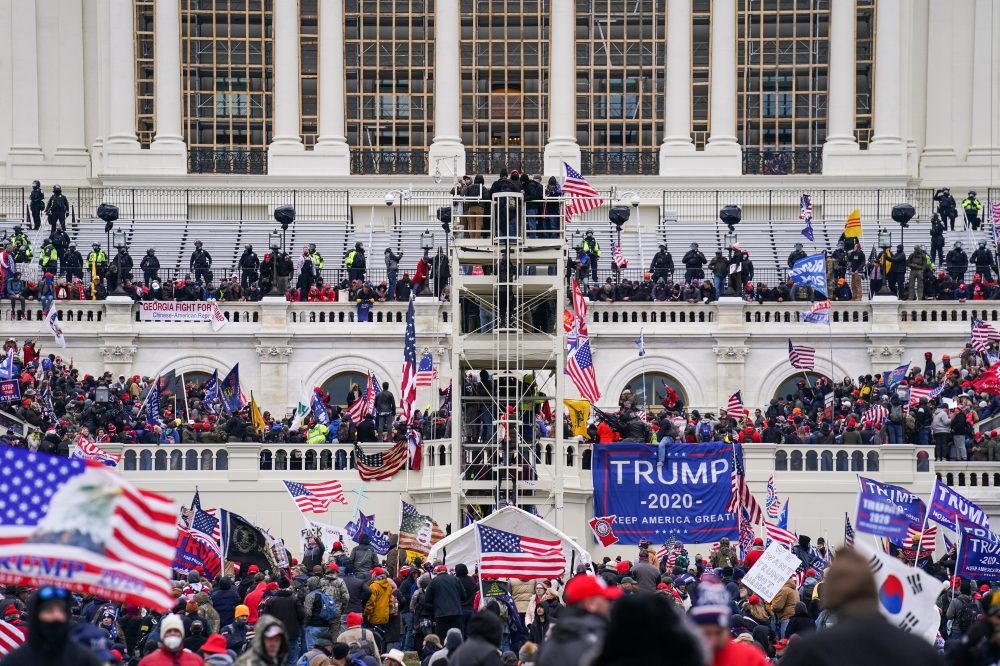

A former South Carolina lawyer who unlawfully entered the U.S. Capitol alongside supporters of President Donald Trump on January 6, 2021, is now positioning himself to assist other participants in seeking compensation from the administration’s newly created $1.776 billion settlement fund for those claiming government persecution.
David Johnston plans to charge a 10% fee for his services, with a maximum of $5,000 per case.
“I think the narrative is changing” about how the history of that day is being told, Johnston said in a video he posted to social media. “I think good things are happening for us.”
Numerous Trump supporters who admitted guilt for their involvement in the Capitol breach are now seeking financial benefits through the settlement fund, which was established to compensate the Republican president’s supporters who claim they faced politically motivated prosecution. Many of these individuals have received presidential pardons.
Despite opposition from both political parties and current legal obstacles that have temporarily halted the fund’s implementation, many January 6 participants remain optimistic about receiving taxpayer-funded compensation. Some are already preparing claims even though no formal application procedure exists and a judge has temporarily blocked the fund’s creation.
Those opposing the fund view it as an attempt by Trump and his supporters to revise the narrative of January 6 events, retroactively legitimize the assault on democratic institutions, and provide financial rewards to Trump’s most devoted followers.
Jason Riddle, a New Hampshire military veteran who served 90 days in prison after admitting to riot-related charges, declined Trump’s pardon offer. He also expressed strong opposition to government compensation for January 6 participants.
“I’d love money, but I can’t accept that. That would bother me for the rest of my life,” he said. “We weren’t innocently persecuted just because of who we are or who we vote for. We were persecuted for committing criminal behavior in the Capitol of the United States.”
However, many other participants do not share Riddle’s position.
Among those expressing interest in compensation are a Florida individual who photographed himself with then-House Speaker Nancy Pelosi’s podium, a New Jersey participant whom prosecutors described as having Nazi sympathies, and a Texas man who received seven years in prison for entering the Capitol while carrying a metal tomahawk.
Pamela Hemphill of Oregon, who received a 60-day jail sentence, declined Trump’s pardon but has prepared a compensation claim seeking $5 million. Unlike many participants who blame Democrats for their legal troubles, Hemphill holds Trump responsible for her situation.
“I wouldn’t have been through all of this if Trump hadn’t lied about the election being stolen,” she said during a telephone interview. “It’s a direct result of his lies that I was even there that day.”
Whether individuals convicted of Capitol-related crimes qualify for payments from the fund, which originated from Trump’s lawsuit against the IRS regarding leaked tax returns, remains uncertain.
Acting Attorney General Todd Blanche has not eliminated that possibility. Blanche stated that while anyone can apply, five commissioners who have yet to be appointed will determine eligibility based on factors including the applicant’s actions, sentence, and time served.
“That’s up to the commissioners,” Blanche told The Associated Press on Thursday when asked about his position on whether violent Jan. 6 defendants should be eligible for payments.
“You have to define something and then stick to it. That’s something I’ve been hesitant to try to do, because it’s very fact-intensive,” Blanche said. “Me sitting here and talking in hypotheticals is something that I don’t think is fair to the process.”
Congressional intervention regarding payments to January 6 participants remains unclear. Frustrated Senate Republicans have indicated they want to establish fund restrictions through Department of Homeland Security spending legislation. They departed abruptly earlier this month following a contentious meeting with Blanche and are scheduled to return Monday with the matter still unresolved.
A Virginia federal judge has temporarily halted the fund’s establishment and blocked claim processing or payments. This ruling came Friday as part of at least three legal challenges to the fund.
Brendan Ballou, a former prosecutor who handled multiple January 6 cases before departing the Department of Justice last year, filed suit representing two police officers who defended the Capitol. Ballou considers the fund’s creation part of Trump’s broader effort to undermine democratic institutions and alter January 6’s historical record.
“And if the president is successful in that effort, if he’s able to get people to either forget or condone that day, he knows that he can get people to accept any attack on democracy,” Ballou said.
Approximately 1,600 individuals faced federal charges related to the Capitol breach. Over 1,200 received convictions and sentences before Trump issued widespread pardons and ordered dismissal of all remaining January 6 cases. Trump also released far-right extremist group members who had been imprisoned for planning the Capitol attack to maintain Trump’s presidency after his 2020 election loss to Biden.
The January 6 community is not the only pro-Trump group seeking fund compensation.
Meshawn Maddock, who faced charges as an alleged fake elector for Trump in Michigan before a judge dismissed her case last year, confirmed that she and her husband, state Rep. Matt Maddock, plan to file claims. She justifies using taxpayer funds because they “paid for the prosecution and investigation of the years that I was being hunted down.”
“I want vengeance and I want retribution,” Maddock said.
Trump’s efforts to reframe January 6 as a peaceful demonstration appear to have encouraged many convicted participants.
Johnston’s current willingness to assist other Capitol participants contrasts sharply with his remorseful attitude during his 2022 sentencing. He apologized for his “terrible lapse in judgment” before receiving three weeks in jail and three months of home detention after pleading guilty to misdemeanor trespassing.
“It was a dumb, dumb thing to do,” Johnston told the judge. “I am 100% responsible for what I did that day.”