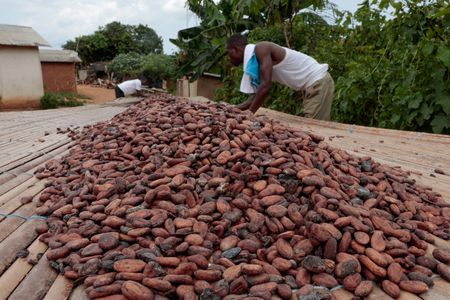

Officials in Ivory Coast are debating whether to slash the payments made to cocoa farmers, following the lead of neighboring Ghana amid a severe downturn in the global cocoa market, according to two government sources speaking to Reuters.
Senior officials from Ivory Coast indicated that all possibilities remain under consideration as the government weighs matching Ghana’s approach. Ghana has already reduced its farmer payments by 28.6% for the remainder of the 2025/2026 harvest season’s primary crop, working in coordination with Ivory Coast authorities as both nations respond to dramatically falling market prices.
These farmer payments, established at the beginning of each harvest period, represent the direct compensation producers receive for their crops before any middlemen, export companies, processing facilities, trading firms, or farming cooperatives add their markup.
Previous reports have not disclosed these coordination talks between Ghana and Ivory Coast, nor the internal Ivory Coast government deliberations about matching Ghana’s pricing strategy.
According to the Ivory Coast-Ghana Cocoa Initiative (ICCIG), these two African nations collectively supply approximately 60% of worldwide cocoa production and have maintained close coordination since the sector’s crisis began.
“We have put all options on the table and discussions are progressing well. Courageous and realistic decisions will be taken soon,” stated the first Ivory Coast official, who requested anonymity due to lack of authorization to discuss the matter publicly.
The second official explained that the ongoing price decline, which has seen cocoa values plummet nearly 50% over recent months, has severely limited the government’s available responses.
Cocoa commodity contracts on the ICE exchange reached their lowest point in two and a half years this Tuesday, as ongoing concerns about unsold cocoa inventory in both Ivory Coast and Ghana continued pressuring market values.
“We must think about the survival of the cocoa sector in Ivory Coast. We need to act; changes are underway,” the source explained, refusing to provide additional specifics.
Both sources confirmed that a multi-ministry committee has convened regarding this issue, with a decision potentially coming in the near future.
An Ivory Coast government representative did not respond to Reuters’ request for commentary.
Alex Assanvo, serving as ICCIG’s executive secretary, explained that both countries are adjusting to this unexpected market reversal and have implemented protective measures to avoid structural harm.
Assanvo noted that the trading departments of Ivory Coast’s Coffee and Cocoa Council and Ghana’s COCOBOD maintain ongoing communication.
He also supported the Living Income Differential program, launched in 2019 to increase farmer revenues, arguing that current market instability demonstrates its importance.
ICCIG is organizing a bilateral meeting to enhance coordination as farmers experience financial strain.
“The organisation remains mobilised to coordinate policies in both countries,” Assanvo stated, noting that all sector participants would be brought together to examine market changes and suggest enhancements to price-stabilization systems.
Export companies and purchasers anticipate Ivory Coast will announce reductions shortly, indicating the question has shifted from whether to when.
“The country is resisting, but for how long? I don’t see Ivory Coast doing something different from Ghana,” commented the director of an Abidjan-based export firm.