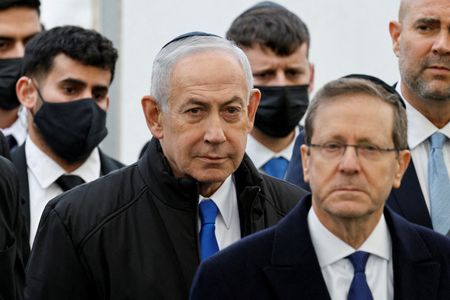

JERUSALEM – Two leading opponents of Israeli Prime Minister Benjamin Netanyahu have declared their intention to form a unified political alliance aimed at removing his coalition from power in the next election, focusing primarily on internal matters including military service requirements for ultra-Orthodox citizens.
However, regarding matters involving Iran, Gaza and Lebanon, the combined party headed by right-wing politician Naftali Bennett and centrist leader Yair Lapid is anticipated to maintain a security approach comparable to Netanyahu’s current stance – who leads what many consider Israel’s most right-wing administration in history – suggesting the nation’s international relations would see little change.
The newly formed alliance, named “BeYachad” which translates to “together” in Hebrew, has yet to publish an official policy document. However, their positions on regional disputes can be understood through their recent public statements.
IRAN
Both Bennett, age 54, and Lapid, age 62, have strongly supported Netanyahu’s choice to coordinate attacks on Iran with the United States, mirroring widespread Israeli public approval for the military action.
When Israel began its air strikes against Iran, Lapid described the conflict to Reuters as a “just war against evil.”
Since then, both politicians have criticized the 76-year-old Netanyahu for what they characterize as failing to accomplish Israel’s primary war goals, including overthrowing Iran’s religious leadership.
Yet neither leader has advocated for renewed combat since the cessation of Israeli and U.S. strikes and Iranian missile attacks following an April 8 truce agreement.
An insider familiar with their new political movement characterized Bennett and Lapid as “hawkish” and “tough on Iran.”
The source, speaking anonymously about the party’s priorities, also noted they are “pragmatic and understand the need for diplomatic agreements and the work that happens after the military use of force to achieve strategic goals.”
LEBANON
Both leaders have strongly endorsed Israeli military actions in Lebanon while questioning an April 17 ceasefire that has not succeeded in stopping clashes between Israeli forces and Iran-supported Hezbollah fighters.
Before Israel’s military entered southern Lebanon in March, Lapid stated that Israel must take all necessary actions to safeguard its citizens.
Following the announcement of the Hezbollah ceasefire in April, Lapid declared that the only viable solution was permanently eliminating threats to northern Israel.
Bennett harshly condemned the ceasefire agreement, writing on Facebook on April 17: “One can already count backwards towards the next round. Hezbollah began this morning to rebuild southern Lebanon and is becoming stronger with missiles ahead of the next round.”
GAZA
Concerning the Gaza conflict, where Israel has maintained lethal strikes despite an October ceasefire, both Bennett and Lapid have faulted Netanyahu for failing to completely eliminate the Hamas militant organization following its October 7, 2023 assault on Israel.
In January, Lapid accused Netanyahu’s administration of achieving the “worst possible outcome” in Gaza, noting that Hamas still maintains tens of thousands of armed combatants. Under the ceasefire terms, Hamas kept control of a narrow coastal strip in Gaza.
In a recent Facebook statement, Bennett claimed Netanyahu’s policies – including permitting some humanitarian assistance into the territory after blocking all aid deliveries for three months in 2025 – had enabled Hamas to regain authority.
“This is with the help of hundreds of aid trucks that Netanyahu’s government brings them every day,” Bennett wrote.
Netanyahu has portrayed Israel’s extensive military campaign that devastated much of Gaza and resulted in over 72,000 Palestinian deaths as successful. He has suggested the possibility of renewed full-scale warfare if Hamas refuses to surrender weapons through a U.S.-supported process, which the organization has so far declined.
PALESTINIAN STATEHOOD
Given polling data indicating most Israelis reject creating an independent Palestinian nation in the occupied West Bank, Gaza and East Jerusalem, a Bennett-Lapid administration would likely avoid major Palestinian policy changes.
Netanyahu rejects Palestinian statehood, and his administration has expedited settlement construction in the West Bank, which government officials describe as efforts to eliminate prospects for Palestinian independence.
In 2022, Lapid, who represents many in Israel’s political center and left who don’t completely oppose Palestinian self-governance, stated that a two-state resolution to the Israeli-Palestinian dispute was morally correct.
During a 2024 ABC interview when questioned about his opposition to a two-state solution, Bennett expressed concern it would result in violence against Israelis.
“What we’ve learned over the past 30 years is that every time we gave the Palestinians a piece of land, instead of building it into a beautiful Singapore they turned it into a terror state and began killing Israelis,” Bennett explained.
Regarding the West Bank, Netanyahu, Bennett and Lapid have all spoken strongly against settler violence targeting Palestinians. Such incidents have increased under Netanyahu’s leadership, with critics claiming he permits settlers to freely attack Palestinian communities and residents. Netanyahu’s office disputes these allegations.