
Israeli military commanders on Monday instructed Lebanese civilians to avoid returning to a wide swath of southern Lebanon territory along the border, strengthening their control over the region even after a U.S.-brokered ceasefire began last Thursday.
The 10-day truce, negotiated through American diplomatic channels, has largely stopped active fighting between Israeli forces and the Iran-supported Hezbollah militia that emerged from broader regional tensions between Washington and Tehran.
However, the peace agreement remains unstable, with Israeli military units maintaining positions far into southern Lebanese territory to establish a protective barrier against potential Hezbollah attacks on northern Israeli communities, while the militant organization claims it retains the “right to resist” Israeli military presence.
Israeli defense officials released a map through social media platforms showing a red boundary line across 21 southern villages, instructing residents to avoid entering the zone between that line and the international border. Military spokespeople said their forces were holding positions in the south “in the face of ongoing terrorist activities” conducted by the Iranian-backed organization.
The published map identified more than 50 additional southern communities where residents should not attempt to return. Military officials also declared the Litani River area off-limits to civilians, though the waterway flows primarily north of the main restricted zone.
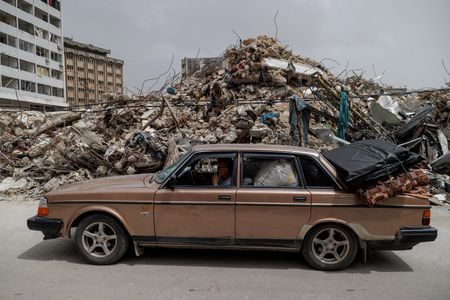
On Sunday, Israeli defense forces had published a similar territorial map, revealing for the first time their new positioning inside Lebanon. The deployment line extends from east to west, penetrating 5-10 kilometers beyond the border into Lebanese soil, covering regions where Israeli forces have been demolishing villages.
Senior Hezbollah leader Mahmoud Qmati warned residents of the organization’s stronghold in Beirut’s southern districts on Saturday against returning to their residences due to continued risks of Israeli military strikes.
Municipal authorities throughout the south have similarly advised civilians against coming home, stating that conditions remain unsafe.
In a Monday statement, Hezbollah claimed that explosive devices previously positioned by their fighters had detonated while Israeli military vehicles moved through a southern area on Sunday, reportedly destroying four armored tanks.
Israeli military representatives did not immediately provide a response when asked to comment on these allegations.
Israeli defense officials confirmed on Sunday that one soldier had died and nine others sustained injuries during operations in southern Lebanon.
Lebanon became involved in the broader regional conflict on March 2, when Hezbollah launched attacks in support of Tehran, triggering an Israeli military campaign that has resulted in over 2,300 deaths, including 177 children, and displaced more than 1.2 million people, according to Lebanese government officials.
Hezbollah has not released its own casualty numbers. Sources familiar with the group indicate that at least 400 of its fighters had been killed by the end of March.
The militant organization has launched hundreds of rockets and drone attacks against Israel. These assaults have killed two Israeli civilians while 15 Israeli soldiers have died in Lebanon since March 2, according to Israeli authorities.