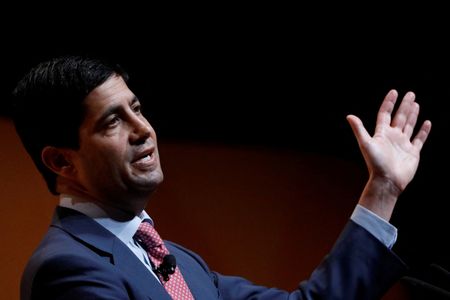

WASHINGTON – Former Federal Reserve Governor Kevin Warsh will undergo intense Senate scrutiny Tuesday as lawmakers examine his vision for leading the nation’s central bank after years of criticizing its policies.
The 56-year-old financier will appear before the Senate Banking Committee as part of his confirmation process to become Fed chair. Current Fed Chair Jerome Powell’s term officially ends May 15, though Republican senators have pledged to block Warsh’s confirmation unless the Trump administration ends what they view as an inappropriate criminal investigation into Powell and the Federal Reserve.
This hearing comes at a pivotal time for the Fed, which is confronting its most significant challenges to independence since the post-World War II era.
President Trump has mounted an aggressive effort to expand his influence over the central bank, demanding substantial interest rate reductions and publicly criticizing officials when they don’t comply. Treasury Secretary Scott Bessent has also expressed criticism of the Fed while discussing potential operational overhauls or establishing a new agreement between the Treasury and central bank – a move that could spark concerns about efforts to finance the nation’s growing debt.
Deutsche Bank’s chief U.S. economist Matthew Luzzetti and his team questioned last week whether Warsh would “voice unconditional support for Fed independence and distance himself from the administration’s call for steep rate cuts.” They noted that “Warsh will have to earn market trust and credibility around his commitment to achieving the inflation target; bona fides that always need to be earned by an incoming chair. The requirement could be more acute in the current context.”
Senators will have numerous economic challenges to explore during the hearing.
Inflation continues hovering above the Fed’s 2% goal; oil prices surged due to the Iran conflict, though they declined recently; Trump believes the central bank should slash its policy rate to 1%; and emerging technologies like artificial intelligence and cryptocurrencies – areas where Warsh has investment experience – could fundamentally alter the economy.
Warsh’s reputation as a strict monetary policy advocate who opposes inflation has evolved into support for lower interest rates based on technology-driven productivity gains. Similarly, his longtime position that the Fed should reduce its $6.71 trillion balance sheet – developed during his previous tenure when the central bank’s bond purchases initially expanded – has also shifted.
LONGTIME FED CRITIC
While Trump considered Powell’s replacement over recent months, Warsh delivered harsh critiques of the Fed, demanding “regime change,” describing his potential role as “knocking some heads,” and characterizing Powell’s leadership as “broken” – though without specifying his planned reforms.
His nomination follows years of opinion pieces, academic presentations, and media appearances, many conducted through his role as the Shepard Family Distinguished Visiting Fellow in Economics at Stanford University’s Hoover Institution, a hub of Fed criticism among analysts who view recent policymaking as dangerously experimental. Warsh, who holds a public policy degree from Stanford and graduated from Harvard Law School, has acknowledged influence from prominent Hoover figures including monetarist Milton Friedman and economist John Taylor.
Both scholars advocated for restricted central banking approaches – Friedman focused on money supply growth, while Taylor developed the “Taylor Rule” connecting suggested interest rates to the Fed’s dual inflation and employment mandates. Warsh has praised rule-based policymaking as “aspirational” while avoiding commitment to implementing it, creating questions that supporters and opponents of such methods will want clarified.
Warsh’s current interest rate perspectives, and Trump’s potential influence on them, will likely dominate the upcoming hearing, which Senator Tim Scott will chair. Scott and fellow Republican lawmakers have praised Warsh’s nomination despite disagreements over confirmation conditions.
WARSH’S APPROACH
The nominee’s interest rate theories mirror arguments former Fed Chair Alan Greenspan presented during the 1990s regarding productivity’s impact on inflation, while aligning with Trump’s demands for lower rates. Trump stated he would only nominate someone he trusted to reduce borrowing costs.
The Fed’s enormous balance sheet presents another sensitive topic. Expanded dramatically during the 2007-2009 financial crisis, substantial Treasury and mortgage-backed securities holdings have become essential tools for controlling interest rates as the Fed pursues its 2% inflation target and maximum employment objectives.
Serving as a Fed governor during that crisis, Warsh opposed the balance sheet’s seemingly unlimited expansion alongside other conservative economists who believed it distorted financial markets. He chose to leave the central bank in 2011 rather than publicly oppose then-Fed Chair Ben Bernanke through dissenting votes during policy discussions still focused on economic recovery from post-crisis stagnation.
Tuesday’s hearing may revisit that period. Warsh joined the Fed in 2006 under President George W. Bush’s appointment and served as a key Bernanke advisor as subprime housing problems escalated into a comprehensive financial collapse that prompted not only Fed bond purchases but massive government Wall Street bailouts.
A lawyer like Powell, with family connections to Republican leadership that eventually included Trump, Warsh has received recognition for his Wall Street expertise and interpersonal abilities as much as his academic credentials. He helped oversee those contentious financial sector rescues before returning to Wall Street as an advisor to billionaire investor Stanley Druckenmiller, a role that enabled Warsh to accumulate personal wealth exceeding $100 million, based on financial disclosures submitted before this week’s hearing.
Senator Elizabeth Warren, the Senate Banking Committee’s ranking Democrat, wrote in an April 15 letter to Powell requesting documents about Warsh’s Fed role during the crisis: “In the lead-up to the crisis, Mr. Warsh failed to meaningfully identify or address the risks associated with subprime mortgages and derivatives.”
Warren continued: “Since 2008, it has been well-documented that Mr. Warsh, in his role as (a) Fed Governor, failed to take seriously the risks posed by the subprime mortgage market and played a central role in helping to arrange numerous multibillion-dollar, taxpayer-funded capital infusions to financial institutions involved in the crisis.”