
HARET SAIDA, Lebanon (AP) — Emergency notifications arrive without warning across Lebanon: cell phones buzzing with text messages, robocalls from unknown international numbers, and difficult-to-interpret maps posted online by Israeli military officials.
These evacuation maps sometimes encompass vast regions of Lebanon, while others pinpoint individual structures. Many airstrikes occur without any advance notification, continuing even after a temporary ceasefire agreement between Israel and the Iranian-supported Hezbollah organization.
These emergency alerts trigger frantic efforts to gather children and elderly family members, forcing families into heartbreaking decisions as they rush toward the unclear boundaries shown on the red-marked evacuation zones. Complete communities have been abandoned, with more than one million residents fleeing during the most intense periods of combat. Lebanon lacks Israel’s infrastructure of air raid warning systems, missile defense capabilities, or official emergency shelters.
Israeli officials claim these notifications serve to protect civilian populations from danger. They assert that Hezbollah has established military positions, underground tunnel networks and weapons storage throughout southern Lebanon’s residential areas, launching hundreds of unmanned aircraft and rockets toward northern Israeli communities without advance warning.
Specialists in international law argue that Israel’s evacuation notices lack consistency and frequently cover excessively large areas with indefinite timeframes. These concerns arise as Israeli officials announce plans to establish a 10-kilometer (6-mile) security buffer along the border and block civilian returns until Hezbollah threats are neutralized.
The current conflict began on March 2, when Hezbollah ended its restraint following a 2024 ceasefire agreement, firing a surprise missile attack into northern Israel as retaliation for joint American and Israeli operations against Iran.
Israeli forces have issued 132 digital evacuation notices during this period — including seven alerts affecting more than 50 southern Lebanese communities since the ceasefire began on April 17.
Local residents report that precisely targeted warnings frequently arrive with minimal advance notice, creating panic and disorder.
Ward Zein al-Din, 56, described hearing windows break from flying debris moments after her father received a call from Israeli military personnel that caused him to cry out. The family has since abandoned their southern community and found refuge in a school building. “I didn’t think we would survive,” she said.
Additionally, evacuation maps distributed through social media by Israel’s Arabic-language military representative, Lt. Col. Avichay Adraee, have instructed entire populations to relocate north beyond the Litani River, approximately 30 kilometers (20 miles) from the border, and sometimes even greater distances.
His comprehensive warnings also cleared Beirut’s densely populated southern neighborhoods, where Hezbollah maintains significant influence, although many residents have subsequently returned. United Nations officials report that substantial numbers of people remain displaced throughout the country, including more than 150,000 living in temporary tent settlements.
“A legal tool is being used to achieve forced displacement,” said Hussein Badreddine, a Lebanese expert in international law at the University of Sydney. “When you evacuate entire areas and keep the orders open-ended, that’s when the legality comes into question.”
Responding to multiple inquiries, Israeli military representatives stated they distribute warnings through telephone calls, text messages, radio announcements, social media platforms and aerial leaflet drops, following the “principles of distinction, proportionality and feasible precautions” under international law.
No advance notification was provided on April 8, when Israeli forces attacked one hundred locations in quick succession, resulting in more than 350 deaths, including casualties in central Beirut. This represented one of the most devastating attacks in Lebanon’s conflict-marked history.
Military officials stated that Hezbollah leadership and personnel “were expected to be present at many of the sites.” The exact number of Hezbollah casualties remains uncertain. More than 100 of those killed were women and children.
Some warnings have been issued without subsequent attacks. Earlier this month, Israeli officials threatened to target the primary border crossing between Lebanon and Syria, forcing its closure for multiple days. The promised strike never occurred.
Military aircraft struck the community of Kafr Tebnit when hostilities erupted. Adraee announced on X that residents should relocate to “no less than 1,000 meters (yards) outside the village.”
Hussein Farran traveled to Nabatiyeh city, where he maintains employment with an electrical utility. His wife, Rola Nahleh, and their 4-year-old daughter, Amal, joined extended family in Kfar Hatta, approximately 17 kilometers (10 miles) beyond Adraee’s designated danger zone.
One month afterward, at 11:29 p.m. on April 4, Adraee instructed residents to evacuate Kfar Hatta. This represented one of 26 emergency notifications issued during the conflict between 10:30 p.m. and 6:30 a.m.
“When warnings are issued in the middle of the night, on platforms that not everyone uses, you can’t expect everyone to get up and leave immediately,” said Kristine Beckerle of Amnesty International. “You have people stuck on the road for 12, 13 hours trying to leave. You have elderly people who can’t move quickly.”
Nahleh informed her husband by telephone that hundreds of people were evacuating, many still in their nightclothes. They decided it would be safer to wait through the disorder until morning.
Two Israeli rockets struck their residence around 3 a.m., killing Nahleh, her mother, father, brother, sister and Amal, who had recently begun kindergarten.
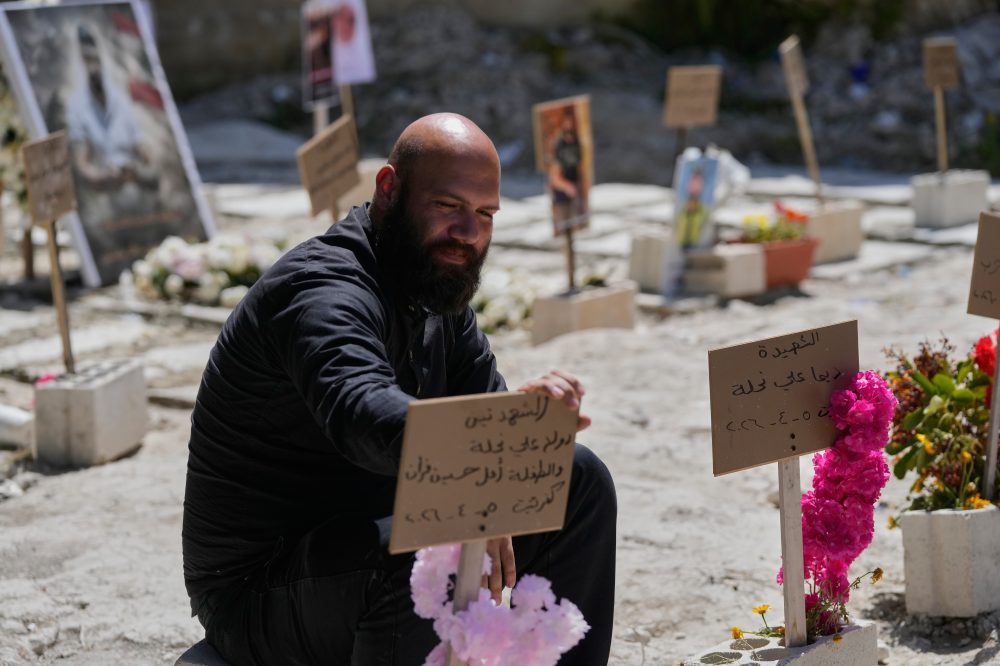
“Even if they gave us a warning, how does it justify killing a civilian family?” Farran asked, gazing at their graves — cardboard signs smeared with handwritten Arabic because the war has made a proper burial in their village impossible.
“They weren’t given a real chance,” he said.
Initially, Ali al-Salim suspected it was a fraudulent call, or a criminal attempting to burglarize his vacant home, as occurred to his family during an earlier conflict. The caller ID showed Germany, but the person claimed to be an Israeli officer and instructed al-Salim to evacuate northward immediately.
As bombing attacks moved closer, al-Salim, his wife and three sons abandoned their southern community of Siddiqin and reached a school in Haret Saida following 18 hours in gridlocked traffic.
Security analysts explain that Israeli military personnel frequently employ randomly generated international phone numbers since direct communication between the two nations, technically in a state of war for decades, is prohibited.
“There is no way to know if a call is real or fake,” said Roland Abi Najem, a Lebanese cybersecurity expert. “The Israeli military benefits from the chaos that helps create a mass exodus.”
Military officials declined to explain their methods for contacting Lebanese phone numbers.
Several days after evacuating, al-Salim learned that his residence was destroyed by an Israeli missile. The emergency shelter proved equally hazardous.
One location that Israel attacked without warning on April 8 was a nearby Shiite religious center, where displaced individuals used bathing facilities. The blast rendered al-Salim’s 14-year-old son, Ali, unconscious and severely damaged his left leg.
“The bombing can happen at any moment. There is no safety at all,” said Ali, now using crutches. “I’ve never felt this kind of fear.”
The ceasefire agreement has provided little reassurance.
Compelled to abandon his southern hometown of Shaqra when fighting began, Mohammad Shahadat delayed one week after the ceasefire before attempting to return. Encouraged by neighbors reporting peaceful conditions, he traveled home last week.
Days afterward, he was again living in a temporary tent in Beirut following another Israeli evacuation warning.
“We didn’t know where to go,” he said.