
TOKYO — A major push into the future of robotics is underway in Japan, with Fujitsu leading a collaboration that combines the country’s world-class manufacturing expertise with cutting-edge artificial intelligence from Nvidia.
At the heart of the effort is a concept called “physical AI” — a technology field focused on developing intelligent robots that can think independently, rather than simply executing pre-programmed instructions. The goal is for these machines to work safely alongside humans in settings like factories, private homes, and medical facilities.
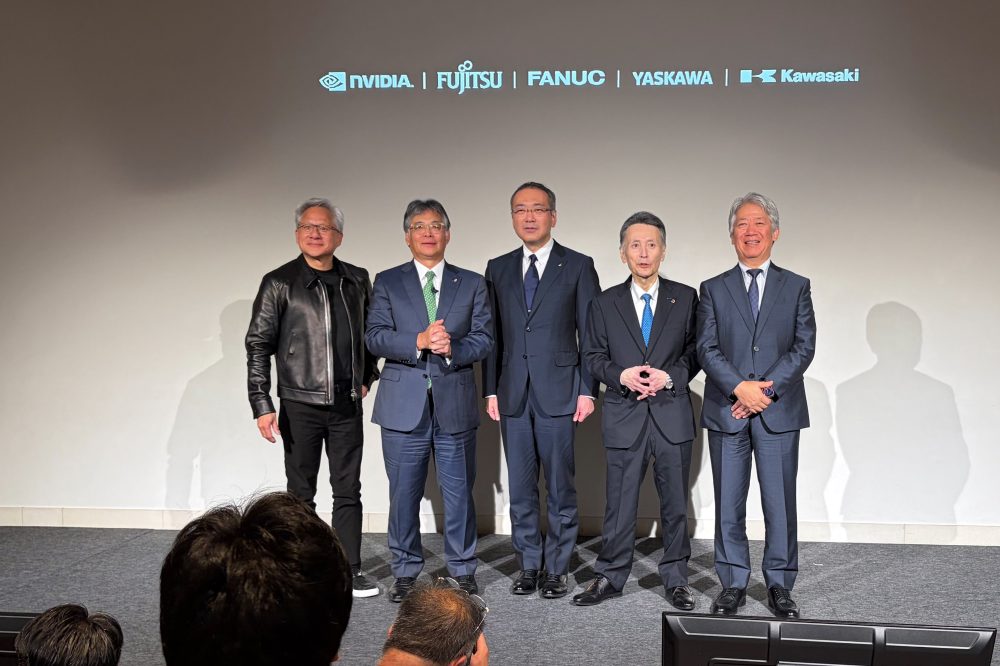
The partnership was formally unveiled in Tokyo on Thursday. Nvidia Corp. Chief Executive Jensen Huang and Fujitsu Chief Executive Takahito Tokita made the announcement alongside the heads of Japan’s top industrial robot manufacturers — Fanuc Corp., Yaskawa Electric Corp., and Kawasaki Heavy Industries.
This latest development builds on a separate agreement that Nvidia and Fujitsu had already announced the previous year.
Company leaders expressed optimism that these advanced robots could help ease Japan’s severe worker shortage. The country is one of the fastest-aging nations in the developed world, and officials believe smart robots could play a meaningful role in caring for elderly people living on their own.
Huang explained why Japan is a natural fit for physical AI, pointing to the country’s long-standing reputation for precision and quality — important qualities given that independently moving robots could pose safety risks if not built to the highest standards.
“Japan’s excellence is a philosophy, a way of life. ‘Made in Japan’ means the highest quality, the highest precision. Japan sets the standard for the state-of-the-art in modern manufacturing,” Huang said.
He also highlighted Japan’s celebrated manufacturing philosophy of “kaizen,” a term meaning “continuous improvement.”
The companies stopped short of providing a specific timeline for when these robots might appear in everyday life, though they emphasized that work is actively in progress. They described the first phase of the collaboration as expected to launch later this year.
As of now, no decision has been made about forming a joint venture, though the companies acknowledged that possibility could emerge down the road.
Japan has openly recognized that it has fallen behind countries such as China and the United States in the AI race and has been working to close that gap. Prime Minister Sanae Takaichi’s government recently unveiled a plan to generate more than 370 trillion yen — roughly $2.3 trillion — in combined public and private investment across technology sectors by 2040, covering areas including physical AI, semiconductors, and data centers.
Nvidia, headquartered in Silicon Valley and known for its open-source technology approach, has been actively building relationships across Japan. Its existing partnerships in the country include major banks, automaker Toyota Motor Corp., video game developer Sega, and the national research institute Riken.