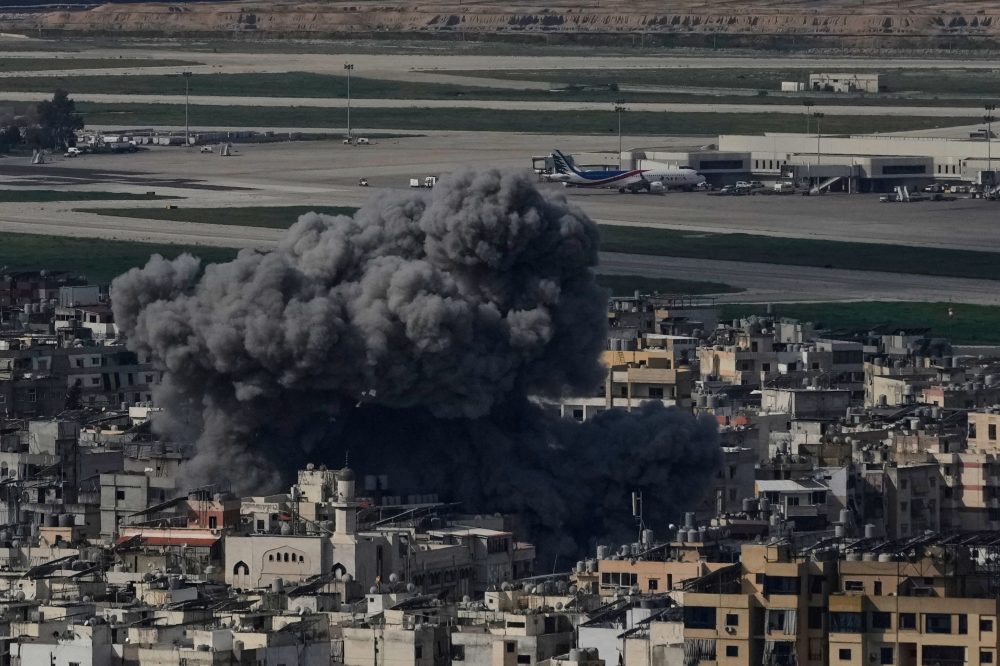

BEIRUT (AP) — Israeli forces commanded residents of numerous border communities in southern Lebanon to leave their homes “immediately” on Wednesday as bombing campaigns targeting Beirut suburbs grew more intense and Hezbollah claimed additional attacks.
Lebanon became embroiled in the Middle Eastern conflict early Monday after U.S.-Israeli operations against Iran, when the Tehran-backed Hezbollah organization launched rockets and drones into northern Israel. This prompted Israeli counterstrikes across various regions that resulted in more than 50 deaths and approximately 300 injuries.
The fighting has also forced tens of thousands to flee from southern Lebanon, the eastern Bekaa Valley and Beirut’s southern neighborhoods.
Israeli military officials released a directive Wednesday instructing residents of numerous southern Lebanese communities near the Israeli border to evacuate and relocate “immediately” north of the Litani River.
The Israeli army’s Arabic spokesperson cautioned on X that anyone choosing to travel south of the river would be putting their lives at risk.
The region south of the Litani River, comprising roughly 8% of Lebanon’s territory, runs primarily along the Israeli border. Lebanese authorities claim they have removed Hezbollah’s military infrastructure from this area over recent months.
The evacuation directive followed overnight bombing raids on the mainly Christian southeastern neighborhood of Hazmieh that targeted a hotel. Additional strikes hit Aramoun and Saadiyat communities just south of Beirut’s international airport, resulting in six deaths and eight injuries. A separate attack on the eastern city of Baalbek claimed six lives and wounded 15, state media reported.
The four bombing operations occurred without advance notice, typically indicating targeted assassination attempts. Security sources speaking anonymously per protocol said the individual targeted in Hazmieh was a local leader from Beirut’s southern Ghobeiri district who sustained injuries.
“We live in a country where a missile can fall on your head at any moment,” said Maggie Shibli, wife of the owner of the Hotel Comfort in a Hazmieh neighborhood that was struck early Wednesday.
Abbas Najdeh, who was displaced from the southern port city of Tyre and was staying at the hotel, said: “We were sleeping then suddenly I, my children and my wife were thrown away.”
Also Wednesday, Israeli military officials issued multiple warnings for residents to evacuate buildings in Beirut’s southern suburbs, which came under attack shortly thereafter.
Hezbollah announced Wednesday that it conducted multiple operations against Israel, including two attacks where the organization claimed it deployed precision-guided missiles.
The directive for residents to abandon the area south of the Litani River came one day after Israel deployed ground forces into southern Lebanon for the first time since a ceasefire concluded a 14-month Israel-Hezbollah conflict in November 2024.
Whether Israel is planning a ground offensive remained unclear. Lebanon’s government-operated National News Agency documented Israeli artillery bombardment of multiple Lebanese border communities, including Aid al-Shaab and Beit Lif.
In eastern Lebanon, the primary border crossing with Syria temporarily shut down Wednesday after Lebanese authorities received warnings of an imminent Israeli attack, which officials subsequently determined was a false alert. Similar false alarms have occurred throughout Beirut and other Lebanese regions, heightening anxiety among civilians.
The current fighting represents another chapter in the ongoing Hezbollah-Israel conflict. Hezbollah initiated cross-border fire into Israel one day following the Oct. 7, 2023, Hamas-led assault on southern Israel that sparked the Gaza war. Following months of limited combat, full-scale warfare began in September 2024, with Israel subsequently launching a ground offensive into Lebanon.
Israeli troops pulled back from most of southern Lebanon following a U.S.-mediated ceasefire that ended hostilities in late 2024, but maintained control of five positions on Lebanese territory. Israel has also continued conducting nearly daily attacks, mainly in southern Lebanon, claiming that Hezbollah has been attempting to reestablish its military presence in the region.