
Military delegations from Lebanon and Israel conducted direct negotiations at the Pentagon on Friday, marking the first such discussions between the two nations in decades, even as combat operations continued in southern Lebanon.
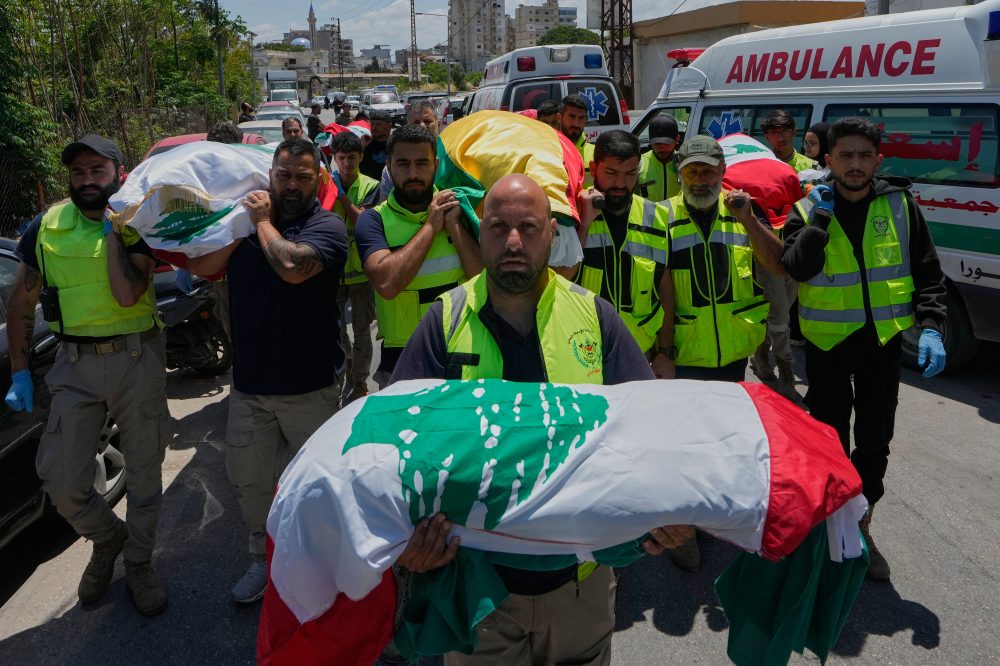
Israeli forces advanced into the southern Lebanese village of Dibbine, located near Marjayoun, while air operations resulted in the deaths of at least six individuals. According to state media reports, five people died in aerial attacks on the villages of Deir Qanoun al Nahr and Abbasiyeh, and a municipal police officer was killed in Ebba village.
The six-person Lebanese military team met with Israeli military representatives in Washington on Friday, with the Lebanese delegation headed by Brig. Gen. George Rizkallah, the army’s operations chief. A senior Lebanese military official told The Associated Press that the goal was to establish a comprehensive ceasefire, building on the nominal truce that took effect on April 17.
The Lebanese representatives plan to request the restoration of a monitoring committee that oversaw enforcement of a previous U.S.-mediated ceasefire which ended the Israel-Hezbollah conflict in late 2024, according to the official.
A second Lebanese official, who receives regular briefings on the Pentagon discussions, confirmed that the delegation would push for full ceasefire implementation and an end to current hostilities. This official noted that successful implementation would lead to future discussions about positioning Lebanese army forces along the border and removing Israeli troops from southern Lebanon.
Both officials requested anonymity as they lacked authorization to discuss the ongoing Washington negotiations publicly.
President Joseph Aoun’s office announced he spoke by phone Friday with U.S. Secretary of State Marco Rubio about Lebanon’s situation and broader Middle Eastern developments. Aoun told Rubio that ceasefire implementation should be the primary focus, calling it “the essential entry point for transitioning to any other issues,” according to his office.
The current talks represent the first direct Lebanon-Israel discussions in Washington in over thirty years, following initial meetings held in April.
Israeli military forces issued multiple evacuation orders for southern Lebanon on Friday, compelling hundreds of families to relocate to safer northern areas.
Combat erupted between Israeli troops and Hezbollah fighters in the villages of Yohmor and Zawtar al-Sahrqieh near Nabatieh city after Israeli forces crossed the strategic Litani River, which serves as an unofficial Israeli military boundary. Extensive southern territories remain under Israeli military authority despite the April ceasefire agreement.
Hezbollah, whose fighters have engaged Israeli forces in the region for several days, issued statements claiming their members attacked Israeli troops within Yohmor.
Both villages sit near the medieval Beaufort castle, positioned approximately 15 kilometers (9 miles) from the Israeli border with commanding views of southern Lebanon. It remains unclear whether Israeli forces intend to seize the castle, located north of the Litani River.
Prime Minister Benjamin Netanyahu toured the northern front Friday and addressed military personnel. “I must tell you that there are very impressive results here. Our forces have crossed the Litani; they have advanced to controlling positions,” he stated.
“We are operating in Beirut, in the Bekaa, across the entire width of the front, and we are dealing Hezbollah a crushing blow,” Netanyahu added, referencing Lebanon’s eastern Bekaa Valley and Beirut’s southern suburbs, which Israeli air forces targeted Thursday.
The southern Lebanon violence occurred as U.S. and Iranian negotiators reportedly reached a preliminary agreement Thursday to extend the ceasefire in the three-month conflict by 60 days and begin fresh discussions on Iran’s nuclear program, according to a U.S. official with knowledge of the matter.
Iran has not yet confirmed any agreement. Vice President JD Vance acknowledged Thursday evening that a tentative deal existed but expressed uncertainty about President Donald Trump’s approval.
Hezbollah legislator Hassan Fadlallah stated Friday that any U.S.-Iran agreement would halt Israel’s Lebanese offensive. Iranian officials, representing Hezbollah’s primary supporter, have maintained that any Washington deal must end the current Israel-Hezbollah war that began March 2, when Hezbollah launched rockets into northern Israel two days after mutual attacks between Israel and Iran.
The ongoing Israel-Hezbollah conflict has resulted in 3,200 deaths in Lebanon and displaced over one million people.