
BEIRUT — Israeli military forces deployed additional personnel into southern Lebanon on Tuesday while issuing evacuation orders for more than 80 villages, as the Iran-backed militant organization Hezbollah declared its preparedness for full-scale warfare, intensifying regional tensions.
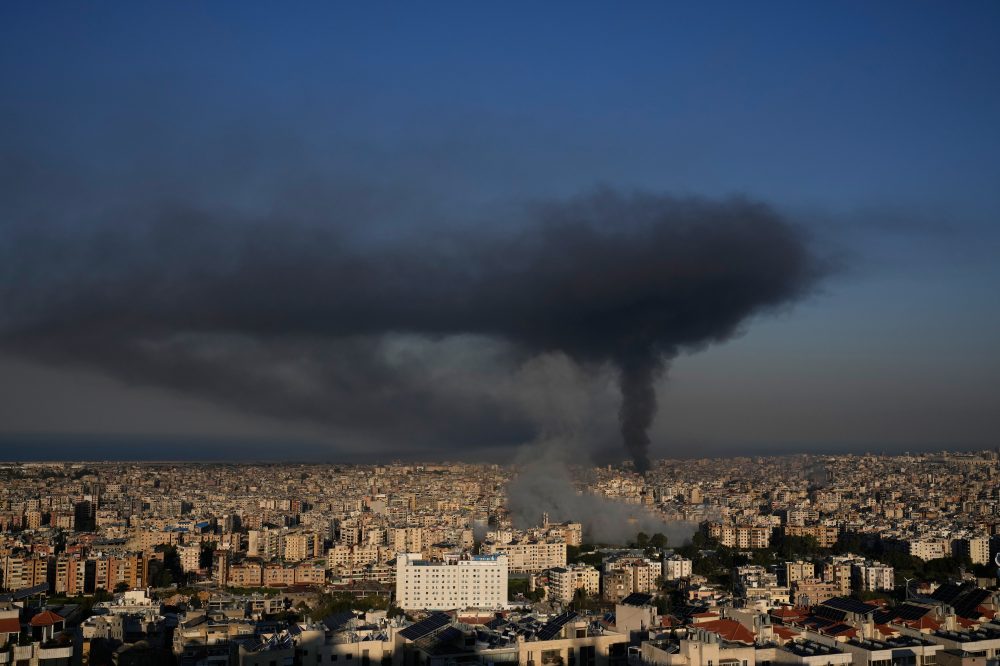
The current escalation began when Hezbollah launched rockets and drone attacks toward northern Israeli territory early Monday. Israel responded with extensive aerial bombardments that resulted in 52 deaths across Lebanon, including a Palestinian fighter and a Hezbollah intelligence commander in Beirut’s southern neighborhoods. The strikes wounded over 150 individuals and forced tens of thousands from their homes.
On Tuesday morning, Hezbollah launched two separate rocket barrages targeting northern Israel, while Israeli overnight airstrikes damaged facilities housing Hezbollah’s television and radio broadcasting operations. Beirut’s southern districts faced multiple unannounced strikes during the early afternoon hours, with Israeli military officials later confirming they had targeted Hezbollah leadership.
Israeli military Arabic spokesperson Avichay Adraee broadcast warnings to residents across more than 80 communities, instructing them to depart immediately and warning against returning until authorities provide clearance.
A high-ranking Hezbollah leader indicated that following more than twelve months of maintaining ceasefire conditions while enduring continued Israeli attacks on Lebanese territory, the organization’s restraint has reached its limit, forcing a return to active resistance and open conflict with Israel.
“The Zionist enemy wanted an open war, which it has not stopped since the ceasefire agreement,” declared Mohamoud Komati. “So let it be an open war.”
Lebanese President Joseph Aoun informed diplomatic representatives from Saudi Arabia, Qatar, the United States, France and Egypt on Tuesday that Hezbollah has been launching rockets from positions north of the Litani river. Lebanese authorities maintain they have successfully disarmed Hezbollah forces south of the river near the Israeli border, with Lebanese military units maintaining complete operational control of the border region.
Just prior to Aoun’s statements, Israeli military commanders announced the deployment of additional forces into southern Lebanese territory, establishing new positions at multiple strategic locations near the border, while Lebanon’s official National News Agency reported Lebanese army units were withdrawing from certain border positions.
Spokesperson Adraee posted on social media platform X that the troop movements within Lebanese territory represent efforts to strengthen forward defensive capabilities and establish additional security measures.
A Lebanese military official confirmed to The Associated Press that Israeli forces had entered several Lebanese areas, noting that the Lebanese army was conducting “repositioning” operations in the region.
The United Nations peacekeeping mission in southern Lebanon, designated as UNIFIL, reported that peacekeepers witnessed Israeli forces entering Lebanese territory at multiple locations Tuesday morning “before returning south of the Blue Line,” the official designation for the border between both nations.
Israel conducted a ground offensive into Lebanon during October 2024 throughout its most recent conflict with Hezbollah. Israeli forces withdrew from most southern Lebanese areas following a U.S.-mediated ceasefire that ended hostilities in November 2024, though they have maintained control of five positions on the Lebanese side of the border since that time.
Following the ceasefire implementation, Israel has maintained almost daily military strikes, primarily targeting southern Lebanon, claiming that Hezbollah has been attempting to reconstruct its military capabilities in the area.
Hezbollah initiated rocket attacks against Israel one day after the militant Palestinian organization Hamas conducted its assault on southern Israel on October 7, 2023, which sparked the Gaza conflict. After months of limited fighting, the confrontation intensified into full warfare during September 2024 before a U.S.-brokered ceasefire officially ended the fighting two months later.