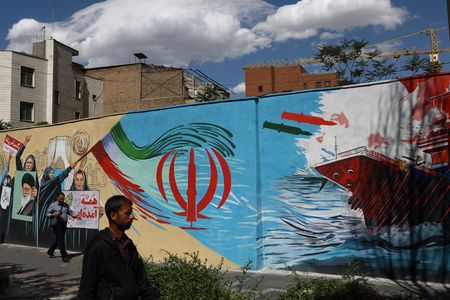

VIENNA, May 29 – Tehran and Washington are engaged in talks about prolonging their current ceasefire to pave the way for negotiations covering Iran’s nuclear activities, with the United States demanding assurances that Iran cannot develop atomic weapons.
Although most of Iran’s uranium enrichment facilities were either demolished or severely compromised during Israeli and U.S. bombing campaigns in June, intelligence suggests a significant portion of the nation’s stockpiled highly enriched uranium remains intact. This surviving nuclear material represents Washington’s primary worry as nuclear discussions approach.
Trump stated on Friday through social media that Iran must consent to having enriched uranium that was buried following previous U.S. attacks be “unearthed” and eliminated under supervision from Iran and the U.N. nuclear monitoring agency.
UNDERSTANDING HIGHLY ENRICHED URANIUM
This material represents one of two substances, alongside plutonium, capable of forming a nuclear weapon’s core.
Unlike plutonium, which requires extraction from reactor spent fuel using large, easily detectable facilities, uranium enrichment can occur through centrifuges with considerably smaller physical presence.
Among Iran’s three known operating enrichment facilities during the June Israeli and U.S. strikes, two were located below ground. The surface facility suffered complete destruction.
Uranium reaches highly enriched status at 20% purity, becoming weapons-grade at approximately 90%.
Contemporary reactors typically utilize fuel enriched up to 5%, though some require higher enrichment levels. U.S. nuclear submarine reactors allegedly operate on fuel exceeding 90% enrichment.
IRAN’S CURRENT STOCKPILE
Iran has not updated the U.N. nuclear monitoring body regarding its enriched uranium status following the June strikes, nor permitted inspectors to return to storage locations.
The International Atomic Energy Agency calculated Iran possessed these quantities when Israeli bombing commenced on June 13:
– 440.9 kg enriched up to 60%
– 184.1 kg enriched up to 20%
– 6,024.4 kg enriched up to 5%
– 2,391.1 kg enriched up to 2%
Using IAEA calculations, the 60% stockpile could produce 10 nuclear weapons if further enriched. The 20% supply would yield one weapon, while the 5% material could create 12.
Survival rates remain uncertain. IAEA director Rafael Grossi indicated his organization believes “a bit more than 200 kg” of the 60% inventory sits within an Isfahan tunnel system that seemingly escaped major damage during June attacks. Additional material was housed at the Natanz nuclear facility, according to his statements.
REASONS FOR ALARM
U.S. officials focus primarily on the 60% material due to its potential for rapid weapons development. Washington seeks its complete elimination, while Iran maintains it has no weapons ambitions.
Higher uranium enrichment levels create exponentially easier pathways for further processing. Advancing from 60% to 90% proves simpler than progressing from natural uranium to 5%.
President Donald Trump withdrew America from a nuclear agreement between Iran and world powers that previously maintained Tehran at much greater distance from bomb-making capability than currently exists. The 2018 U.S. exit triggered the deal’s collapse, prompting Iran to rapidly expand its atomic activities.
The 2015 agreement limited Iranian enrichment to 3.67%.
However, even 90% enriched uranium requires additional processing for weapons cores. Enriched uranium exists in gaseous form and must convert to metal for weaponization.
TRANSPORTATION POSSIBILITIES
Yes. Iran previously transferred enriched materials between facilities under IAEA supervision before June attacks.
During the 2015 deal and its predecessor, Iran’s uranium stocks enriched to 20% underwent dilution or conversion to reactor fuel plates before international shipment.
International transportation of nuclear materials like highly enriched uranium involves sensitive but standard procedures.
“It requires some precaution but it can be moved,” Grossi explained to PBS in March regarding the 60% material.
IRAN’S WILLINGNESS TO NEGOTIATE
Iran’s supreme leader has directed that the 60% material should remain within the country, according to two senior Iranian sources last week.
Iranian officials suggest Tehran might consider sending half the stockpile to a third nation in exchange for 5% enriched uranium, while diluting the remainder domestically.