
Iran’s Islamic Republic confronts an unprecedented challenge as it seeks a new leader following the death of Supreme Leader Ayatollah Ali Khamenei, who was killed in U.S. and Israeli airstrikes one week ago.
The regime’s traditional base of unwavering supporters appears to be eroding significantly, creating uncertainty about whether Iran’s next leader can maintain control. Mojtaba Khamenei, the deceased leader’s hardline son, emerges as a leading candidate for succession.
However, interviews conducted by Reuters with militia members, citizens, government officials, and political experts reveal that the Islamic Republic’s support network has contracted dramatically compared to previous decades.
“The strategy in choosing a hardliner as the new leader would be to consolidate the base, but they’re ending up with an increasingly small circle of supporters,” explained Ali Ansari, who teaches modern history at the University of St Andrews in the UK.
“And the longer this goes on, the more it will all fray at the edges,” Ansari added.
The Islamic government originally gained power through a 1979 revolution supported by millions of Iranian citizens. However, years of corrupt governance, authoritarian rule, and poor administration have eroded that backing, creating widespread disillusionment among regular people.
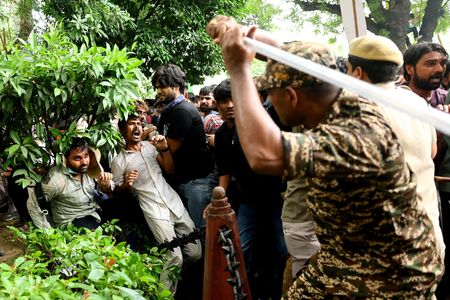
A dedicated group of supporters continues to exist, consistently voting to maintain the Islamic system and participating in street demonstrations to suppress opposition movements.
These well-coordinated loyalists can mobilize rapidly, presenting a significant challenge to any American or Israeli ambitions for regime change.
Mahdi Rastegari, a 32-year-old religious instructor and Basij militia member, demonstrated this commitment: “We have given many martyrs. They have sacrificed themselves for our leader. Now we must show that the path of the leader Khamenei continues. We will solve any problems and support whoever is chosen as leader. We will even give our lives for him.”
Recent electoral data illustrates the hardliners’ minority status. In Iran’s most recent presidential contest, the most conservative candidate, Saeed Jalili, received approximately 9 million votes initially and 13 million in the runoff, while more than 61 million of Iran’s 85-plus million citizens were eligible to participate.
Despite representing a clear minority, the hardliners’ weakness doesn’t provide much encouragement to those seeking political transformation, as the continued military assault has sparked concerns about potential chaos.
Babak, a 34-year-old business owner from Arak who requested anonymity for his surname, expressed this sentiment: “The Guards and the system are still powerful. They have tens of thousands of forces ready to fight to keep this regime in place. We, the people, have nothing.”
The death of Iran’s leader on the conflict’s opening day, combined with emerging divisions within the country’s leadership structure, will test hardline loyalty to the Islamic Republic more severely than ever before.
Individuals like Basij member Rastegari form part of a power structure that extends from the supreme leader’s now-destroyed Tehran headquarters to every town and neighborhood, creating barriers to internal opposition movements.
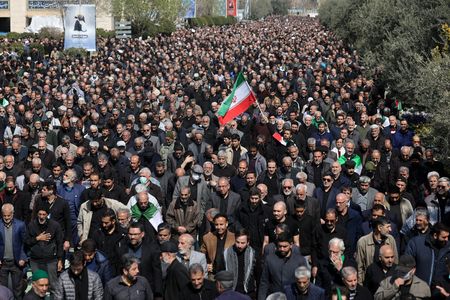
Since Khamenei’s death, hardline supporters have organized government-sponsored memorial services for him nightly, even as bombs continue falling throughout the nation.
These supporters include genuine believers willing to sacrifice their lives as martyrs for their conviction in clerical rule guided by divine authority, alongside those motivated by personal gain who have profited from publicly backing the system.
Ali Mohammad Hosseini, another Basij member, transitions from working at his father’s grocery store in the Shiite religious center of Qom to spending evenings at checkpoints designed to prevent public dissent.
The 29-year-old stated: “The most important issue is preserving the regime, which is what the Americans are targeting.” He described supporting whichever cleric succeeds Khamenei as a “religious duty” worth dying for.
Such dedication isn’t widespread, though. Hassan, another Basij member who requested only his first name and disclosed his location in the Shiite holy city of Mashhad, expressed skepticism about the Islamic Republic’s future.
“We need to be realistic,” he observed, citing ongoing American pressure and the devastating consequences of destructive airstrikes should a hardliner like Mojtaba Khamenei assume leadership.
Basij members and other system loyalists have historically received benefits including priority university admission, employment opportunities, and discounted bank financing – advantages that a collapsing economy might eliminate.
“We do not even have airports any more. No ports. How are they going to rebuild this economy?” questioned Hassan, who is 29 years old.