
DUBAI – Iranian counter-attacks throughout Gulf nations have created the most severe economic disruptions the region has experienced since COVID-19, shuttering airports, stopping port activities, and creating turmoil in financial markets.
The Iranian offensive, conducted in retaliation for a combined American-Israeli operation against Iran, impacted all major Gulf states – an area that has worked for decades to establish itself as among the globe’s most dependable commercial centers. The attacks resulted in three deaths in the United Arab Emirates, while residents of Dubai and Abu Dhabi reported hearing explosive sounds for a consecutive day on Sunday.
These attacks represent an unparalleled escalation for Dubai, a metropolis that built its contemporary reputation on remaining separate from regional warfare. Starting as a modest fishing community, Dubai transformed limited oil income into developing harbors, aviation facilities, and commercial districts before shifting focus in the 1990s toward high-end tourism, property development, and banking services.
Vijay Valecha, chief investment officer at Century Financial, explained the regional economic effects: “Regionally, the impact across (Gulf) economies is mixed.”
He continued: “Elevated oil prices provide a fiscal cushion for producers such as Saudi Arabia and Qatar, strengthening revenues and liquidity. However, trade, logistics and tourism, particularly in the UAE, would face pressure if shipping risks rise or regional sentiment weakens.”
FINANCIAL MARKETS TUMBLE
Regional stock exchanges experienced significant declines when Sunday trading commenced, with Saudi Arabia’s primary index falling over 4% at opening before recovering to close down 2.2%. Oman’s market finished 1.4% lower while Egypt dropped 2.5%, both recovering from steeper early losses. Kuwait’s stock exchange made the rare decision to halt all trading indefinitely. UAE financial markets, which remain closed Sundays, are scheduled to resume Monday.
Mohammed Ali Yasin, chief executive of Ghaf Benefits, a Lunate company in Abu Dhabi, commented on market conditions: “Markets will continue to be fragile and volatile as long as the military actions are active.”
Yasin added: “Usually in such events, the international institutional investors are the ones that put the selling pressures initially… while local ones try and soften the drops by picking the leading stocks.”
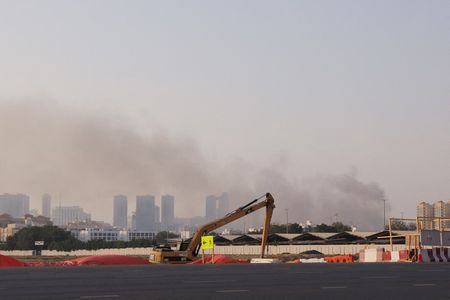
Iranian forces targeted aviation hubs, defense facilities, shipping ports, and hospitality venues throughout the Gulf region. Both Dubai International Airport and Abu Dhabi’s Zayed International Airport suffered infrastructure damage, resulting in one civilian death and 11 injuries between the two locations. A section of Dubai’s Jebel Ali Port ignited following aerial defense activities.
Major UAE corporations include property developer Emaar Properties and retail giant Majid Al Futtaim. The nation has increasingly attracted international hedge funds and major banking institutions seeking access to substantial sovereign wealth managed by organizations like ADIA and Mubadala.
RAMADAN BUSINESS DISRUPTIONS
The timing of these disruptions proves especially problematic for Gulf commercial activities. The strikes occurred during Ramadan, Islam’s sacred month, when business iftar and suhoor gatherings – the shared meals ending and starting daily fasting – represent crucial networking opportunities throughout the region.
Reuters obtained correspondence showing that events organized by Dubai airline Emirates, Abu Dhabi renewable energy company Masdar, Mubadala, education provider GEMS, and the Department of Government Enablement have been canceled or delayed.
In a region where personal relationships form the foundation of commercial transactions, losing Ramadan’s networking period creates additional, though less apparent, economic damage beyond the visible disruption already occurring.
Attacks also struck residential neighborhoods near Dubai Marina and Palm Jumeirah, igniting the Fairmont The Palm hotel and causing damage to the Burj Al Arab. The Fairmont had recently been purchased for $325 million by Kuwait’s Arzan Investment Management – a transaction viewed as indicating rising Gulf hospitality market demand – making this damage a prominent symbol of the impact on the region’s thriving tourism sector.
The United States, United Kingdom, and European Union released revised travel warnings for Gulf nations following the attacks, recommending citizens use extreme caution and avoid unnecessary travel. Critical transportation airports, including those in Dubai, Abu Dhabi, and Qatar’s Doha, were either closed or operating under severe restrictions Sunday as most regional airspace remained inaccessible.
International company employees are anticipated to follow local guidance regarding remote work arrangements in upcoming days. The UAE federal labor authority recommended companies establish work-from-home policies through March 3, encouraging them to keep employees away from outdoor locations, except for essential positions requiring on-site presence.