
WASHINGTON (AP) — A small rural community in Texas is squaring off against the Trump administration in federal court over a border wall that residents say could put their town underwater.
The town of Presidio, situated along the U.S.-Mexico border, went before a federal judge Tuesday arguing that the administration’s border wall construction plans threaten a network of levees and berms that protect the community from dangerous flash flooding. Attorneys for the town also contend the government is bypassing legal requirements in its rush to build.
The court hearing unfolded as the Department of Homeland Security pushes ahead with a $46 billion effort to construct a continuous border wall stretching from the Pacific Ocean to the Gulf of Mexico — a long-standing centerpiece of President Donald Trump’s agenda. The department is facing mounting resistance from landowners, environmental advocates, Native American tribes, and others who say the rapid pace of construction is threatening historical sites, religious locations, and established ways of life along the border — even as crossings from Mexico have dropped to extreme lows.
The lawsuit was filed by Presidio’s development district, representing a community of just over 3,200 people. The case highlights the tension that can flare between small local governments and federal authorities in Washington — a dynamic that has long resonated with many Americans, especially Republicans.
Attorneys for the development district argue that the government’s construction plans could undermine the flood-control infrastructure built along the Rio Grande and its tributaries during the 1970s and 1980s. They also say the government violated the Rivers and Harbors Act by failing to seek approval from the Army Corps of Engineers before proceeding with work on or near the levees.
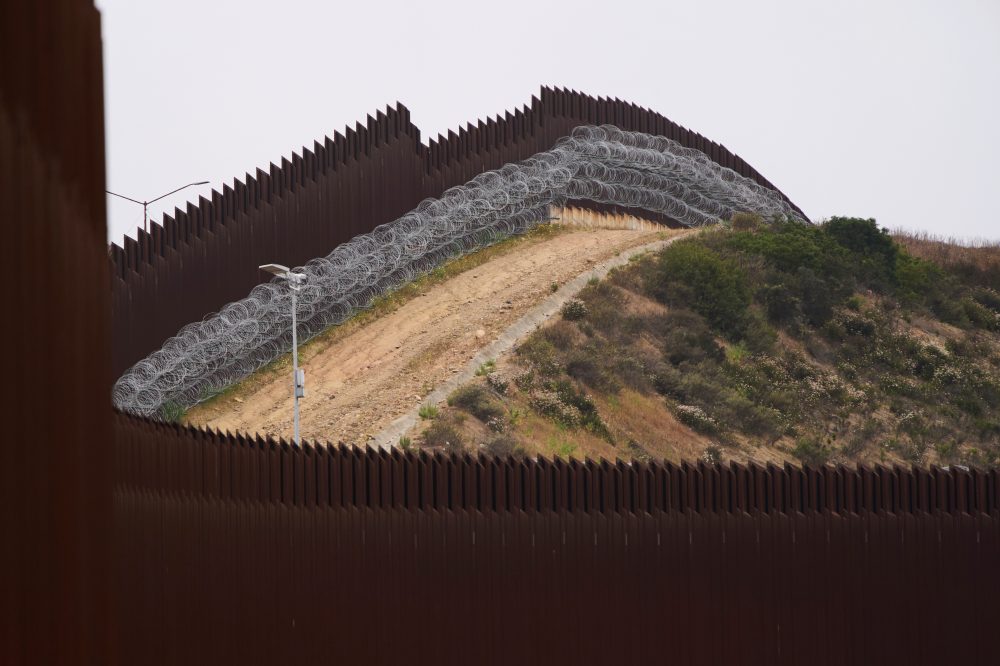
According to court documents filed by Presidio’s development district, Customs and Border Protection intends to “replace the earthen slope of the existing levee with a concrete wall, with 30-foot steel bollard panels installed on top.” The district said it has tried to get more information from the agency, but has been told the details cannot be disclosed for “national security” reasons.
“There is unfortunately a long history here of CBP construction causing or increasing flood risks,” said Laura Bakst, an attorney with Democracy Forward, which is representing the development district.
A government attorney countered during Tuesday’s hearing that it’s premature to claim the wall would harm Presidio, since Customs and Border Protection has not yet settled on a final construction plan.
As the wall-building effort has accelerated, both former Homeland Security Secretary Kristi Noem and current Secretary Markwayne Mullin have issued waivers exempting the project from numerous environmental and archaeological protection requirements that typically apply to federal construction projects.
Congress did grant Homeland Security the power to waive certain rules specifically to speed up border wall construction. However, critics argue the department has stretched that authority far beyond what Congress intended by issuing sweeping waivers along the entire roughly 2,000-mile border.
In Presidio’s situation, attorneys argued that even with the waiver of the Rivers and Harbors Act, the specific language of that law still required Homeland Security to consult with the Army Corps of Engineers before beginning the project.
Louis Katz, another attorney with Democracy Forward, described the department’s broad use of waivers as an “extraordinary exertion of authority.”
One central question in the case is when construction would actually begin — a concern shared by landowners all along the border. Construction crews have already moved equipment and steel bollard panels into position near Presidio, but no wall building has started in the area.
A Justice Department attorney, Alexander Yun, told the judge that construction was unlikely to begin as early as the start of August, and suggested it could get underway in late August, September, or October.
Homeland Security has made clear that completing the wall is a top priority. During congressional testimony in June, Secretary Mullin stated that the initial phase of the wall would be finished “this time next year.” The head of Customs and Border Protection, Rodney Scott, has said the agency is currently erecting 6 miles of wall per week.
The push for construction is happening even as border crossing numbers have hit their lowest levels in decades. The Big Bend Sector, which includes the Presidio area, has not seen the heavy crossing activity experienced in other parts of the border in recent years, largely due to the remote and rugged terrain on both sides.
Despite that, the Justice Department attorney maintained that the recent low crossing numbers represent an “anomaly” and that the administration’s goal remains “zero illegal crossings.”
Judge Reggie Walton pushed back on that framing, saying it’s “just a reality” that people will always attempt to cross the border. The judge also acknowledged he was wrestling with the limits of his own authority to restrict the department, given that Congress has explicitly granted it the power to waive certain requirements.
Judge Walton said he expects to issue a ruling within the coming week.