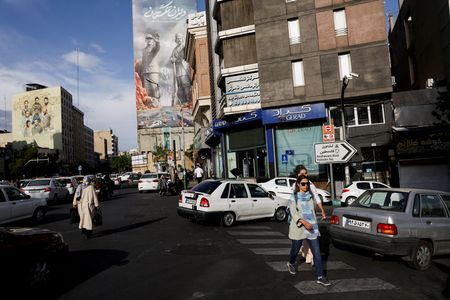

Iranian authorities are displaying propaganda materials throughout Tehran that emphasize national solidarity and triumph against international powers, coming just months after violently suppressing demonstrations and amid ongoing economic struggles affecting citizens.
The campaign features images of Revolutionary Guardsmen and the blocked Strait of Hormuz, while officials organize military-style group weddings and weapons training in religious buildings to showcase national defiance.
The current messaging differs from previous revolutionary religious content by focusing on nationalist elements designed to appeal beyond core supporters.
“The old ideology of the Islamic Republic no longer really had much traction within the society. And therefore there was a need to draw on other elements of Iranian identity that could mobilize masses,” said Ali Vaez, Iran project director at the International Crisis Group.
Whether this approach will succeed with a deeply disillusioned public remains uncertain, according to Vaez and other experts.
Despite Iran’s ability to resist U.S. and Israeli military strikes and force U.S. President Donald Trump into negotiations by blocking the Strait of Hormuz, a crucial international oil passage, the country confronts severe domestic challenges.
The nation’s economy, already struggling before current conflicts, faces potential collapse while increasing government crackdowns reveal officials’ concerns about possible renewed civil unrest.
Against this challenging environment, authorities continue using traditional Iranian propaganda themes of national resistance and Western antagonism while reducing emphasis on some historical revolutionary imagery.
Traditional Shi’ite Muslim martyrdom symbols, prominent for decades, have partially been replaced by Persian national and historical figures previously rejected by the Islamic Republic as representing monarchist history.
Additionally, state television broadcasts of government-organized demonstrations now include interviews with women not wearing headscarves, content previously forbidden in Iranian media.
“It’s an attempt to show that everything is normal in Iran, we’re all united and we don’t butcher our own people,” said Ali Ansari, professor of modern history at the University of St Andrews in Scotland.
“It’ll work to some extent with waverers in the middle but most Iranians don’t believe it really.”
Iran’s achievement in blocking the Strait of Hormuz has become central to both international propaganda efforts targeting Trump and domestic messaging campaigns.
One display shows Revolutionary Guardsmen with a fishing net capturing U.S. vessels and aircraft. Another depicts fabric stretched across Trump’s face in the strait’s distinctive outline.
These images continue Iran’s tradition of celebrating national heroism while condemning the United States, including a famous mural depicting the Statue of Liberty with a skull face.
However, departing from past practices, a large Tehran poster features Rais Ali Delvari, a guerrilla fighter against British occupation of Iran’s Gulf region one hundred years ago, standing with a Revolutionary Guards commander to block the strait with raised hands.
“These banners showing national heroes are for wartime purposes. After that they will come back against us and the repression will begin,” said Narges, 67, a retired government employee in Shiraz who asked not to give her family name.
Iranian political sources report that power has shifted dramatically during wartime from religious leaders to Revolutionary Guards commanders, completing a gradual transition occurring over years.
“The direction of travel when it gets to the narratives that the regime is putting out there is actually indicative of the transformation that the regime is undergoing. It is moving from a theocratic system into a military one,” said Vaez.
Pictures of the Iranian national football team saluting and new Supreme Leader Mojtaba Khamenei with an oversized Iranian flag reinforce the patriotic messaging.
Infrastructure attacks and Trump’s threats of “civilisational erasure” have enhanced the effectiveness of these strategies, Vaez explained.
“These have all helped the Iranian regime to portray this war, not as a war against the Islamic Republic, but a war against Iran as a state,” he said.
Officials have organized almost nightly demonstrations during the conflict to maintain street-level support, though both government supporters and critics question their effectiveness.
“It’s all a game, a performance meant to show the world that people are with the system. Instead of these displays they should fix the economic situation,” said Arshia, 23, a recent French-language graduate from Yazd.
For Mohammed, 26, a hardline student in Tabriz, the patriotic sentiment felt genuine, but he expressed anger about unveiled women participating alongside unrelated men in rallies. “This is not what the revolution was for,” he said.
A recent mass wedding featured couples displayed in Revolutionary Guards vehicles decorated with balloons and machine guns, positioned next to ballistic missile replicas painted bright flamingo pink.
State television broadcast weapons training in mosques, where military instructors taught men and women to disassemble and operate assault rifles.
Such imagery might serve the dual purpose of warning Iranian dissidents that authorities maintain heavily armed backing, Ansari suggested.
“It goes to the heart of the fact that the regime is not as secure as it’s pretending to be. They’re presenting to their own people that this is a regime that is tough,” he said.